

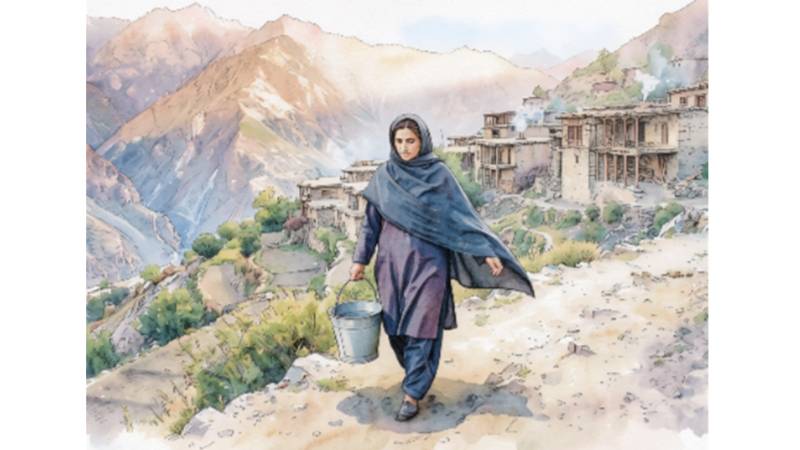
Seventy years after Fredrik Barth studied Indus Kohistan, fewer than three in a hundred of its women can read. A prominent anthropologist, Fredrik Barth, visited the Dardic communities in the north and did his fieldwork in 1954; his report, Indus and Swat Kohistan: An Ethnographic Survey, came out in 1956. Barth wrote extensively on the cultures and social institutions, including local councils, leadership, customary laws, and elders, of these communities. Barth’s discussion portrayed the regions as stateless societies, especially the Indus Kohistan valleys of Patan, Kandia, Palas, and Dasso, and the upper Swat communities, i.e., Torwali and Gawri. Barth saw the Indus Kohistani region as acephalous (no central authority), divided, faction-ridden, and dominated by religious leaders outside the political structure. Decades on, we have a new name, but its power structure remains the same.
Barth argued that the Indus Kohistan region was acephalous, as there was no central authority or common leadership for the region. The locals were divided into political factions, and power was divided into genealogical sections such as Jaflor, Nilor, and Dre Khel. Mullahs were consulted in local matters, but they were not included in the council (jirga). The religious leadership was revered; however, the clergy stayed outside the political structure. Barth notes that despite the apolitical status of mullahs, this section still held greater authority and often punished culprits pardoned by the jirga. The clergy would beat them, burn their houses, or ostracise the alleged wrongdoer.
The religious class acted outside the political structure, thereby creating a permanent parallel power. Today, mullahs have outnumbered the jirga membership and have covertly overtaken its powers. In Indus Kohistan, social authority is exercised by mullahs in a very subtle way: it is the clergy that decides girls’ education, women’s mobility, NGO work, and family disputes in the locality. For instance, an ex-MNA and a prominent Kohistani cleric Moulana Abdul Haleem declared formal female education as ‘unislamic’ in a Friday sermon in 2012. He also forbade parents from sending their girls to school, or else they would be ‘doomed’. In another instance, Moulana Karimdad led a 12-member clerical decree in 2023 banning female NGO workers from working with male workers in the field; otherwise, the married staffers would be expelled, and the unmarried would be forced to marry their colleagues. MPAs and other officials are, in effect, subject to the clergy’s approval in most social matters.
Unlike Indus Kohistan, the neighbouring Torwali and Gawri communities of upper Swat embraced education and outmigration, producing teachers and doctors despite facing pressures of cultural assimilation
Barth touched upon other communities as well in his report, including the Torwali, Gawri, and Gujjar communities living in upper Swat. Barth’s comparison reveals that the Torwali and Gawri communities were more cohesive than Indus Kohistan and had a consolidated political organisation. Geographically, upper Swat lies next to the Pashtun ethnicity below it, and this closeness to the rest of the province has brought both cultural assimilation and social change. Torwali and Gawri communities, on the other hand, view this assimilation as an alienation from their local cultures and languages, for the social centres are dominated by the Pashto and Urdu languages. However, given the geographic advantage, these communities did not resist education in the first place, thus producing teachers, doctors, etc., and sending locals abroad who, in turn, send remittances back.
In Indus Kohistan, female education is perceived as dishonour (baighairti) and a threat to religion, resulting in the lowest female literacy. According to a 2024 Lok Sujag report, the female literacy rate stands at only 3 per cent in the Indus Kohistan district, the lowest in Khyber Pakhtunkhwa. The clergy’s hold and low literacy in the Indus Kohistan region barred the development of any professional class that could challenge the clergy. Without education and development initiatives, no alternative leadership has emerged, and the few political dynasties work within a cycle the clergy controls.
In the same vein, factionalism—compared with the collectivism in the Torwali and Gawri belts—also makes the case for social change and development worse by granting and gaining the benefits of schools, roads, contracts, etc., only for a specific locality. The Torwali and Gawri communities in upper Swat have a collective and unified stance on common goals, such as roads and other essential facilities. Recently, Darya-e-Swat Bachao Tehreek (DSBT) presented presented a single stance of the diverse communities in upper Swat that the Madyan Hydropower Project (MHPP) is endangering the entire upper Swat’s economic, social, cultural, and environmental existence. The representative movement, DSBT, said a big ‘no’ to the development of the project.
Continued resistance from the local community—protesting that the construction of the MHPP would cause ecological damage and threaten tourism and farming, over and above the lack of prior consent in the development of the project—compelled the World Bank to withdraw funding for the hydropower project. The provincial government officially cancelled and dropped the project from the World Bank funding programme in mid-2026. Prior to the withdrawal of funding by the World Bank, the federal government had also excluded it from the Generation Capacity Expansion Plan (IGCEP 2025–35). The collectivism of these communities resulted in the removal of the hydropower project by the provincial government, whereas in Indus Kohistan, factionalism ensures no shared goals.
Consequently, the education and healthcare conditions in the Torwali and Gawri communities are much better compared with the Patan-Kandia valley, due to greater social mobility, outmigration, and exposure to the wider population, despite the fears and threats to lands, the river, and local culture as millions of tourists flood the valley annually. The Torwali and Gawri communities are open to NGOs and female education; as a result, the valley has moved forward and acts together on shared concerns, which is what social change looks like.
Moreover, it is also wrong to say that no development has occurred in the last seven decades in the Indus Kohistan region. Schools, the Karakoram Highway, and mobile phones have reached the Kohistani region; however, material development without social change is no development at all. Gender roles, social mobility, and collectivism over individual interests are still a dream being chased by the valley. Gender roles and decision-making are monopolised by mullahs, and local politicians pay only lip service to changing attitudes.
The question is not whether Indus Kohistan needs roads and other material development; the valley lacks quality education and social mobility, a transforming element for social change. Better schools, scholarships, and room for young leaders would create a generation able to hold traditional power holders, including the clergy, to account. Only then will the Kohistan Barth described begin to change.