

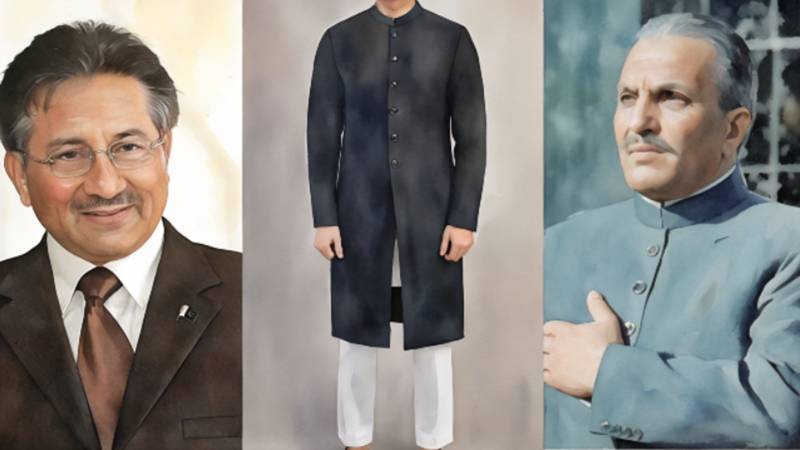
“To symbolise the dramatic change marked by this Lucknow session, not only in the League's platform and political position, but in Jinnah's personal commitment and final goal, he changed his attire, shedding the Saville Row suit in which he had arrived for a black Punjabi sherwani long coat, donned by the Quaid-i-Azam (Great Leader) for the first time in public on the morning of 15 October 1937.”
While the Muslim League marked an alignment with Sikandar Hayat Khan’s Unionist Party at the 1937 Lucknow session, biographer Stanley Wolpert noted a pivotal sartorial transformation. It was not the first time Jinnah had worn Eastern attire as he had been seen in a sherwani during his visit to Khairpur House in Sindh but this moment was qualitatively different. Jinnah was meticulously crafting an image, using the sherwani to position himself as the sole representative of India's Muslims and to seek their validation for his political project.
This politicised change of attire established a pattern, perhaps unintentionally, that would come to define Pakistan’s political culture for decades: a relentless pursuit of external validation, stitched into the very fabric of its leaders' clothing.
Amid newscasts depicting the Taliban and Osama bin Laden, Musharraf appeared to Westerners as the one person from the region who was 'like us'
Jinnah’s sherwani was neither the first nor the last sartorial signal. Decades later, General Zia-ul- Haq’s project of Islamisation mandated a shift from the formal sherwani to the shalwar kameez. Women were also obliged to adopt modest dress, typically a shalwar kameez with a dupatta. This enforcement was an act of external validation directed at two key audiences: the West, by aligning with the US in Afghanistan as a frontline Islamic state, and the Arab world, by presenting a purified, authentic Islamic republic.
The profound irony, as historian AH Dani has documented, is that the shalwar kameez itself has non-Islamic origins, tracing back to the Buddhist Kushan rule in the second century that was later adopted by the Pashtun tribes, with various versions evolving and spreading across the Subcontinent.
The turn of the 21st century saw this trend continue with a different aesthetic. Omer Aziz astutely observed in “The Many Suits of Pervez Musharraf,” that the general employed a strategic wardrobe. Well-cut Armani suits projected a familiar, moderate figure to Western allies, while the shalwar kameez was reserved for domestic political rallies. Aziz noted that the suits gave Musharraf an air of familiarity. Amid newscasts depicting the Taliban and Osama bin Laden, Musharraf appeared to Westerners as the one person from the region who was “like us.”
This psychological playbook remains in use today. Without naming names, one can recall a recent political rally where a member was seen guiding the leader to add an “Islamic touch”—a moment that went viral and revealed the same old engineering for validation. The people and scenarios change, but the underlying quest for approval remains constant.
This pattern begs a critical question: from whom is this validation sought? The answer is consistently anybody but the self. For Jinnah, it was the Muslims of the Subcontinent, particularly the pivotal Punjabi electorate. For Zia, it was the West, Arab nations, and the mujahedeen, whose approval legitimised his jihad. For Musharraf, it was the United States. For contemporary leaders, it is the mass population still yearning for the idealised Islamic state promised to them for generations.
This elite behaviour has seeped into the national psyche, a phenomenon illuminated by Social Identity Theory (SIT). Developed by Henri Tajfel, SIT posits that individuals derive their self- concept from their group memberships. In Pakistan, a nation forged from a singular religious identity, this process has become a de-facto psyche.
The liberal, wielding English fluency and Western aesthetics as a shield, seeks validation from a global audience, desperate to signal, “I am not one of them.” The conservative, doubling down on rigid interpretations of faith, seeks certification from an imagined, pure Islamic ummah, desperate to proclaim, “I am the truest among us.” This internal conflict is not organic; it is the political elite’s strategy of external validation, trickled down and weaponised in daily life. We have become a nation of curators, meticulously managing our appearance, language, and religious performativity for an external gaze, terrified of the void that might be revealed if the performance stopped.
To substantiate, when celebrities perform their piety on talk shows, they seem not merely sharing faith—they are seeking validation of their moral standing from a viewer jury. In this same way, the rampant character assassination on social media about clothing acts as a grassroots inquisition in which we regulate each other’s uniforms to anchor cultural fidelity. This scrutiny spares no one, not even Pakistan’s Nobel laureate, who faces constant scrutiny on her wardrobe abroad, as if her clothing and not her advocacy for girls’ education is the definitive statement of her “Islamic identity.” In effect, the question "What are you wearing?" has become a destructive proxy for “Which side are you on?”—a divisive political weapon we have eagerly, and tragically, turned upon ourselves.
To sum up, until we find the confidence to validate our own complex, multifaceted identity, we remain trapped in a cycle of performance, forever changing our clothes to suit an audience that is never our own. From Jinnah’s sherwani to the viral ‘Islamic touch’ of today, the wardrobe has changed, but the search for a borrowed legitimacy has not. The project of Pakistan will only be complete when its identity is self-defined, woven not from the thread of external approval, but from the sturdy cloth of our own collective confidence.