

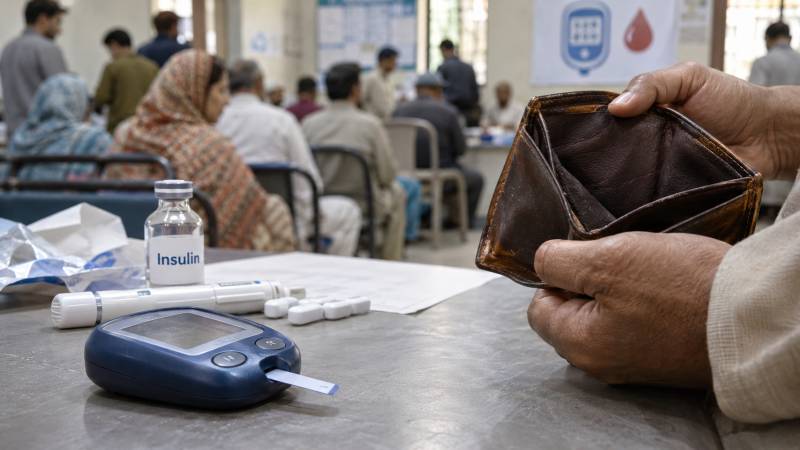
Pakistan's diabetes debate is trapped in a dangerous illusion. At seminars, conferences and awareness campaigns, experts repeat the same medically sound advice: eat a balanced diet, maintain a healthy weight, exercise regularly, sleep adequately, monitor blood glucose and seek early diagnosis. The advice is not wrong. Much of it is supported by decades of medical research. The real question, however, is one that receives far less attention:
Can millions of Pakistanis actually afford to follow this advice? That question was largely absent from recent discussions on the country's growing diabetes crisis. We were told that diabetes is spreading rapidly, that millions remain undiagnosed and that prevention through lifestyle modification remains the first line of defence. What we were not told was how these recommendations fit into the economic reality of the people expected to follow them.
There is a significant difference between medical correctness and practical possibility. A labourer or a low-paid white-collar employee earning between Rs25,000 and Rs60,000 a month while supporting a family, paying rent, meeting utility bills, arranging transportation and coping with inflation inhabits a very different world from the one described in conference halls and policy papers. He may fully understand the dangers of diabetes. He may know the value of exercise, healthy food and regular monitoring. Yet understanding a problem and having the means to address it are two entirely different things.
The diabetes debate in Pakistan continues to focus on awareness while largely neglecting affordability. A patient does not manage diabetes through knowledge alone. He manages it through spending. For those who cannot afford the required treatment, awareness can itself become a source of psychological distress: they know what they need to do to protect their health, but lack the means to do it.
Insulin costs money. Oral medications cost money. Glucose monitoring requires equipment and test strips. Laboratory investigations cost money. Doctor consultations cost money. Transport to hospitals costs money. Recommended diets cost money. Every month. Every year. For the rest of a patient's life. Yet discussions about diabetes, its prevention and treatment pay remarkably little attention to the actual economic burden borne by patients.
How much does diabetes cost a lower-income household annually? What percentage of family income is consumed by medicines and diagnostic tests? How many patients skip investigations because they cannot afford them? How many reduce prescribed doses or interrupt treatment to make their medicines last longer? How many delay seeking medical attention until complications emerge?
Consider the cost of insulin. A single insulin pen can cost around Rs1,750 at the prevailing retail price. A patient requiring 20 units twice daily consumes 40 units a day. A commonly used 300-unit pen would last just seven and a half days at that dosage. The monthly expenditure can therefore become a substantial burden even before accounting for other prescribed medicines, consultations and investigations. For a household earning Rs60,000 a month and supporting four family members in rented accommodation, this is not a minor medical expense. It is a question of survival amid competing necessities.
Even the basic requirement of monitoring blood glucose can become a financial obstacle. A glucose-monitoring device can cost between Rs5,500 and Rs8,000, while replacement test strips add a recurring expense. Beyond glucose monitoring, patients may need regular investigations to assess cholesterol, kidney function and cardiovascular risks. The cumulative cost can become substantial.
Even when patients can afford these investigations, another uncomfortable question remains: why do laboratories charge substantially different prices for apparently similar tests? Why might one laboratory charge around Rs1,000 for a lipid profile while another charges more than Rs3,000? Consultation fees also vary considerably from one doctor to another. Public-health experts speak confidently about prevalence rates, risk factors and disease trends. Far less attention is given to the economics of survival. This omission is not a minor oversight. It is central to the crisis itself.
Advising people to eat balanced diets without discussing food affordability risks transforming public-health guidance into wishful thinking, particularly when millions of families are forced to prioritise immediate hunger over nutritional quality.
The familiar advice about healthy diets illustrates the problem. Experts routinely encourage patients to consume more nutritious food. That recommendation is medically unimpeachable. But healthy food must first be financially accessible. For millions of families, purchasing food is no longer simply a question of nutritional value but of affordability. Families struggling with inflation frequently prioritise immediate hunger over nutritional quality because the former cannot be postponed. Advising people to eat balanced diets without discussing food affordability risks transforming public-health guidance into wishful thinking.
The same disconnect applies to physical activity and lifestyle changes. A person working long shifts under physically exhausting conditions may not experience life in the same way as someone whose workday ends comfortably in a climate-controlled office. Manual workers may already be physically exhausted by the time they return home. Unemployment, debt, housing insecurity and the responsibility of supporting dependants can also create persistent psychological pressure, affecting both physical health and the ability to manage chronic illness.
These are not anti-medical questions. They are public-interest questions. The problem becomes even more serious for low-income patients who have little choice but to depend on public healthcare facilities. While those who can afford private treatment have alternatives, poorer patients often face overcrowded hospitals, inadequate facilities and conditions that make an already difficult experience even more distressing. If prevention is a national priority, where are the subsidised insulin programmes, low-cost diagnostic schemes, community screening initiatives and publicly available data on treatment affordability? Public awareness campaigns have their place, but awareness alone cannot substitute for policy interventions that reduce the cost of disease management.
The question of institutional responsibility also arises in other areas affecting the lives of economically vulnerable citizens. A recent column by Naeem Sadiq, Manslaughter by intent, not neglect, published in The Express Tribune, examines workplace deaths, particularly among sanitation workers compelled to enter dangerous sewage systems. It highlights the vulnerability of people whose economic circumstances leave them exposed to risks that better-off citizens can often avoid.
The connection with healthcare is not difficult to establish. In one case, workers are exposed to preventable occupational hazards because institutions fail to protect them. In the other, patients face preventable complications because essential healthcare remains beyond their financial reach. The circumstances are different, but both raise questions about the state's responsibility towards economically vulnerable citizens. The right to life cannot be meaningful if workplace safety and access to essential healthcare depend largely on a person's economic position.
Perhaps the most important omission from the current diabetes debate is the absence of socioeconomic data. We are routinely told how many people suffer from diabetes. We are rarely told who those people are. We need to know how the disease is distributed across income groups, how many patients remain untreated, what proportion of household income is spent on treatment, and how employment status and financial circumstances affect their ability to manage the disease. We also need to distinguish between the prevalence of diabetes among different income groups and the financial consequences of the disease for those groups.
Without information on income, employment status, household expenditure and treatment affordability, statistics about prevalence alone tell policymakers how many people have diabetes but not why many fail to manage it successfully. The recent seminar correctly highlighted the dangers of diabetes and the importance of prevention, early diagnosis and treatment. But it did not adequately confront the economic circumstances that determine whether ordinary citizens can act on that advice. Diabetes is no longer merely a medical problem. It is a socioeconomic problem. It is a policy problem. It is a governance problem.
The real challenge before Pakistan is not simply convincing its citizens that diabetes is dangerous. Most already know that. The challenge is creating a society in which following medical advice does not depend on the size of one's income. Until that happens, millions of Pakistanis will continue to hear excellent advice that they simply cannot afford to follow, while policymakers mistake awareness for action and the diabetes crisis quietly deepens around them.