

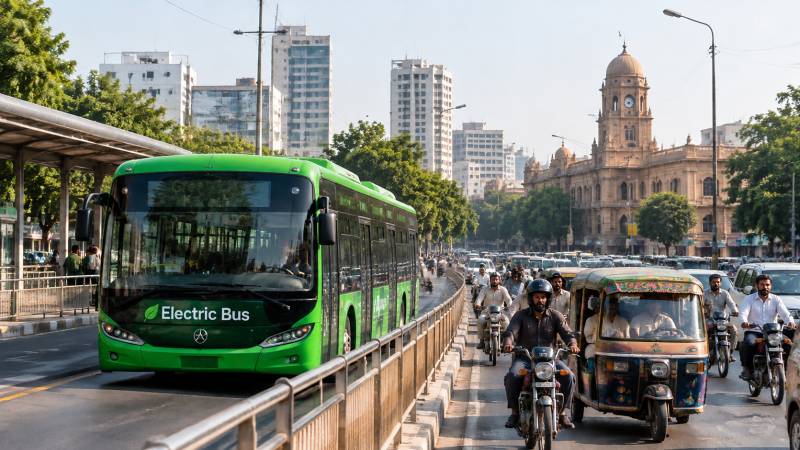
There is something fundamentally wrong with a government’s priorities when it chooses to make electric vehicles more affordable for those who can already afford cars, while millions of ordinary citizens continue to struggle with the cost, inconvenience and indignity of travelling to work, school or university every day. Yet this is precisely the question raised by Pakistan’s approach to automobile policy, particularly its emphasis on encouraging the purchase of electric vehicles through financial incentives and concessions.
On the surface, promoting electric vehicles makes perfect sense. They are generally cleaner, reduce dependence on imported fossil fuels and represent an important part of the global transition towards environmentally sustainable transportation. There is little reason to oppose their introduction or wider adoption. The problem, however, is not with electric vehicles themselves but with the priorities that determine who benefits from government intervention.
When the government introduces measures that make electric cars cheaper, the immediate beneficiaries are people who have the financial means to purchase a vehicle in the first place. Even with subsidies or tax concessions, a new electric car remains beyond the reach of most Pakistanis. For someone struggling to pay rent, buy groceries, meet school expenses or simply make ends meet, a reduction in the price of an electric vehicle is practically meaningless. And therein lies the fundamental flaw in this approach.
Government policy should ideally be designed to provide the greatest benefit to the largest number of people, particularly those who lack the financial resources to improve their circumstances independently. Instead, we repeatedly see policies that appear to favour those who are already relatively privileged. It is worth asking a simple question: why should public resources be used to make private vehicles more affordable for people who are already financially comfortable, when the same resources could be directed towards improving transportation for millions who cannot afford any vehicle at all?
The wealthy, by definition, have greater purchasing power. They can afford cars, fuel, maintenance and insurance. While they may welcome a government concession that reduces the cost of purchasing an electric vehicle, their mobility does not depend on receiving such assistance. For a low-income worker, however, access to affordable and reliable transportation can make an enormous difference to daily life. Consider the situation in Karachi, Pakistan’s largest city and economic hub. Millions of residents depend on buses, minibuses, rickshaws and other forms of shared transportation to get around. Many spend considerable amounts of time travelling to and from their workplaces. Others must change vehicles several times to reach their destinations, adding to both their expenses and their exhaustion.
There is something fundamentally wrong with a government’s priorities when it chooses to make electric vehicles more affordable for those who can already afford cars, while millions of ordinary citizens continue to struggle with the cost, inconvenience and indignity of travelling to work, school or university every day.
For these citizens, the government’s priority should not be making an electric car cheaper for someone living in an affluent neighbourhood. It should be ensuring that a worker travelling from one end of the city to another can do so safely, comfortably, reliably and at a reasonable cost. This is where public transport becomes critically important.
A well-designed public transportation system benefits society in ways that subsidies for private vehicles simply cannot match. Affordable buses, urban rail networks and other mass transit options serve large numbers of people simultaneously. They reduce the financial burden of commuting, improve access to employment and education, and help make cities more productive. More importantly, they directly benefit low- and middle-income households, for whom transportation expenses can consume a significant portion of monthly earnings.
There is also an important lesson to be learned from developed countries. In many major cities across Europe and parts of Asia, extensive public transport networks are used by people from virtually every income group. Professionals, students, office workers, business executives and tourists travel on the same trains, buses and underground systems. The reason is straightforward: when public transportation is efficient, affordable, safe and widely available, it becomes an attractive option regardless of income.
In cities such as London, Paris and Singapore, public transport is not regarded merely as a service for those who cannot afford cars. It is an essential part of urban infrastructure, designed to move large populations efficiently. Even wealthy residents frequently choose public transport because it is convenient and often faster than driving. That should be the ambition for Pakistani cities as well.
Instead of concentrating disproportionately on incentives for private electric vehicles, policymakers should consider how the transition towards cleaner transportation can be made inclusive. Why not prioritise electric buses, expand mass transit networks and improve the availability of affordable public transport across urban centres? Such an approach would combine environmental objectives with social and economic benefits. Electric buses could help reduce pollution while providing affordable mobility to thousands of commuters every day. Expanded routes and better connectivity could make employment opportunities accessible to people who currently face long, expensive and exhausting journeys.
It would also help reduce the number of private vehicles on already congested roads, something that simply encouraging more car ownership is unlikely to achieve. Of course, this does not mean that electric vehicles should be discouraged or that the government should abandon efforts to modernise the automobile industry. The transition towards cleaner technology is necessary, and policies encouraging innovation and investment have their place. But there must be a sense of proportion, and above all, a recognition of the country’s economic realities.
Pakistan is not a wealthy country where most households can afford private cars. For a substantial section of the population, owning even a conventional vehicle remains an unattainable aspiration. Policies that primarily make car ownership cheaper for the relatively affluent therefore risk widening the gap between those who benefit from government assistance and those who need it most. Ultimately, the effectiveness of a transportation policy should not be measured merely by how many electric cars are sold or how attractive the incentives are for prospective buyers. It should also be judged by whether ordinary citizens can travel more affordably, conveniently and safely.
A government genuinely concerned with improving people’s lives must recognise that mobility is not a luxury. It is an essential requirement for economic participation and social opportunity. The real achievement would not be making an expensive electric car somewhat cheaper for someone who can already afford one. It would be making reliable, affordable and efficient transportation available to millions who currently have no such option. That is the difference between an automobile policy designed around private consumption and a transportation policy designed around public welfare. And it is a distinction Pakistan’s policymakers would do well to understand.