


Two developments this week have shaken the country’s political and institutional landscape: a former prime minister referring to the sitting chief of the armed forces in disparaging terms, and the DG ISPR responding with unusually sharp language — even signalling readiness for a “bare-knuckle” counter. For a state already grappling with economic strain, intensifying political polarisation, and mounting cross-border security pressures, this clash of rhetoric at the highest levels reveals a troubling erosion of restraint at a time when coherence is critical. The exchange not only deepened internal anxieties but also projected an unsettling image of the country internationally.
The PTI chairman’s response focused on calling the press briefing “inappropriate and unfortunate” but avoided addressing the fundamental issue: the disrespectful language used by Imran Khan for the army chief. A society where political leaders freely insult each other and state officials respond in similar tones risks normalising a culture of confrontation where institutions are dragged into perpetual conflict. Any framework of national respect must apply equally: state institutions must maintain dignity in their communication, and political leaders must refrain from personalised attacks, especially against those holding constitutional or national security responsibilities.
Lt Gen Ahmed Sharif Chaudhry’s press briefing framed Imran Khan’s criticism of military leadership as a national security threat. He spoke of a “delusional mindset” exploited by foreign actors, especially India, portraying the anti-army narrative as part of a broader information war targeting Pakistan’s cohesion. He questioned the constitutional legitimacy of political leaders regularly meeting with a convicted felon to craft political messaging against state institutions. He cited specific actions — calls to halt remittances, appeals to the IMF, and civil disobedience campaigns — as potentially harmful to national stability.
The political landscape became further blurred when Imran Khan and party leaders, while in power, frequently used abusive language against rivals, calling them looters, thugs, and thieves
One dimension of the briefing carried particular weight: the charge that Imran Khan and his party have shown softness towards the TTP and other militant networks. While contested politically, such claims underscore the broader challenge of balancing political expression with the imperative to protect national security. Historical context reinforces this caution: in 2005, Lt Gen Safdar Hussain publicly called Baitullah Mehsud a “soldier of peace” after a meeting intended to reduce tensions in the tribal regions. While initially celebrated as confidence-building, Mehsud later became one of the deadliest adversaries Pakistan faced, demonstrating how misjudgments in handling militancy can have severe consequences.
The DG ISPR’s remarks intersect with statements from ex-servicemen, including the Pakistan Ex-Servicemen Society (PESS). While expressing concern over hostile propaganda against the military today, these leaders had previously extended open moral support to Imran Khan, a gesture unprecedented in Pakistan’s civil-military history. Their current alarm highlights how political passions can cloud judgment, alliances shift, and rhetoric can quickly outpace prudence.
These historical footnotes are not mere irony. They reveal a perilous continuum. We have seen, time and again, how the ultimate political charge that of being a “security threat” is deployed against civilian leaders. While the immediate provocations may change, the pattern does not. Today’s specific accusations must therefore be heard against this backdrop: not as a unique national security assessment, but as the latest invocation of a familiar political script. This script does not strengthen national security; it systematically weakens it by eroding public trust and ensuring that every political conflict becomes an existential one.
Disrespect generates hatred, and hatred breeds enmity and violence. Pakistan’s history illustrates how such cycles have far-reaching consequences. During the Afghan Jihad, covert and overt support from the United States and Middle Eastern countries helped create militant networks to counter Soviet influence and protect perceived religious identities. These conflicts, while contextually understandable at the time, normalised the use of violence and hatred as a political and religious instrument. Today, sectarian and militant violence continues to claim hundreds of lives annually. Between 2021 and September 2025, more than 700 people have been killed in sectarian incidents across Pakistan, spanning Sunnis, Shias, Ahmadis, Christians, Hindus, Sikhs, Zikris, and other communities.
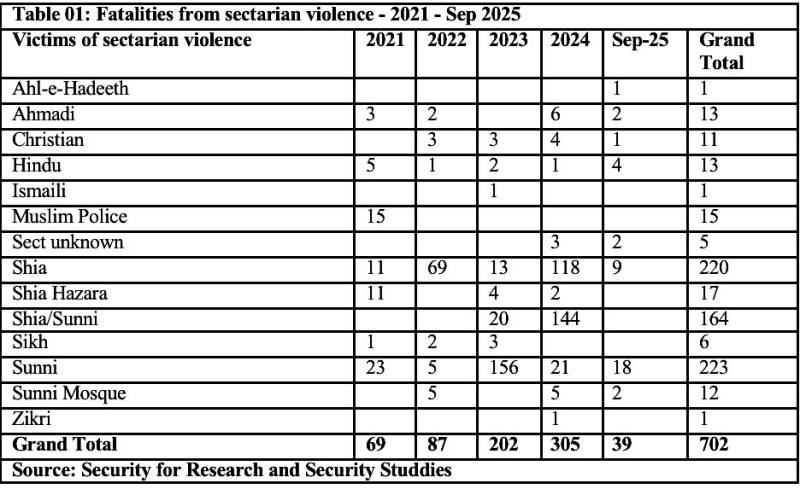
The political landscape became further blurred when Imran Khan and party leaders, while in power, frequently used abusive language against rivals, calling them looters, thugs, and thieves. Disrespect gradually extended to state institutions, culminating in Imran Khan’s recent assertion, labelling the Army Chief as a “delusional person” — a remark that provoked the DG ISPR’s strongly worded, “bare-knuckle” response. Viewed in isolation, such incidents might seem singular, but history shows that cycles of hatred and disrespect can escalate into terrorism, sectarian violence, and general instability.
The takeaway is clear: no individual, including high-ranking officials, should be subjected to disrespect, and those who propagate hatred along religious, ethnic, or provincial lines must be legally constrained. Political leaders, institutions, and the public alike must cultivate a culture of respect, restraint, and lawful engagement to prevent the normalisation of enmity and the perpetuation of violence. In Pakistan’s current context of political fragmentation and regional insecurity, restoring that culture is essential for national stability, security, and the protection of human life.