

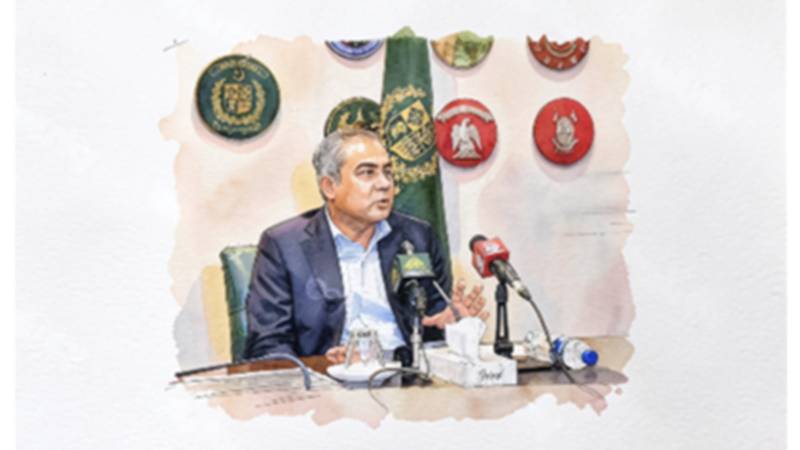
This piece, like so many others appearing recently across print, television, and social media, is about the pronouncement by Mr Mohsin Naqvi, the Federal Interior Minister—a key stakeholder and beneficiary of the current hybrid political system—who has declared that the system has crumbled. It would be prudent that, before his actual wise declaration is analysed, a word or two about his operating style is acknowledged.
Without being an idolater of the minister, this scribe has consistently admired him for his down-to-earth style. He rarely wears Western suits, and when he does, they are clearly inexpensive. He mostly sports ordinary-looking shalwar-kameez, with his sleeves rolled up, in typically awami style. Even on his foreign tours, he is similarly dressed and appears quite confident and comfortable. He speaks in plain, straightforward language. That is quite a departure from the politicians and bureaucrats who are dressed for cool, air-conditioned travel and working environments at the public's expense. The only point against him is his clinging to the lucrative post of Chairman of the Pakistan Cricket Board—a task clearly beyond his expertise and time, especially when he has been indulging in foreign forays despite his busy schedule managing the vast matters of his ministry. Pakistan Cricket, too, Mr Naqvi, is crumbling.
It is admitted here that this scribe deliberately waited for two weeks to offer these comments to avoid the appearance of a knee-jerk reaction. The issue, however, remains alive and is being discussed extensively and regularly by people better informed and experienced than this writer. This delay has also made the length of this write-up a bit longer than usual.
A Foundation on Slippery Ground
A house built on earthquake- or landslide-prone land has a short life and must deal with the ruinous aftermath staring it in the face for its entire short existence. The inbuilt adverse seismic forces pull at its rapidly deteriorating pillars, much like Samson bringing the entire edifice of oppression down with his irresistible force. The same is true of the system of government where one of the primary pillars is the worthy minister, as it is built on the slippery ground of elections that are widely believed to have been stolen. Just as justice has to be done and be seen to have been done, elections have to be free and fair, and the electoral process must be transparent enough to be visibly non-controversial—something that the July 2018 and February 2024 elections lacked.
Mr Naqvi is not the creator of the prevalent system. He parachuted into the coveted seat of what is traditionally known as the Takht-e-Lahore after the dismissal of the PTI government. That very few persons in the province had heard of him, or could recognise him by his face, had its parallel in that equally strange and obscure show-piece by the name of Buzdar, installed by the PTI government in 2018. For those, like this scribe, who feel the pain and effects of this poorly governed and abjectly managed nation, it is agonising that such high positions of responsibility are distributed in such a callous manner.
Is this nation facing such a dearth of competent persons that finding ten persons who can face the press and the nation with a cheerful, logical face using decent language has become impossible?
For the political families at the top, the only objective is the attainment of power, illegally if not legally, whatever the cost to the people. All members of the houses of the Nawabshah, Multan, Gujrat, and Lahore families hold political offices, maintained at tremendous expense to the exchequer. Their protocol cavalcades are miles long. The bill for their government-maintained homes, offices, vehicles, and aircraft runs into millions of dollars every year. They are the beneficiaries of this moth-eaten system but have every motive to maintain it. Whether it crumbles or drags on is of no concern to them.
Who will mend these ways? There lies the problem that the honourable minister honestly alluded to. This country has been turned into a grazing ground for the elite, who follow no rule or law. A crumbling system is an indirect or polite pointer to a diminishing society and State. However, the issues of governance are real and are not going away unless tackled with a firm resolve. Here, in the following paragraphs, a few prominent issues are discussed, beginning with the challenge that governing Punjab presents.
The Challenge of Governing Punjab
Punjab is a vast fiefdom. For a comparison, the Sikh empire extended over 520,000 square kilometres at its widest with a population of about 10 million at the start of the 19th century, which rose to about 22 million at the beginning of the 20th century. The province now comprises 205,000 square kilometres and counts 127 million inhabitants. That is more people than in many nations of the world. It extends from the Himalayan foothills in the north to the erstwhile state of Bahawalpur across the Sutlej, up to upper Sindh in the south; and from the eastern border on the east to across the Indus at Mianwali and DG Khan. The size of the Pakistani Punjab is about the size of the UK in area but with 30 million more people, and it is ruled by what can only be termed the first Maharani of the province. It is ruled from the colonial corner of Lower Mall in Lahore, or from its current perch in GOR-1 within the Lawrence Garden complex, or whatever the stately garden complex is now called on Jail Road.
The north-to-south length of the province is 640 km, without any autonomous governing body in between. Many cases of importance pertaining to administrative, judicial, or revenue issues must be decided in Lahore, at a great discomfort and expense to the people. This is a mockery of an efficient government. Comparing it with India, this is roughly the distance between Delhi and Allahabad (whatever it is named now), but with scores of independent local bodies in between, including in the major towns of Bulandshahr, Aligarh, Etawah, and Kanpur. The ordinary people of Allahabad need no darshan (visit) of Lutyens' Delhi for jobs that force the people of Kot Sabzal, near the Sindh-Punjab border, to commute to the hallowed corridors of GOR-1.
As to how Punjab grew so large, a reminder must be made here about a historical fact regarding Bahawalpur, easily accessible here. The eponymously named State was carved out of the ancient Mughal Multan Subah by the Daudpotra tribes of upper Sindh during the Abdali invasions in the aftermath of the breakdown of the Mughal Empire. The State was merged in 1955 to form One Unit in West Pakistan, a hat-trick pulled out of their magicians’ caps by the scheming anti-people feudal-bureaucrats at the helm at that time, with the evil intention of counterbalancing the more populous East Pakistan. When the provinces were restored in July 1970, in the dying convulsions of the country, everyone conveniently forgot that Bahawalpur also needed restoration. Instead of rationalising the spread of Punjab at that time, when such an opportunity was presented, the clueless Yahya regime squandered the chance and made Punjab too unwieldy and difficult to govern. Systems, therefore, didn't break down in the last two or three decades. We have been digging out its roots soon after the sapling was planted in 1947.
The Signs of Systemic Decay
Regarding the breakdown of the system, of which there are instances galore, it is troubling to think that recently a digital library in Khuzdar used by students – the only one of its kind there – was closed to make space for a conference hall. The library was to be moved two miles away where access for the students would have been difficult. If an example of 'elite capture' needs to be cited, this is a clear one. To their great credit and applause, the students resorted to peaceful demonstrations. The civil administration responded by registering cases against the students. Luckily, for once, the provincial administration realised the mistake, not only because their original step was wrong, but because it was creating another law-and-order situation in a restive area. The library was restored and cases against students withdrawn. However, the architects of this anti-people misadventure continue to occupy their posts, instead of being sacked for their insensitive decisions.
As for the protesting students in Khuzdar, these are the kind of cockroaches that Mr Naqvi was referring to in his address, who he feared may wipe out the system by force, as they did in Bangladesh and Nepal. India survived them because democratic methods prevailed there. Some of these cockroaches across our country, whose peaceful protests were treated as rebellion, have already been labelled as fitnas (rebels), produced before courts, and placed behind heavy iron doors without access to further legal redress.
It is sincerely hoped that some other fitnas—doctors, lady doctors, professors, students, et al.—those who languish behind jails in our unfortunate South Western province and elsewhere, are treated as our own sons and daughters. They may, or must, have been pushed across the red lines due to political affiliations or administrative repression, yet they are our own kith and kin, and an asset for the future. Generation Z and Alpha must be understood and their aspirations responded to. The fitna and foreign-sponsored melodrama has gone a bit too far and needs to be moderated, as is clear in the case of AJK, where peaceful legitimate demands have been mishandled by both sides to create bloodshed. Unfortunately, it has also forced the ever-loyal Kashmiri diaspora in Western nations to take up protests and slogans against their own state's highhandedness, instead of their usual target of Indian repression. That is because the optics on both sides of the control line are appearing similar. The AJK electoral exercise in progress right now is an exercise in travesty. The results are clearly being driven in one direction. Is this tarnished electoral exercise going to help the already deteriorating situation? Certainly not.
Inept public relations efforts across the board in this current 'crumbling' regime are also a sign of decay. Is this nation facing such a Qahat ur Rijal (dearth of competent persons) that finding ten persons who can face the press and the nation with a cheerful, logical face using decent language has become impossible? Instead of the poison being emitted from their high podiums, these spokespersons need to spread harmony, empathy, and reconciliation; a task that is proving ever more difficult. That, Mr Naqvi, is another crumbling wall that needs rebuilding from the foundation upwards.
Bullets are a recipe for disaster and not an answer to political issues. Magnanimity should be the call of the day. Let sense prevail. Restraint is an ointment that the nation needs. Lack of communication, especially with the Z and Alpha generations, will be counterproductive; as the serene environment of AJK, the hauntingly charming landscape of Baluchistan, and the forbidding mountains of the erstwhile FATA prove. The poet Sahir Ludhianvi warned us that:
خون پھر خون ہے، ٹپکے گا تو جم جائے گا
خاک صحرا پے جمے یا کف قاتل پہ جمے
(Blood is blood: If it spills, it will clot:
On the sands of the deserts, or on the sleeve of the assassin)
It is significant that a day after Mr Naqvi's foreboding caution, the DG ISPR, Mr Aleem Khan, and MQM followed suit, indicating that the wisdom descended from a common spring. However, that's a moot point. The urgent need is to correct the situation, for which a few humble suggestions are made in the subsequent paragraphs.
The Path Forward: Justice and Institutions
The first urgent issue facing the nation is the lack of credibility of the system, without which economic progress is not possible. The sanctity of elections must be maintained if credibility is to be restored. It is only the fascists, Islamists, and tyrants who manipulate elections for winning power. No nation can progress under military rule, direct or indirect. Way back in 1755, two years before the Battle of Plassey handed over the Indian subcontinent to the British, Adam Smith, the author of The Wealth of Nations, wrote:
"Little else is requisite to carry a state to the highest degree of opulence from the lowest barbarism, but peace, easy taxes, and a tolerable administration of justice; all the rest being brought about by the natural course of things."
None of these three elements are present in our society. Therefore, any hope for economic development here is a forlorn dream. While the nation is rebuilt from the ashes of the debris of the demolished edifice, it would be prudent to take notice of these wise words. As for justice, Hazrat Ali's words warm our hearts when he said that a nation can survive without religion but not without justice. With so many leading figures of the current regime claiming descent from the exalted Imam, including, I believe, Mr Naqvi, these wise words should be the guiding principle. However, given the way justice has been trampled, twisted, manipulated, and tarnished in the last few years, it is a wonder if anyone wants to be reminded of what the greatest of the Imams said about the necessity of having justice.
Let's assume a house with a large family: sons and daughters of all ages, including grandchildren. An authoritarian patriarch or matriarch will certainly erode the family unity, especially considering the lack of tolerance, short attention span, access to a wider world of information, and centrifugal tendencies of the post-2000 AD generation that came of age in the Information Age. A real familial democratic attitude, respect for diversity in ideas, and acceptance of life choices shall create a semblance of unity—at least as much as is possible in this new social world order. A sense of injustice, much diluted in the last few years, is one of the prime causes of the crumbling State foundations. How about restoring the judiciary, dear worthy minister, by selecting the best judges and letting them follow the law?
Then there is the quality of political leadership that has been forged since independence. There are three nurseries that produce grassroots politicians: student unions, trade unions, and local bodies. Zia killed the first two and politicians the third. Resultantly, the political leadership has passed on to the House of this and that person, leaving grassroots leadership to a few. To his (dis)credit, Zia discouraged the progressive leftist student organisations and encouraged the militant Maudoodi version. As a result, the country got militancy, violence, and regression, and that is where the nation continues to be stuck. Let these nurseries of future leadership be restored in true letter and spirit. There will be some unrest as a result of this step, but the system will settle into the chaotic democratic process.
Demographic and Educational Crises
The next two related issues of utmost urgency and importance are population growth and a lack of education. Ours is the fifth most populated nation on earth, with a population growth rate estimated between 2.55% based on 2023 intercensal figures and 1.6-1.9% based on Worldometer Pakistan statistics. There are 30 million children out of school, of which over half are in Punjab. These are frightening figures that need no elaboration. With an average capacity of 1000 children per school, a large number—30 thousand additional schools—are required, with half a million teachers, to cater for this looming catastrophe. Trillions of rupees are needed for new school buildings and running expenses while our economy is on the life support of IMF loans, rollover of existing debts, and internal borrowing. Vocational training institutes are required in the hundreds so that, at least, we can export quality-trained manpower instead of raw labour.
That should serve as a cold reminder that the System is indeed crumbling, if it has not already. Extremism, Mullahism, terrorism, and street crimes are all indicators of this malady. Our best-educated are leaving the country for the greener pastures of the West, where they do well, becoming a source of foreign remittances. However, we need professionals and entrepreneurs in the country. Most of the KEMC, GIK, and DOW graduates are abroad. The annual alumni meeting of the Aga Khan Medical College is held in New York, as are many ex-servicemen gatherings in London, Toronto, and Texas. Of the three PhDs in my class of the 1960s, two have settled abroad. All four children of the third, all of them medical or engineering PhDs, are in the UK and US. That is no way to run a nation.
The above figures are a sombre reminder that Mr Naqvi is absolutely correct in his initial assessment, though he has been indulging in some spin-doctoring lately, which, given his appointment, is acceptable. His solution of new provinces or administrative units is debatable and needs another piece.