

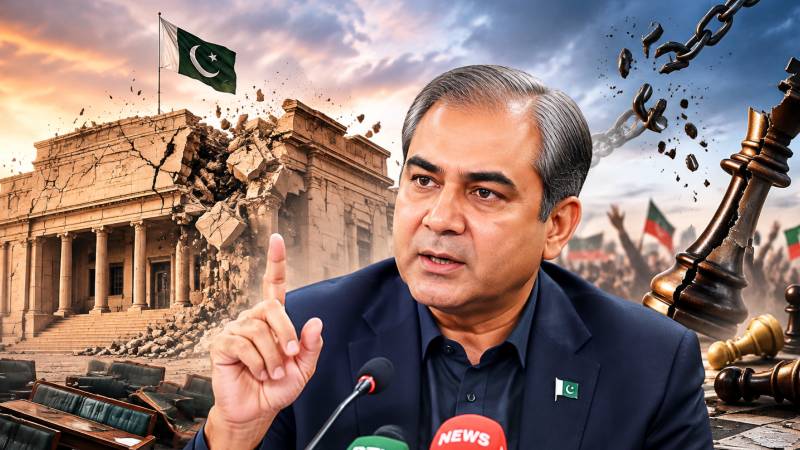
Political crises do not always begin with the rumble of tanks. More often, they begin with a remark that appears, on the face of it, quite ordinary but which, with the passage of time, changes the whole direction of the political landscape. Pakistan, perhaps, is passing through one such delicate moment at present. Addressing a policy seminar, Federal Minister for Interior Mohsin Naqvi remarked: "Whether you believe it or not, the system we are living in has collapsed."
This is not a statement that can be brushed aside, because it was not said by any opposition leader, any disgruntled politician, any retired general, any TV anchor, or any political analyst. This was said by the government's own Interior Minister — who is not just one member of the cabinet among many, but is widely considered to be among the most influential figures close to the very centre of state power. It is for this reason that this remark is being taken as a verdict delivered from within the state, about the state itself. And when a state itself begins passing judgment upon itself, then a question mark is placed over the credibility of the entire governmental structure.
Naqvi did not utter this sentence in passing, on some street corner. He said it at a seminar where highly sensitive subjects; the federation, the NFC Award, the creation of new provinces, the constitutional structure were already under discussion. Words, at times, take on more weight from their surroundings than from their own place in a sentence, and that is why this remark cannot be viewed apart from its background.
For the last several months, various ministers of the government have been saying, again and again, that the present federal financial arrangement is becoming unbearable for the centre. Talk of revisiting the NFC Award is in the air, the debate over new provinces has come alive once more, and there is renewed emphasis on the need for constitutional reforms. On the other side, senior journalist Hamid Mir has disclosed that different drafts of new constitutional amendments have already reached the Prime Minister's Office.
If all these developments are viewed as one single picture, it is not difficult to gather that Pakistan is nearing yet another major transformation. This question carries weight also because our history is full of such experiments already. We have heard it said before, more than once, that "the politicians have failed," that "the system stands paralysed." And so, "extraordinary circumstances demand extraordinary decisions." Each time, the nation was told a new beginning was at hand; each time, it was assured that the mistakes of the past would not be repeated this time round.
But the memory of history is far stronger than human memory; it remembers outcomes, not promises. In 1958, the country was shown the dream of political stability. In 1969, it was said this was merely the last transitional phase. In 1977, it was claimed that power would be handed to the elected representatives of the people within a matter of months. And in 1999, a vision of accountability, transparency, and a modern Pakistan was put forth. Today, looking back, every one of these experiments certainly produced fresh problems of its own, but not one of them could give Pakistan that constitutional stability in search of which the journey had originally been undertaken.
This history is not an indictment against any one individual or any one institution — it is simply a reminder of a fact. Every major experiment carried out in Pakistan outside the framework of the constitution did produce a temporary order, but it could not produce lasting trust. Perhaps because states do not run on force alone, states run on trust and trust is not born out of a decree, but out of political consensus.
The second aspect of Mohsin Naqvi's statement is, perhaps, even more startling than the first. If a federal minister says the system has collapsed, it also means the problem is not merely one of government performance. Then the question is no longer simply why the economy is weak or why inflation keeps rising — the question becomes whether the very constitutional and political arrangement under which the Prime Minister, the cabinet, Parliament, the courts, and all state institutions are functioning, is itself being declared a failure.
If that is so, then what is left of the Prime Minister's day-and-night labour? If a Prime Minister works fourteen hours a day, pleads Pakistan's case in capitals across the world, takes economic decisions, and grapples with law-and-order challenges — and yet one of the most important ministers in his own cabinet announces that the whole system has collapsed — then the problem is far bigger than the performance of any one government. The question, then, will not be asked of the government alone, but of the entire state structure — and this, perhaps, is precisely the point where politics ends and constitutional debate begins.
If Mohsin Naqvi's remark is not merely a political comment but a signal from the state itself, then its first test is not for the opposition, it is for the government's own house. Because if the system has truly failed, the question will first be put to those very parties who, for the last three years, have been claiming to be saving this same system.
The PML-N said the state needed stability; the PPP said democracy had to be saved; and both parties took the position that political loss could be borne, but the system should not be allowed to derail. Towards this end, they paid their own political price too; they accepted responsibility for controversial decisions, and defended steps with which even their own voters were not altogether satisfied. Be it judicial reforms or constitutional amendments, the argument at every turn was that state stability was the highest priority. But the question now is: if, after all this, a key minister of the government himself announces that "the system has collapsed," then what political meaning is left in all those sacrifices? Is this not, in effect, an admission that even so heavy a political price could not produce the desired results?
This question is particularly weighty for the Pakistan Peoples Party. There is hardly any party in Pakistani politics that has made the 18th Constitutional Amendment as much a part of its political identity as the PPP. For the PPP, the 18th Amendment is not merely a few clauses of the constitution; it is the new foundation of the federation. It is the agreement arrived at, after years of struggle, between the centre and the provinces; it is the document that tried, for the first time, to give the provinces the sense that Pakistan is not merely the name for Islamabad, but a shared home of four units.
That is why, in Sindh, whenever there is talk of the 18th Amendment or the NFC Award, it is not taken merely as a financial or administrative matter, but as a question of political existence itself. This is precisely why the PPP appears to stand against every debate that gives rise to the impression that provincial autonomy is being weakened.
This question carries weight also because our history is full of such experiments already. We have heard it said before, more than once, that ‘the politicians have failed,’ that ‘the system stands paralysed.’ And so, ‘extraordinary circumstances demand extraordinary decisions.’ Each time, the nation was told a new beginning was at hand; each time, it was assured that the mistakes of the past would not be repeated this time round.
But circumstances are no longer what they were. Various ministers of the government are speaking openly about the need to change the federal financial system. It is being said that the centre has become financially weak, that revisiting the present NFC formula has become unavoidable, and proposals for new provinces, too, keep surfacing from time to time. Now that the Interior Minister himself is saying that the present system has collapsed, the PPP may be standing before perhaps the most difficult political question of its history: will it give preference to power, or to its own founding political narrative? Because some decisions save governments but they change the verdict history writes about parties.
The PML-N's test, too, is no less severe. This party has, throughout its political history, more than once locked horns with the establishment, and on many an occasion, come to terms with it as well. But over the last several years, it took a different path — supporting decisions, in the name of state stability, which its critics termed a fundamental shift in the balance of power. It was also accused of having become the establishment's "political partner," or, as some of its opponents would have it, its "B-team."
The PML-N rejected these objections by saying that if the state itself weakens, politics does not remain safe either. This was a political position, and history will be its judge. But if this same party is now asked to support still more fundamental constitutional changes, the question will not simply be whether it votes in favour of these amendments; the real question will be: how far back is it willing to retreat?
Every political party has a limit to compromise, beyond which compromise ceases to be strategy and becomes, instead, a question of identity. In politics, defeat is sometimes not suffered at the ballot box at all; defeat comes on the day a party is no longer able to convince its own workers that it is still the same party for which they struggled for years. This is the point at which power and politics part ways from each other. Power can be temporary. Political identity cannot.
That is why, if in the days ahead an attempt is made at major changes concerning the federal structure, the NFC, provincial autonomy, or constitutional powers, the real test will not be for the opposition; it will be for those very allies sitting within the government whose own existence has, till today, rested upon these same constitutional principles. And perhaps that is why today's most important question is not whether new amendments will come or not, but this: if they do come, who will pay the political price of getting them passed? And after paying every such price, does anything remain in politics which the people call "trust"?
At this point, the debate is no longer merely one of government versus opposition; it becomes a debate about the Pakistani federation itself. States do not run only from their capitals; they run from their peripheries as well. Their strength is not measured only by the building in which decisions are taken, but also by the towns and settlements upon which the effects of those decisions fall.
Islamabad may be the centre of power, but it is not the complete picture of Pakistan; Rawalpindi may be the centre of state planning, but the whole psyche of Pakistan cannot be contained there. Pakistan is also the port of Karachi, where the economy draws breath; it is also the mountains of Quetta, where every government announcement is weighed in the light of local history; it is also the bazaars of Peshawar, where the state's decisions are seen through the mirror of border experience; it is also the valleys of Gilgit-Baltistan, still, to this day, wrestling with the question of their own constitutional identity; and it is also the towns of interior Sindh, where federation does not mean Islamabad alone, but a fair distribution of resources, identity, and authority.
This is precisely why federations do not survive on constitutional clauses alone, federation is the name of a feeling. The feeling that in this country, it is not one unit's voice alone that is heard, but everybody's; and the belief that decisions are taken not merely on the basis of power, but on the basis of trust as well. When this feeling begins to weaken, states may appear strong on the outside, but they begin to hollow out from within.
Pakistan's history is witness to this. After the creation of Pakistan, a large share of power kept accumulating at the centre, and it was assumed that a strong centre was itself the guarantee of a strong Pakistan — but history taught a different lesson altogether. When East Pakistan felt that its political majority carried no weight against state power, the matter no longer remained one of government alone — it became a crisis of the federation itself. 1971 was not simply a military defeat — it was a federal failure as well. Even after this, instead of learning the lesson, Pakistan repeatedly took the same road again, taking force to be a substitute for trust, though the two are as different as earth from sky. Force can produce obedience; trust produces belonging. Obedience can end. Belonging carries on across generations.
That is why, whenever the question of rearranging the constitutional structure comes up in Pakistan, the first question that arises is: will its effect be felt in Islamabad alone, or across the whole federation? If a change is made to the NFC Award, how will Sindh look at it? If there is a fresh division of powers, what will Balochistan's reaction be? If the formation of new provinces comes under consideration, will there be national consensus behind it, or will it give birth to a fresh political dispute? These are not the questions of any one party — these are questions of the state as a whole.
It has been Pakistan's misfortune that constitutional debates here have mostly begun in an atmosphere of political crisis, and legislation made amid crisis is never as strong as legislation made through consensus. At present too, the country is passing through extraordinary economic pressure, political division is at its peak, and the absence of trust between institutions has come out into the open. In such an environment, if a debate begins over the state's basic arrangement, its consequences can travel very far. It is easy enough to say the system should be changed — the difficulty lies in who will accept the new system. A constitution is not merely a set of clauses written on paper — it is a collective consent, and collective consent is born not out of an order, but out of dialogue.
Perhaps this is the very lesson that the world's successful federal states learnt long ago. In America, the constitution is over two centuries old, yet reforms keep being made within it. Germany, after the Second World War, built its federation on constitutional balance rather than on force. In India, despite sharp political differences, the federal structure has kept moving forward through continuous political negotiation. No strong state has made it a habit to change its entire system in response to every crisis — it has tried, instead, to improve the system. This is precisely the difference between reform and adventurism: reform moves forward gradually, while adventurism tries to reach its destination in a single leap — and history shows that in politics, it is usually these very leaps that come at the heaviest price.
Pakistan, perhaps, once again stands at such a crossroads, where the decision is not merely how many amendments will be made to the constitution, but also this: will the federation emerge stronger, or will it fall into greater uncertainty than before? Because the real strength of a constitution does not lie in its clauses, but in the trust the people place in it; and when that trust weakens, even the finest constitutional text turns lifeless.
The question is not merely whether the system has collapsed or not. The real question is: if it truly has, then who will revive it, and by what method? Through Parliament? Through political consensus? Or, once again, through some extraordinary path which is later sought to be folded back into the constitution?
This is the very question on which Pakistani politics stands today. Various ministers of the government keep saying, again and again, that the federation's financial resources are shrinking, that the NFC Award needs revisiting, that constitutional reforms have become unavoidable, and that the state structure must be made more effective. This debate is, in itself, understandable — every constitution has room for improvement, no system is the final word. But there is as much difference between reforming a constitution and changing its very spirit as there is between repairing a building and digging up its foundations afresh. Repairing a building makes it stronger; digging up the foundations again and again leaves the whole building unstable.
That is why every debate over constitutional change in Pakistan carries with it a historical fear as well. This fear is not without reason — we have seen, more than once, how a debate that begins in the name of "reform" ends up, eventually, at a new balance of power. This is why, even today, when constitutional amendments are spoken of, it is not legal experts alone who take notice — the provinces sit up too. Sindh wonders whether the 18th Amendment will remain safe or not; Balochistan watches which way the balance of resources and powers will tilt; Khyber Pakhtunkhwa raises questions in the context of its own political standing; and in the minds of the smaller provinces, one question keeps circling: is this new interpretation of the federation, perhaps, just another attempt to make the centre powerful once again?
These questions may seem, from Islamabad, to be an exaggeration — but Pakistan is not Islamabad alone. States do not break because their power has grown less; states grow weak when their different parts begin to feel that decisions are not being taken with them, but imposed upon them. That is why, in any constitutional debate, the thing that matters most is not numerical majority, but national consensus.
If new constitutional amendments do come about, who will get them passed? Parliament. And in Parliament, the majority rests with the PML-N and the Pakistan Peoples Party. Both these parties may find themselves standing before an extraordinary political test. The Pakistan Peoples Party has, for years, tied its identity to the defence of the 18th Constitutional Amendment, and for it, provincial autonomy is not merely a constitutional matter but a political ideology as well. If tomorrow some amendment comes forth which, in Sindh, is taken as a departure from the spirit of the 18th Amendment, will the PPP be able to accept it? And if it does accept it, what answer will it give its own voter?
The PML-N's trial, too, will be no smaller. In recent years, this party has taken upon itself the responsibility for a great many decisions in the name of state stability, decisions for which it has had to pay a heavy political price. If it is now asked for support on still more fundamental constitutional changes, the question will not be one of voting alone — the question will be whether every political party's compromise, too, has some final limit.
Once political identity is wounded, rebuilding it takes not years, but sometimes generations. Pakistan's political history is full of such instances — many parties remained in power but lost their ideological workers, and many governments survived but lost their moral force. In politics, sometimes the greatest defeat is not suffered at the polls — it comes on the day the people begin to feel that a party has abandoned its own position.
That is why the months ahead are of extraordinary importance not just constitutionally, but politically as well. Nations do not grow strong by changing their system again and again — they grow strong by letting their institutions mature. A constitution is not merely a book of law, it is a covenant of trust between the state and the people. Change within this covenant is always possible, but if its very foundation is shaken, then the resulting crisis becomes difficult to contain. The question at present is not merely what amendments are about to be made to the constitution. The real question is this: by what name will future generations remember this era — as an age of reform or as yet another historical failure!