

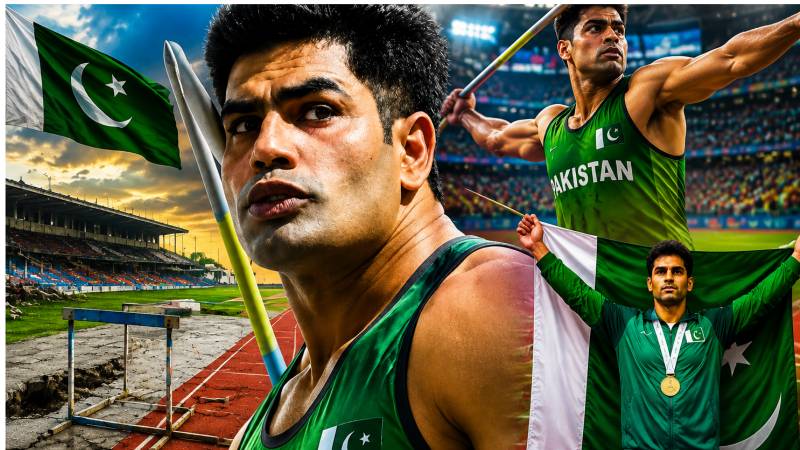
The disappointment over Arshad Nadeem's performance at the Commonwealth Games is understandable. Expectations were always going to be extraordinarily high after what he achieved at the Paris Olympics. But before criticism begins to overshadow perspective, it is worth remembering exactly who Arshad Nadeem is and what he has already accomplished—not just for himself, but for Pakistan. Arshad Nadeem will always be a champion.
His Olympic gold medal was not merely another sporting triumph. It was one of the greatest achievements in Pakistan's sporting history. By winning gold in the men's javelin throw, he accomplished what many had once considered impossible. Even more remarkably, he set a new Olympic record with a throw that surpassed the previous mark that had stood since the Beijing Olympics in 2008.
In fact, outside of the three hockey gold medals won decades ago, no Pakistani had ever stood on the highest step of the Olympic podium. Arshad changed that narrative forever. His success becomes even more impressive when viewed in a regional context. India, with a population nearly seven times larger than Pakistan's and significantly greater investment in sports infrastructure, has also won only one Olympic gold medal in athletics. That alone illustrates just how rare and extraordinary such an achievement is.
This is why one disappointing performance should not define Arshad Nadeem's legacy. The world's greatest athletes experience fluctuations in form. They have highs and lows, victories and setbacks. Sporting excellence is never a straight line. Every Olympic champion, world champion and record holder has endured defeats along the way.
There is another important factor that deserves consideration. Arshad has been recovering from injury. Returning to elite competition after injury is rarely straightforward. Rehabilitation is not simply about recovering physically; it is about regaining confidence, rhythm, timing and competitive sharpness. Even the finest athletes require time before returning to their absolute best. Rather than questioning Arshad Nadeem, Pakistan should instead be asking a much more important question: how has an athlete of his calibre managed to achieve so much despite the country's sporting system, rather than because of it?
This is the real issue. Pakistan simply does not possess the kind of athletics infrastructure that allows world-class competitors to train consistently against high standards. Elite athletes require modern facilities, qualified coaches, sports scientists, physiotherapists, nutritionists, biomechanical analysis and regular competition against equally accomplished opponents. These are not luxuries; they are the basic requirements of international sport today.
Arshad Nadeem has had to overcome obstacles that athletes from leading sporting nations rarely encounter. The fact that he became an Olympic champion despite these limitations speaks volumes about his talent, determination and resilience. It should also raise uncomfortable questions about how many other gifted Pakistani athletes never realise their potential because the system fails them long before they reach the international stage.
Sporting success cannot depend on exceptional individuals emerging once every generation. It must be the product of a system that consistently identifies, nurtures and develops talent.
That requires serious government commitment. The federal and provincial governments must recognise that investment in sport is not an expense but an investment in national development. Modern athletics centres should be established across the country, equipped with internationally compliant tracks, field facilities and specialised training equipment. Existing stadiums should be upgraded and maintained instead of being left to deteriorate.
The magnitude of this achievement cannot be overstated. Pakistan had never before won an Olympic gold medal in athletics.
Equally important is the creation of a structured domestic competition calendar. Pakistani athletes need frequent, high-quality competitions to measure themselves against the best in the country and, where possible, against international competitors. Without meaningful competition, athletes struggle to maintain the standards required for global events.
Schools, colleges and universities must once again become the foundation of Pakistan's sporting ecosystem. For decades, educational institutions produced many of the country's finest athletes. Today, competitive sport has largely disappeared from campuses. Reviving inter-school, inter-collegiate and university competitions would significantly expand the pool of young talent while encouraging healthier lifestyles among students.
Coaching also deserves urgent attention. Pakistan needs to invest in developing qualified coaches through internationally recognised certification programmes and regular exchanges with countries that have established excellence in athletics. Great athletes are often the product of great coaching.
Elite competitors should also have access to comprehensive sports science support, including injury prevention, rehabilitation, nutrition, psychology and performance analytics. These disciplines have become standard across the world's leading sporting nations and frequently determine the difference between winning a medal and narrowly missing the podium.
Financial security is another critical issue. Too many Pakistani athletes continue to worry about their livelihoods while preparing for international competition. Scholarships, sponsorship programmes and performance-based funding should ensure that elite athletes can focus entirely on training instead of financial uncertainty.
The private sector must also play a far greater role. Corporate Pakistan has the resources to sponsor athletes, competitions and academies. Public-private partnerships could transform Pakistan's sporting landscape if approached with transparency and long-term planning. Finally, sports administration itself requires reform. Federations must be professionally managed, transparent and accountable. Selection should always be merit-based, while funding should be linked to measurable outcomes. Politics and administrative inefficiency have held Pakistani sport back for far too long.
Arshad Nadeem has already shown what a Pakistani athlete can achieve when extraordinary talent is combined with extraordinary determination. Imagine what could be accomplished if that talent were supported by world-class infrastructure, professional coaching and a functioning sporting system.
Pakistan should celebrate Arshad Nadeem not only for the medal he brought home but also for the lesson he has given the nation. Individual brilliance can win Olympic gold once. Sustainable excellence requires institutions, planning and investment. His Commonwealth performance may not have met expectations, but it should serve as something far more valuable than another medal—it should be the catalyst for finally building a sporting ecosystem worthy of the champions Pakistan already has and the many more it has yet to discover.