

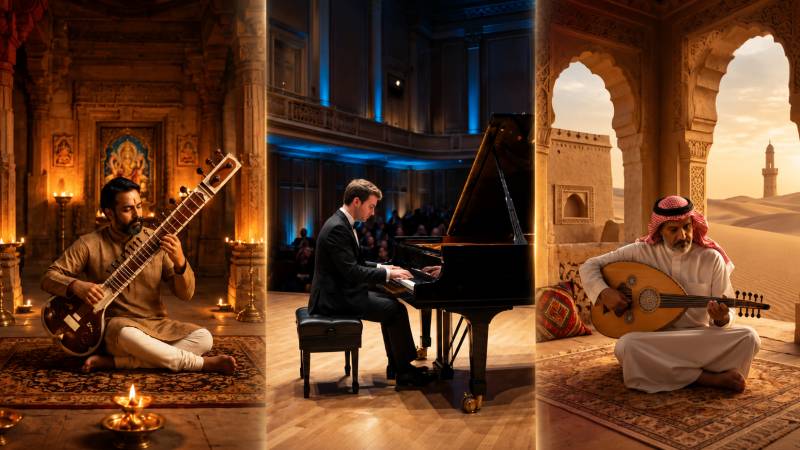
Raag music is among the oldest surviving artistic traditions of South Asia. Revered for its depth, subtlety and spiritual intensity, it continues to flourish across India, Pakistan, Bangladesh, Nepal, Sri Lanka and Afghanistan while inspiring musicians and scholars far beyond the region. Over centuries, the tradition has interacted with diverse cultures, languages, faiths and aesthetic philosophies, yet it has retained a remarkable continuity of artistic identity.
Like every great classical tradition, Raag music is historical, creative, intellectually refined and aesthetically sophisticated. Its foundations lie not merely in performance but in a broader civilizational environment combining philosophy, spirituality, poetry, oral transmission and artistic discipline. Its history can broadly be understood through three phases: the ancient period, from the Vedic age to the twelfth century; the medieval period, marked by cultural synthesis and courtly patronage; and the modern period, characterized by institutionalization, documentation and technological dissemination.
Ancient Foundations
The roots of South Asian musical thought are generally traced to the wider civilizational continuum of the Indus Valley and Vedic cultures. Archaeological discoveries from ancient settlements reveal societies familiar with organized artistic and ceremonial practices, suggesting a sophisticated aesthetic culture long before the emergence of written musical theory.
The earliest substantial references to structured musical practice appear in Vedic literature, particularly the Samaveda, whose melodic chants were employed in ritual and contemplative settings. Preserved through oral transmission across generations, these chants established a lasting relationship between sound, spirituality and disciplined vocal expression.
In South Asian thought, sound was never regarded merely as entertainment. It was understood as a means of contemplation, emotional refinement and metaphysical inquiry. This vision found expression in the concept of Naad Brahma, the cosmic principle of sound, through which music became both an artistic and spiritual pursuit.
The ancient region of Gandhara, encompassing present-day north-western Pakistan and eastern Afghanistan, occupies a special place in this cultural memory. Situated at the crossroads of South Asia, Central Asia and Persia, Gandhara became a centre of artistic exchange. Its sculpture, architecture, painting and urban culture reflected a sophisticated environment shaped by interaction among civilizations. Its legacy is particularly significant because it reminds us that the musical cultures of South and Central Asia have been connected for millennia through trade, migration, spirituality and artistic exchange.
Taxila further illustrates this continuity. One of the great centres of learning in the ancient world, it embodied a teacher-disciple relationship that would later find a powerful parallel in the guru-shishya tradition. This relationship remains central to the transmission of classical music across South Asia.
Music, Spirituality and Oral Tradition
South Asian classical music developed fundamentally as an oral tradition. For centuries, compositions, improvisational techniques and stylistic nuances were preserved through memory rather than notation. The relationship between teacher and disciple was therefore artistic as well as spiritual.
The guru or ustad was not merely an instructor of technique but a guide responsible for shaping the character, temperament and artistic sensibility of the disciple. Years of disciplined practice, listening and internalization were considered essential before a student could meaningfully perform or innovate within the tradition.
This system enabled music to survive political upheavals, changing dynasties and social transformations while maintaining continuity with the past. At the same time, it encouraged individuality within discipline. A student inherited a tradition while gradually developing a distinctive personal expression. Over time, this process contributed to the emergence of stylistic lineages and schools known as gharanas.
The emotional essence of music, rasa, remained central. A raag is never understood merely as a scale or sequence of notes. Rather, it is treated as a living melodic entity capable of evoking particular emotional and spiritual states. Each raag possesses its own mood, atmosphere, grammar and aesthetic temperament.
A significant part of this expressive quality is achieved through meend, the graceful gliding from one note to another while subtly traversing intervening microtones, or shrutis. This continuous melodic movement gives the music depth, fluidity and emotional nuance. Equally important is taan-kari, the art of rapid and intricate melodic elaboration, which can generate excitement and heightened aesthetic intensity.
Together, these techniques allow the performer to move beyond technical display and guide the listener towards a deeper emotional and contemplative experience.
A raag is never understood merely as a scale or sequence of notes. Rather, it is treated as a living melodic entity.
Medieval Synthesis and Cultural Interaction
A major phase of consolidation occurred between the thirteenth and eighteenth centuries with the arrival and settlement of Muslim rulers, scholars and Sufi saints in the Indian subcontinent. Interaction between indigenous traditions and Persian, Central Asian and Turkish influences produced a remarkable cultural confluence.
This period witnessed the flowering of what may broadly be described as Indo-Islamic culture, in which music, poetry, architecture and spirituality interacted creatively. Sufi traditions played a particularly important role, introducing new dimensions of devotion, emotional expression and mystical experience.
The medieval period also produced important musical literature. Sangeet Ratnakar by Sarangadeva documented earlier traditions while reflecting evolving musical practices. Centuries later, Muhammad Raza's Naghmat-e-Asfi contributed to theoretical discourse and reflected the continuing evolution of musical thought.
It was during this long period of interaction that Raag music gradually acquired much of its present character. Encounters between indigenous traditions and influences arriving through Persia, Central Asia and the wider Islamic world enriched the existing musical vocabulary and helped shape a vibrant and intellectually dynamic tradition.
Among the towering figures associated with this cultural renaissance was Hazrat Amir Khusrau (1253–1325), the poet, musician and intellectual associated with the Delhi Sultanate. Although some claims concerning his specific musical innovations remain debated, his symbolic importance in the development of Indo-Persian artistic culture is undeniable. He remains an important figure in discussions of South Asia's composite cultural identity.
The medieval period also witnessed the emergence and refinement of major classical genres. Dhrupad, characterized by meditative depth, dignity and structural discipline, became one of the earliest formalized styles of North Indian classical music. It was later complemented by Khayal, a more flexible and improvisational form that allowed greater melodic and emotional exploration.
The Bhakti movement similarly employed poetry and music as vehicles of devotion and social expression. Sultan Hussain Sharqi of Jaunpur is traditionally associated with the development of Khayal, while Raja Man Singh Tomar of Gwalior contributed significantly to the patronage and revival of Dhrupad. The Mughal courts later became major centres of artistic activity, producing legendary musicians such as Mian Tansen, whose name remains synonymous with musical excellence throughout South Asia.
Subsequent generations of composers, including Niamat Khan Sadarang and Feroz Khan Adarang, enriched the Khayal repertoire with compositions that remain an essential part of performance practice. During this period, gharanas gradually emerged as hereditary and pedagogical centres of musical learning, preserving distinctive stylistic approaches, repertoires and teaching methods.
The Visual World of Raagmala
The mystery of raag found expression not only through sound and poetry but also through painting. The Raagmala tradition, which flourished primarily during the sixteenth and seventeenth centuries, sought to visualize musical ideas through symbolic imagery.
Raags were portrayed as living personalities inhabiting particular seasons, landscapes and emotional worlds. Through colour, gesture and setting, painters attempted to capture the inner temperament of musical forms and make abstract melodic concepts accessible to wider audiences.
The Raagmala tradition demonstrated that a raag was understood as far more than a melodic framework. It represented a complete aesthetic experience encompassing sound, poetry, emotion, time, season and visual imagination. The interaction between music, painting and literature remains one of the sophisticated achievements of South Asian artistic culture.
Colonial Encounter and Modern Documentation
The twentieth century introduced another major transformation through recording technology. The establishment of the Gramophone Company in India in 1902 enabled performances by classical and folk musicians to be preserved for future generations. Music could now travel beyond courts and private gatherings, reaching audiences on an unprecedented scale and safeguarding repertoires that might otherwise have disappeared.
The same period witnessed the establishment of music schools, public conferences and new systems of documentation. Pandit Vishnu Digambar Paluskar founded Gandharva Mahavidyalaya in Lahore in 1901, opening classical music education to broader sections of society. Pandit Vishnu Narayan Bhatkhande's research, documentation and Thaat classification system laid important foundations for modern music education and scholarly study.
Begum Atiya Fyzee also contributed to introducing South Asian music to international audiences. Her writings, enriched by Raagmala illustrations prepared by Samuel Fyzee Rahamin, represented an early attempt to present South Asian musical heritage within a cosmopolitan intellectual framework.
Music in Pakistan after Independence
The partition of the Indian subcontinent in 1947 created new political realities but did not sever the deep cultural roots of classical music. In Pakistan, Raag music continued to survive and evolve despite changing social priorities and limited institutional support.
Among the early figures committed to preserving musical heritage was Feroz Nizami, who taught music in Lahore and contributed to public discourse through his writings on music and culture. Khwaja Khursheed Anwar and Faiz Ahmad Faiz later played pioneering roles in documenting Pakistan's classical music heritage through projects such as Aahang-e-Khusravi and Gharano Ki Gayaki. These initiatives preserved valuable repertoires and remain important resources for scholars, performers and listeners.
Pakistan also produced a remarkable generation of classical and semi-classical musicians who sustained the tradition through performance, teaching and recording. Despite institutional challenges, the ustad-shagird tradition helped maintain the continuity of gharana knowledge and repertoire.
The Indus Raag Project
The Indus Raag project emerged from my own passion for preservation, documentation and cultural continuity. Conceived in 2005 and culminating in the release of the first volume of the Indus Raag album in 2012, the initiative sought to archive, celebrate and promote the musical heritage of the South Asian subcontinent. A sequel followed in 2016.
By documenting classical and folk traditions from different regions and communities, the project sought to highlight the common artistic vocabulary connecting the peoples of South Asia despite political and geographical divisions. It also attempted to present classical and folk music not as relics of the past but as living traditions capable of speaking meaningfully to contemporary audiences.
Indus Raag received international critical acclaim. British world music publications praised its scope, documentation and contribution to the musical literature of the Indo-Pak subcontinent. Publications in Britain, India and Pakistan highlighted its significance for cultural revival, innovation and cross-border artistic collaboration among musicians from India, Pakistan and other parts of the world.
Raag and Muqam: A Shared Musical Heritage
As a student, curator and producer of Raag music, I have long been fascinated by the remarkable parallels between the Raag and Muqam traditions. My engagement with musicians, scholars and cultural practitioners from South Asia, Central Asia and beyond has repeatedly reinforced my view that these two great melodic systems, although shaped by different historical experiences, share important aesthetic, intellectual and spiritual foundations.
Raag developed principally across India, Pakistan, Bangladesh, Nepal, Sri Lanka and Afghanistan, while Muqam flourished throughout Persia, Türkiye, the Arab world, Central Asia and parts of Afghanistan. Despite their emergence in distinct cultural environments, both traditions share profound conceptual, aesthetic and spiritual foundations.
At their core, both Raag and Muqam are melodic systems. Unlike Western classical music, which evolved largely around harmonic development, these traditions place melody at the centre of artistic expression. Over centuries, each developed into a sophisticated musical language governed by its own theoretical principles, performance conventions and pedagogical methods.
A defining characteristic of both systems is their capacity to facilitate emotional and psychological transformation. In Raag, this is expressed through alap, contemplative development and the association of particular raags with specific times, seasons and emotional states. In Muqam, similar effects are achieved through distinctive modal colours, emotional associations and spiritual symbolism.
Ultimately, both traditions seek to arrive at a condition that South Asian aesthetics would describe as rasa: the distilled essence of emotional and spiritual experience. From my perspective as a listener, the taqseem tradition of Muqam possesses a particular fascination because it echoes many improvisational impulses familiar within the Raag system, although through a different musical vocabulary. In both traditions, the cumulative effect is the creation of a rich psycho-acoustic environment capable of transforming the listener's inner experience.
Another important similarity lies in their oral transmission. For generations, musical knowledge was passed directly from master to disciple through the guru-shishya parampara and ustad-shagird rivayat. This process preserved not only repertoire and technique but also artistic temperament, aesthetic judgment and philosophical outlook.
The spiritual dimension is equally significant. Raag music has been shaped by temple traditions, yogic disciplines, the Bhakti movement and Sufi influences expressed through forms such as qawwali and sama. Likewise, Muqam occupies an important place in the Sufi traditions of Central Asia, Persia and the wider Islamic world.
Interesting correspondences may also be observed between certain Muqams and South Asian raags and thaats. These comparisons should not be interpreted as exact equivalences. Rather, they illustrate shared aesthetic sensibilities across a vast geographical region. For example, Muqam Saba evokes aspects of Bhairavi and Todi; Nahawand suggests affinities with Kafi; Ajam broadly corresponds with Bilawal; while Rast, Hijaz, Bayati, Sikah and Kurd reveal varying melodic parallels within the Raag system.
Such parallels are best understood not as evidence of direct identity but as reminders of centuries-old interaction among civilizations. Trade routes, migration, scholarship, pilgrimage, empire and spiritual exchange created networks through which ideas, aesthetics and artistic practices travelled across Asia.
At the same time, the differences between the two traditions must be acknowledged. Raag music developed elaborate concepts such as rasa, time theory, seasonal associations and extensive improvisational forms including alap and taan. Muqam traditions developed their own modal organizations, compositional structures and regional variations, each reflecting the historical experiences of their respective cultures.
If Muqam may be regarded as one of the great melodic languages of Central Asia and the broader Islamic world, Raag represents its counterpart in South Asia. Both traditions emerged from different historical experiences, yet each seeks to transform sound into a vehicle of contemplation, emotion and spiritual insight. They remain deeply Eastern and Asian traditions, creating the magic for which they are widely known.
Artistic traditions can transcend geography, connect communities and preserve humanity’s collective search for beauty, wisdom and spiritual meaning.
The history of Raag music is ultimately a story of continuity within change. From the melodic chants of the Vedic age to sophisticated contemporary performance traditions, it has continuously adapted to new circumstances while preserving its essential identity.
Across more than two millennia, the tradition has absorbed influences, welcomed innovation and engaged with diverse cultures without losing its distinctive character. Ancient philosophy, Buddhist learning, Bhakti devotion, Sufi spirituality, courtly patronage, oral transmission, modern institutions and contemporary technology have all contributed to its evolution. Above all, artistic sincerity has allowed the tradition to remain alive.
Viewed alongside the great Muqam traditions of Central Asia, Persia, Türkiye and the Arab world, Raag music also reminds us of the deep cultural conversations that have linked Asian civilizations for centuries. These traditions emerged in different lands and languages, yet they share a belief in the transformative power of sound and the ability of music to illuminate the inner life.
In an age increasingly defined by political boundaries and cultural fragmentation, the shared heritage of Raag and Muqam offers a different message: artistic traditions can transcend geography, connect communities and preserve humanity's collective search for beauty, wisdom and spiritual meaning.
The study of Raag and Muqam is therefore not merely an exploration of musical systems. It is also a reminder of a broader civilizational legacy in which culture served as a bridge between peoples, regions and faiths. Their continuing presence in contemporary life stands as a testament to the enduring human desire to seek harmony, creativity and transcendence through the universal language of music.