

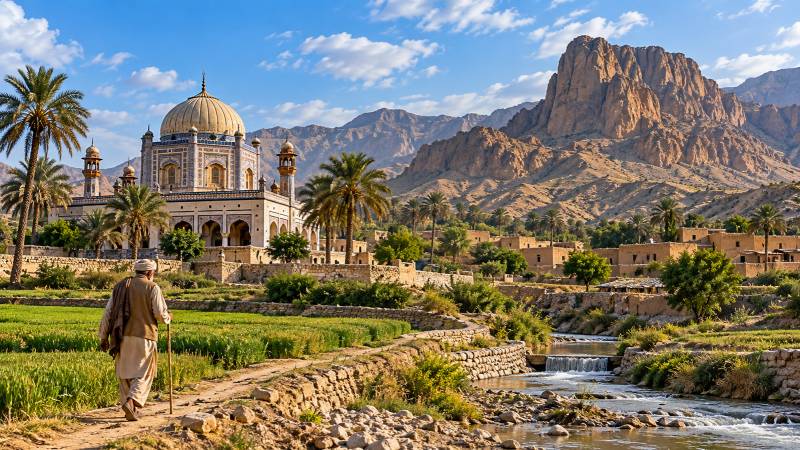
Daman is a stretch of land between Indus and Koh- Suleman. The British called it Pachad, meaning the western borderland. This is a long strip of land of Tehsil Taunsa Sharif extending towards Dera Ismail Khan. To its west lies great Suleman mountain bordering Punjab and Balochistan, while the mighty Indus flows on its east. Before canal and tube well irrigation was introduced, only torrents cascading down from Koh-e-Sulaiman were the only source of watering the fields of the tract. It was an uphill task to irrigate the vast fields, each field usually extended to acres.
Taming the flooding torrents needed the giants' strength . A temporary dam was constructed, with the help of bullocks, to divert the water to the parched fields. The torrents would flow only during monsoon season. Millet was the only crop to sustain. At times, grains and mustard would also bloom. Trees were rare. With the background mentioned above, the dark nights of Daman were fearsome but the gleaming moonlit nights were enchanting. On moonlit nights the mud houses would look like the houses of a fairyland and the dry land would glitter in the clear moonlight. There was hardly any crime. A sense of calm prevailed among the people.
The stories of a wandering Fakir were common, at the sight of the glowing wandering Fakir the person on foot would recoil in horror, if he walked the wandering Fakir would chase him and a horse rider would hold the bridle reciting verses from the Quran. Later, I came to know that it was will o’ the wisp —-a wandering, glowing Fakir. At nights wolves reigned and the shepherd had to be vigilant to save his herd from them. The howling of jackals would deepen the mystery of the landscape. The enchantment and mystery of the landscape of the past is diligently portrayed in the stories of Najeeb Haider. His stories, mostly written in the genre of magical realism , evoke the magic and mystery of the landscape.
The socio-economic relations that evolved in the landscape are vividly depicted. Remembering the stories told by Irshad Taunsive, a great narrator and poet of his time, about the mysterious landscape and its horror, told in the remote johk (hamlet) lit by the dim light of a lantern, still sends a shudder down my spine. I usually spend a few nights after every six months or so with friends to recall and enliven the surrounding mystery. Now, the canal and tube-well irrigation has changed the landscape. The mystery of the landscape has faded; the noise of tractors has polluted the environment, and the calm is a thing of the past now.
Before canal and tube-well irrigation was introduced, only torrents cascading down from Koh-e-Sulaiman were the source of watering the fields of the tract. Taming the flooding torrents needed the giants’ strength.
It is also called the land of Khawaja Suleiman (1770-1850), commonly known as Pir Pathan.He was a prominent Chishti Sufi saint. He established his spiritual centre at Taunsa Sharif, which developed into an important centre of Chishti teaching and spiritual activity. His period coincided with considerable political change in the region, including the decline of Afghan influence, the expansion of Sikh power, and, near the end of his life, the British annexation of Punjab in 1849.
Pir Pathan laid great emphasis on education and that was his miracle. According to a study in the Journal of the Punjab University Historical Society Pir Pathan built a madrassa in 1790 at the town of Taunsa Sharif, attracting students from all over the subcontinent. D.C.Phillot writes in Notes on the Shrine of Taunsa. “Pir Pathan opened a public library and collected many ancient books by known authorities. This library was the largest in India, next to the Royal Library.” Consequently, the Daman witnessed a high literacy rate and a rise of intelligentsia in the region. Later, Taunsa Sharif was nicknamed a mini- Greece by the visitors. In my childhood I knew many people who could recite Hafiz Shirazi, Ghalib, Omer Khyaam and Rumi. Moreover, Pir Pathan's influence saved the dwellers of the region from the marauders of Waziris who would raid the prosperous area for plunder. The area Sanghar Tehsil (those days the Sikh and later colonial settlement established Sanghar Tehsil) was prosperous as it had a riverine land, and a land irrigated with hill torrents.
The people were hardworking who resiliently fought against the odds of nature and tilled the land to sustain and to live with grace. The gazetteer provides evidence “that British officials recognised people’s agricultural ingenuity and resilience. The farmers cultivated an exceptionally difficult region where agriculture depended on unpredictable hill torrents. They had to construct and maintain embankments to intercept floodwater. The gazetteer further observes that , “considerable labour and capital were necessary before land could be cultivated.” In the light of these observations, one is inevitably led to ask: when and why were the natives branded as indolent and lazy?