

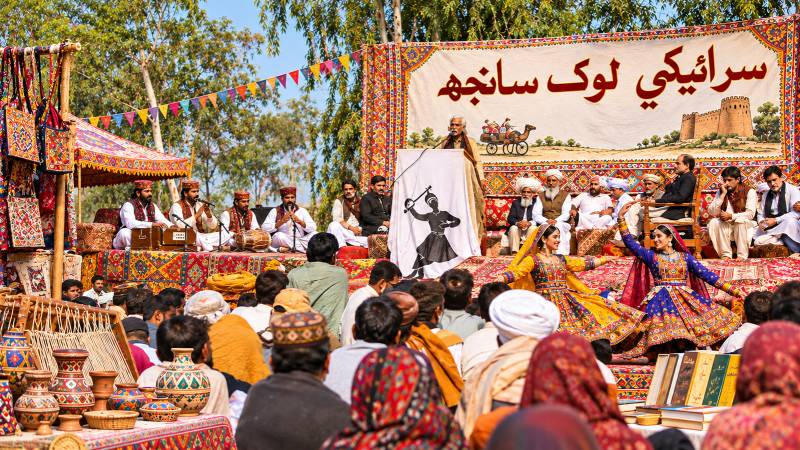
In the mid-1980s, Ustad Fida Hussain Gaadi launched a Siraiki cultural movement named Siraiki Lok Sanjh. A session was held in 1985 at Bangla Korai, Rajanpur, in which prominent Siraiki poets and intellectuals participated. The gathering outlined the aims and objectives of Siraiki Lok Sanjh, which sought to preserve and promote the Siraiki language, literature, folklore, and cultural heritage. The movement also aimed to foster a collective cultural consciousness among the people of the Siraiki Waseeb and bring together poets, intellectuals, artists, peasants, and workers on a common cultural platform. Although primarily a cultural initiative, Siraiki Lok Sanjh played a significant role in awakening awareness of the region’s distinct identity and its social and political rights.
Since its foundation, Siraiki Lok Sanjh has organised an annual festival at Mehray Wala, Rajanpur, a tradition that continues under the patronage of Ashiq Buzdar, famed for his poem Asan Qaidi Takht Lahore Day. The festival played an important role in bringing people together and asserting their long-neglected cultural identity. The movement was nurtured by Ustad Fida Hussain Gaadi, who emphasised cultural activities rather than turning the movement into a political cause. He believed that cultural awakening was the primary means of reviving the identity of the Siraiki Waseeb.
Over time, this cultural movement succeeded in bringing the identity politics of the Siraiki Waseeb to the forefront. One of its major achievements was the recognition of Siraiki as a distinct language in the national census. Siraiki was also introduced as a subject in university curricula, paving the way for scholars to pursue advanced studies and earn Ph.D. degrees in the language. However, with the passage of time, cultural activities alone appeared insufficient to address the political and economic grievances of the Waseeb. Realising the deleterious effects of remaining apolitical, particularly in the face of Lahore’s continued indifference to the region’s development, Siraiki Lok Sanjh decided to make tactical political moves to assert the rights of the Waseeb. The movement now has significant political achievements to its credit. Its workers struggled hard, remained resilient and focused, and eventually made considerable progress.
It is on record that on May 3, 2012, the National Assembly passed a resolution for the creation of a new province in Punjab. The Senate subsequently passed a Constitutional Amendment Bill on March 6, 2013, for the creation of a separate South Punjab province. However, the bill never saw the light of day in the National Assembly owing to opposition from the PML-N. Meanwhile, the Punjab Assembly endorsed the demand for provincial status, but the PML-N, in an apparent attempt to divide the Siraiki Waseeb, championed the creation of two provinces—South Punjab and Bahawalpur.
Siraiki Lok Sanjh sought to preserve and promote the Siraiki language, literature, folklore and cultural heritage while fostering a collective cultural consciousness among the people of the Siraiki Waseeb.
In 2018, when concerted efforts were being made to bring Imran Khan to power, the Junobi Punjab Soba Mahaz was also staged as a political charade. Although the initiative was little more than a political gimmick, it nevertheless demonstrated that the demand for a separate province in Punjab had reached the corridors of power. This, in itself, was a significant achievement for the people of the Siraiki Waseeb. Siraiki Lok Sanjh also holds an annual gathering at Jaisal Klasra, Layyah, towards the end of October, largely through the efforts of Safdar Klasra, the General Secretary of Lok Sanjh. People from all walks of life participate in the event. Spanning three days, the gathering features a variety of cultural and literary activities, with the final day devoted to theatrical performances.
At the conclusion of the gathering each year, a declaration is made public reiterating the demand for a separate Siraiki province. The declaration sets out the historical, political, and economic arguments for provincial autonomy. “Many decades ago our forefathers struggled to gain a Siraiki province. Since the 1960s we have been peacefully gathering in melas, conferences, dialogues and marches all over Siraiki Wasaib to materialize our dream of a new province. Today we gather at Jaisal Klasra, because others have begun to rename it,” says the declaration.
It further states:
“We are counted when Punjab counts its population, its land, its labour, its crops and its votes. We disappear when money is allocated. We call this ‘fiscal’ colonialism. In the Punjab development budget for 2026 to 2027, out of Rs752 billion only Rs76.2 billion can be traced directly to the fourteen districts of Siraiki Wasaib. Lahore alone has Rs113 billion. One city is given more than all fourteen districts of our homeland together. Lahore counts us. Lahore does not pay us. Under the existing NFC formula, if Siraiki Wasaib stood in the federation as a province, its share would be around Rs1,597 billion.”
The declaration thus presents the demand for a separate Siraiki province not merely as a question of cultural identity but also as a struggle for political representation, economic justice, and control over the resources of the Waseeb.