

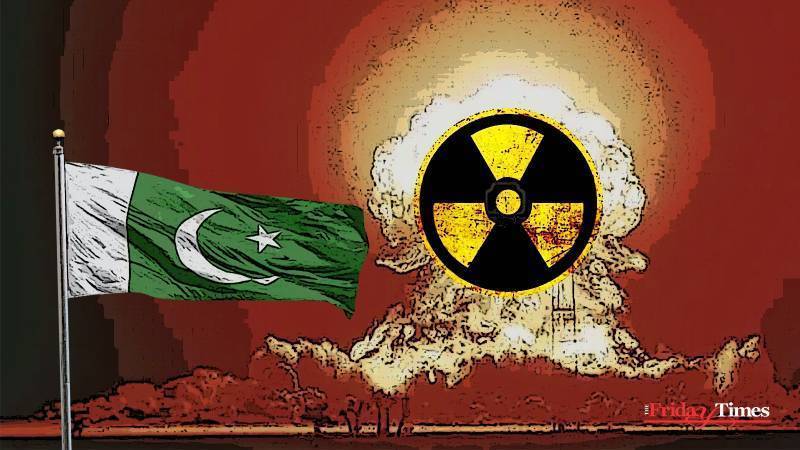
Pakistani senior military official Lt. Gen. Khalid Kadwai, who helped shape the country’s nuclear strategy in the post-nuclear testing environment, and Indian university professor and foreign policy expert Happymon Jacob hardly have anything in common. Khalid Kadwai headed Pakistan’s Strategic Plans Division--which serves as a secretariat for the country's Nuclear Command Authority (NCA). Happymon Jacob is an associate professor of disarmament studies at the School of International Studies, Jawaharlal Nehru University, New Delhi. Khalid Kadwai is leading an almost retired life but is still considered influential in Pakistan’s nuclear and strategic establishment.
Happymon Jacob is considered a highly influential foreign policy expert in India. Both have recently but separately attempted to explain and interpret the post-May 7-10, India-Pakistan conflict and its nuclear and security implications for the military strategies of their respective countries. Khalid Kadwai still serves as an advisor to the National Command Authority (NCA)--the highest decision-making body in Pakistan which controls the country's nuclear weapons and his words would be interpreted as official policy or at least a reflection of official thinking. On May 28 he addressed a seminar in the Institute of Strategic Studies Islamabad on the issues related to the latest conflict between Pakistan and India and its nuclear implications. Whereas Happymon Jacob recently penned a piece titled, ‘Deterrence by Exhaustion’: Nine Elements of India’s Emerging Strategy Against Terrorism”, in which he tried to explain India’s position on issues related to deterrence, military strategy, and lack of nuclear dimensions of the latest conflict.
In the following lines, I have tried to present a comparison of the views of these experts and semi-official figures in Pakistani and Indian nuclear, strategic, and military establishments. Although Happymon Jacob doesn’t have any official capacity, the way he presents the Indian state’s case clearly indicates that his assertions could be taken as a reflection of official thinking on the question of nuclear and military strategy in New Delhi. In his speech, Khalid Kadwai clearly presented the view that the day conflict clearly had a nuclear dimension, and the military strategies of the two countries were clearly defined by the limits imposed on them by the possession of nuclear weapons by both countries.
Happpymon Jacob, however, underplays the nuclear aspect of the conflict and favors the official position that India had called Pakistan’s bluff. Both experts obviously present their respective countries as winners in the recent conflict. Both experts point out what is new in the military strategies of their countries: Kadwai argues that Pakistan’s Air Force has emerged as a new conventional deterrent in the inventory of the Pakistani military after it established complete dominance of the skies over South Asian rival’s territories. Happymon Jacob presents the India view that India’s military would respond to any sub-conventional threat with conventional force and this has become a new normal in South Asia.
India not only wants to take punitive action but also wants to be seen as doing so openly and visibly
Although implicitly both the experts concede the point that the May 7-10 conflict represented the breakdown of nuclear deterrence, both, however present conflicting views on how their respective countries have re-established deterrence in their unique ways. One cannot find any common ground between Kadwai’s speech and Jacob’s piece nor does there appear to have any point of convergence between the views of the two experts. They are travelling on two parallel tracks which under the present circumstances do not seem to have any meeting point. I will use quotations from General Kadwai’s speech and Jacob’s piece to present their viewpoints on questions such as what are the nuclear implications of the May 7-10 conflict? What was the impact of Operation Sandoor and Pakistani Operation Bunyan al Marsoos on the opposing sides' military strategy? What is the new normal, from each country’s perspective? Why and how are nuclear weapons still relevant or not relevant according to each country’s perspective? And other related questions. Afterward, I will present my own conclusions and the emergence of a clear imperative for South Asia that the two countries start direct nuclear talks in order to avoid a big disaster.
In his piece Happymon Jacob lays out the outlines of India’s new military strategy that has emerged after India ignored Pakistan’s nuclear deterrent and launched conventional military strikes across an international border, “This strategy involves publicly declaring a conventional military response to Pakistan, unlike 2016, when actions were unannounced and only acknowledged afterward, and then following through on these commitments. Through the new approach, which entails openly communicating its intentions to Pakistan and the international community, India aims to establish a well-publicised tripwire strategy, which may deter Pakistan from crossing certain red lines. India not only wants to take punitive action but also wants to be seen as doing so openly and visibly. Setting public redlines for the adversary to enhance deterrence is the objective here”.
Pakistan’s Lt General Khalid Kadwai presents a completely different picture of the situation that has emerged in the wake of conventional conflict between the two countries. Kidwai argues that nuclear capabilities on both sides not only figure prominently in the military strategies of the two countries they also figure prominently in the foreign policies of international powers which, during the course of this conflict, showed panic response towards developments in South Asia. “In the Pahalgam escalation, both India and Pakistan while planning their respective operational responses and counter-responses took into account the deterrence effects of the respective nuclear arsenals as well as of the operational technologies in the respective conventional inventories. In my opinion, both capabilities exercised a profound influence on the response options and decision-making of not only India and Pakistan but also of the international community” Kadwai says in his speech.
“On each occasion, Pakistan’s nuclear weapons capability has emerged as not only a guarantor of Pakistan’s national security but also as a guarantor of peace and stability in South Asia by keeping India’s aggressive designs in check. Whether it was India’s Operation Brasstacks of 1986 cleverly wrapped in the garb of an exercise, Operation Parakaram of 2001-2002 lasting nearly 10 months of futile deployment, or the failed so-called strategic strikes of 2016 and 2019, it is Pakistan’s nuclear capability which has continued to consistently generate two simultaneous strategic effects on every occasion. One, the nuclear capability, silently visible on the horizon in the background, deters India’s larger war designs and curtails the application of its military choices against a nuclear Pakistan. Two, the nuclear capability invariably shakes and spurs the international community into timely action to prevent things from going out of hand between two heavily armed nuclear powers. It is in nobody’s interest to have a global Armageddon. All in all, Pakistan’s nuclear capability retains the promise of being The Great Equalizer against a much larger adversary”.
If you focus on Pakistan’s conventional pushback against India’s conventional response, you will miss the point; the point is the rising costs Pakistan has to pay with each iteration of this back and forth
Interestingly and ironically, the two experts didn’t even care to comment on each other's concerns about cross-border terrorism that each side alleges emanates from the other side of the border. General Kadwai accuses India of conducting a terror campaign in Pakistan’s Balochistan and Khyber Pakhtunkhwa provinces under the nuclear umbrella and complains that the West doesn’t seem to care about it. Jacob on the other hand states that since the 2001 attack on the Indian parliament India has gradually raised the cost of sub-conventional attacks on Indian soil, “Since the 2001 Parliament attack, there has been a gradual escalation in the intensity of India’s response to terrorism, culminating in the 2025 Pahalgam attacks. The most intense Indian response to terrorism so far was seen this month, which combined unprecedented degrees of kinetic and non-kinetic responses. The underlying idea is that if Pakistan uses terrorism as a cost-effective strategy to pressure India and internationalise Kashmir, India’s response should aim to make Pakistan’s strategy costly and unsustainable. Expecting Pakistan not to respond conventionally is unrealistic, but the message about assured conventional retaliation to terror strikes by India is unlikely to be missed out on in Pakistan. If you focus on Pakistan’s conventional pushback against India’s conventional response, you will miss the point; the point is the rising costs Pakistan has to pay with each iteration of this back and forth”.
Jacob argues India’s aim is to operate below the nuclear threshold in order to respond to sub-conventional threats from Pakistan with conventional force without provoking Pakistan’s nuclear response, “As for the military response, India clarified beforehand that it was solely targeting terrorist infrastructure, avoiding civilian or military targets. The Indian objective is to carve out a distinct space above the sub-conventional domain and below the nuclear domain where it can undertake punitive actions in order to respond to terror attacks. So far it has succeeded in doing so. If you focus on the decent job Pakistan may have done in this space, you will miss the point – the point is that India has managed to create this clear and distinct space for future operations if necessary”.
Jacob also argues that India’s strategy is long-term — seeking to exhaust Pakistani resources and capabilities through an extended limited conflict. While Pakistan, having singularly gamed India as its sole strategic challenge for decades, is likely to showcase great performance in the conventional domain, it will find it hard to sustain such a decent performance ever in the long run. The objective is to highlight this and convince Pakistan that in the longer run, the payoff structure is skewed against it if it continues to support or encourage terrorism against India. This policy is based on the belief that over time, India’s consistent conventional responses will influence Pakistan’s incentive structure, leading Pakistan to face high costs with minimal or no returns. India hopes that this will force Pakistan to abandon/modify its sub-conventional strategy.
Lt General Khalid Kidwai argues that India’s determination to challenge the concept of deterrence by conducting a false flag operation was followed by a politically driven commitment trap compelling India to break deterrence, escalate, and physically commit forces to kinetic offensive actions by striking targets inside Pakistan and in Azad Kashmir, thereby compelling Pakistan, in turn, to undertake appropriate kinetic retaliatory actions in order to re-establish deterrence.
In Kadwai’s words one of the indications that nuclear weapons remained relevant in the Pak-India military equation was the fact that India remained afraid to mobilise its Cold Start Doctrine and restricted its military action to a much less ambitious strategy, “Please note that the much deliberately conceived and prepared for over a decade, the much invested-in and the much-hyped Cold Start Doctrine did not figure out in the Indian military’s response option. There were no reorganised Independent Battle Groups (IBGs) striking Pakistan to make their bridgeheads within 48-96 hours of an alleged terrorist event, there were no Theatre Force Reserves (TFRs) mobilising rapidly as follow-on forces to join the early battles for a breakout. There was no rush to capture Pakistan’s sensitive spaces while remaining below Pakistan’s nuclear threshold. For all practical purposes, the Indian Army went missing in action. Resultantly, it now appears that the Cold Start Doctrine has been given a formal decent burial or perhaps a cremation. The Cold Start Doctrine figured out neither in February 2019 nor in May 2025.”
Not only would Pakistan’s nuclear weapons continue to influence India’s military planning, but India would now be faced with a Pakistani conventional deterrent in the shape of the powerful Pakistan Air Force, which has emerged as a dominant air power in South Asia
“The Indian DRS response strategy is in itself a major climb down from the Cold Start Doctrine because the Indian military probably concluded that the Cold Start Doctrine was much too ambitious to be undertaken given the strategic balance prevailing in the South Asian nuclear environments. It is clear by now that Pakistan’s robust nuclear weapons capability and the linked international reactions that come into play became the reason for the Indian operational climb down from the Cold Start Doctrine to a relatively less ambitious Dynamic Response Strategy”.
Kadwai argues that not only would Pakistan’s nuclear weapons continue to influence India’s military planning, but India would now be faced with a Pakistani conventional deterrent in the shape of the powerful Pakistan Air Force, which has emerged as a dominant air power in South Asia. “Air superiority has changed hands. The PAF is now the dominant air power in South Asia. This is the new normal. Mr Modi and the IAF might have noted it by now however reluctantly. Further, the new normal is that this dominance gap is likely to be widened with even greater technology inductions in the PAF in the near future”
“The new normal is that the battle-proven conventional deterrent of the Pakistan Air Force has assumed a leading deterrence role in South Asia.
The new normal is that Pakistan’s robust nuclear deterrence will continue to exercise strategic level deterrence in order to constrain and curtail India’s political and operational objectives and choices thereby ensuring the maintenance of relative peace and strategic stability in South Asia.
Why are direct talks on nuclear issues the need of the hour?
General Kadwai’s speech and Jacob’s piece are not Pakistan’s and India’s official policy statements. But we can safely assume that both of these pieces reflect official thinking in Islamabad and New Delhi. There seems to exist no common ground between these two positions: General Kadwai, a true representative of the Pakistan security establishment, is not ready to part company with the old assumptions about the relevance of its nuclear weapons. On the other hand, Jacob is representative of Indian official thinking when he out-rightly discounts Pakistan’s nuclear weapons as relevant in the new realities that, in his views, have emerged in the wake of the May 7-10 conflict. There are no direct talks between Pakistan and Indian officials on nuclear issues and there are no chances that such talks will occur in the near future.
In the wake of May 1998 nuclear tests, Washington jumped in to coax both New Delhi and Islamabad to hold direct nuclear talks. Washington held bilateral talks with New Delhi and Islamabad separately to tutor them in the handling of nuclear weapons and their political and strategic implications. After the Lahore Summit between Pakistani and Indian prime ministers, the two sides agreed to hold nuclear talks at the foreign secretary level in which they agreed to exchange views on each other's nuclear doctrines and strategies. The two also agreed to work out new military and nuclear confidence-building measures (CBMs). At present the hotline between Director Generals of Military Operations (DGMOs) is the only link between the two nuclear states. The two countries only a few weeks ago lobbed nuclear-capable missiles on each other’s military installations, most of which are located in the center of urban areas. While they were firing nuclear-capable missiles and rockets into each other’s territory there was no official communication link between the two sides through which they could have conveyed to the other side that their missiles and rockets were not mounted with nuclear warheads. This time there was no miscalculation but there is no guarantee that there will be none if the two sides again come to blows.
Worsening the situation still more is the fact that the two sides are clinging to the idiotic conception of deterrence. The assertions from both sides indicate that they seem to believe that inflicting pain and instilling fear in the hearts and minds of the adversary is the only way to achieve deterrence, “a false flag operation, was followed by a politically driven commitment trap compelling India to breakdown deterrence, escalate and physically commit forces to kinetic offensive actions by striking targets inside Pakistan and in Azad Kashmir, thereby compelling Pakistan, in turn, to undertake appropriate kinetic retaliatory actions in order to re-establish deterrence” Says General Kadwai. Similarly, Jacob also thinks that India’s military strikes established deterrence against Pakistan’s use of sub-conventional threats against India. This is not only coming from semi-official personages but reflects the official thinking as represented in statements coming from leaders and officials. Pakistan has a right to complain that India is deliberately undermining Pakistan’s nuclear deterrence by violating Pakistan’s red lines. India, on the other hand could complain that their nuclear deterrence has been repeatedly undermined by the Pakistani side when it used sub-conventional threats against Indian territory. The only way to come out with stable nuclear deterrent relations is to start talking directly. Pakistan and India’s stable nuclear deterrent could only be established on two principles: a) if Pakistan’s nuclear weapons could deter and neutralise India’s conventional military superiority, and b) if this deterrence relation ensures that sub-conventional threat against India is neutralised. For this to materialise Pakistan and India should hold sustained nuclear dialogue.
For nuclear deterrence relations to remain stable, there needs to be a stable political environment in the region. Obviously, we cannot ignore the Kashmir issue. Similarly, India has added a new source of instability by threatening Pakistan with economic strangulation after it held the Indus Water Treaty in abeyance. How the Indus Water Treaty is relevant in nuclear debate, let's turn to General Kadwai’s speech in order to find out, “No discussion on the current escalation will be complete without addressing India’s action of holding the Indus Water Treaty in abeyance. It is a life-and-death challenge thrown at Pakistan. Pakistan’s National Security Committee (NSC) wasted no time in taking up the challenge by clearly declaring that any Indian tinkering with Pakistan’s share of water from the three allocated rivers, that is, the Indus, the Jhelum, and the Chenab, will be treated as an act of war and therefore, will be responded to accordingly”
“In this context, I would ideally first like to advise India not to test Pakistan’s resolve. There are innumerable occasions in the past when India tested Pakistan’s will and resolve, and did not find Pakistan wanting in an appropriate response. Nevertheless, in case India wishes to continue on the path of provocative insanity, it will find that Pakistan has a variety of non-kinetic and kinetic tools in its toolbox to address the act of war. On the response rung, these may range from the lowest, that is, dialogue as provided for in the Treaty itself, to the ultimate. I shall only recall to refresh the Indian leadership’s memory that in Pakistan’s oft-quoted four nuclear thresholds, point number three clearly identifies economic strangulation as one of them. Do not test Pakistan’s resolve. Pakistan will never permit economic strangulation”. Thus stability in Pak-India relations could come only as part of a comprehensive package, not in isolation.