

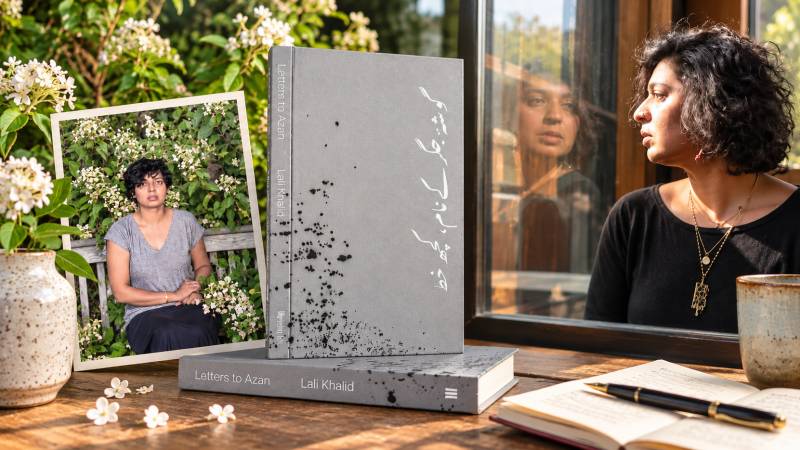
Letters to Azan by Lali Khalid, an accomplished artist and educator, is a window into her evolving craft and creative journey that traverses deeply personal and implicitly political orbits. The collection is a reckoning with loss and a celebration of the hope and ultimate redemption in love that we all seek at different stages of our lives.
Khalid’s personal story has crisscrossed with the mythical. She and Azan, the key protagonist in this collection, were split apart by a colour and gender-blind legal system. For years, Khalid has been fighting a custody battle in the Midwest, resulting in long periods of separation and hard-earned holidays with her son. There is intimacy and unshakeable bonding between Khalid and her son, but there are also visible lingering shadows of longing and loss. This is where the medium of photography transforms everyday images into a multilayered, complex narrative.
Khalid has found new dimensions in her layered practice over the years. From an exploration of the self and identity to engagement with the cultures of her adopted homeland, Khalid has covered many a theme using no-holds-barred experimentation with her craft. This body of work is perhaps her most personal, as it delves into a primordial relationship: mother and son. The photographic representations of Khalid and her son Azan, interspersed with handwritten notes, employ the age-old motif of Madonna and Child.
In the classical images, the Madonna speaks to us in different ways. While she is usually with the son (Jesus), there are images in which she is alone, sometimes brooding or deep in reflection. She can also be seen in various positions and hues, and there are times when she is less formal. It was during the Renaissance that more personable and informal representations of Madonna and Child emerged. These popular depictions travelled throughout the world and can be found in the Indo-Islamic art of the sixteenth and seventeenth centuries. Indian artists working under the patronage of the Mughal Court sought inspiration from illustrated copies of texts introduced by Jesuit missionaries and European traders. The Islamic tradition also celebrates Mary as the pious woman, and there is an entire chapter of the Holy Quran named after her. In part, these themes are a continuation of the feminine Divine representation embedded in the belief systems of many ancient civilizations.
The modern representations have continued to engage with the motif but have subverted it and made it even more worldly and mundane; almost bringing the heavenly to a gritty, messy earth. The iconography, however, remains timeless and relevant. Khalid inherits these multiple traditions as a Pakistani American born in a Muslim household in Lahore, Pakistan. She trained at the National College of Arts in Lahore — a school set up by the British colonial authorities and later at Pratt Institute in New York. It is therefore unsurprising that these themes are reflected in her work, along with the strong emphasis on textual imagery present in almost all artistic traditions.
Khalid’s work is also a strong critique of the American legal system, and of how the much-touted value of ‘motherhood’ in conservative and primarily Christian America can be dispensed with for the ‘other’.
The opening image of a letter entitled “Sabar” (or patience, forbearance) is illustrative. It speaks of the necessity to inculcate patience, almost a charitable stoic quality. But it also hints at the frustrating nature of the court battles Khalid has been engaged in. Another note cites a popular poem in Punjabi by Munir Niazi, a celebrated Pakistani poet:
the ways were hard, somewhat
the sorrows collared my neck, as well
the townsfolk were harsh, somewhat
the death wish, I had, as well
translation by Jasdeep Singh
There is togetherness, anxiety, and a certain measure of remorse in these photographs. Niazi’s lines reflect on that: a wish to reconsider, to reimagine a life that may have led to a different plight for our Madonna and Child.
Khalid, however, does not limit herself to traditional or modern iconography. She expands it in her oeuvre and embraces elements from her cultural tradition: the presence of extended family in what is often considered personal in Western sensibilities. Notes from Khalid’s sister and mother and images of her parents appear in the visual landscape. This is Azan’s maternal universe, wherein the central figure of the mother is haloed by the extended family. It is both a reflection of the immense love that he receives and of the ruptured communications from them. The handwritten notes exist as little pieces in this love-puzzle. They also contextualize the photographs and the fragile scenes.
One haunting photograph shows upside-down colourful balloons. Another depicts a slightly open closet door. Some images are luscious and borderline blank, waiting to be filled in — like a mother’s lap, or her home after a long wait, a court-ordered reunion or a farewell.
Letters to Azan builds on Khalid’s earlier work, which was striking for the multiplicity of self-portraiture. There are some remnants of this style here too, with the artist appearing as a mother, or pensive on her own. But the addition of Azan and the placement of modern, earthly epistles indicate that the artist is breaking her own mould and unwittingly expanding the range of age-old iconography.
Khalid’s work is also a strong critique of the American legal system, and of how the much-touted value of “motherhood” in conservative and primarily Christian America can be dispensed with for the “other.” Khalid is a Muslim woman of colour, an immigrant, and the mother of a half-White child, and this collection tells a riveting, heartbreaking story without aesthetic manipulation. The stark honesty and profound love central to these images stand in sharp contrast to the climate of disinformation, fear, and divisions that have shaken the world we live in.