

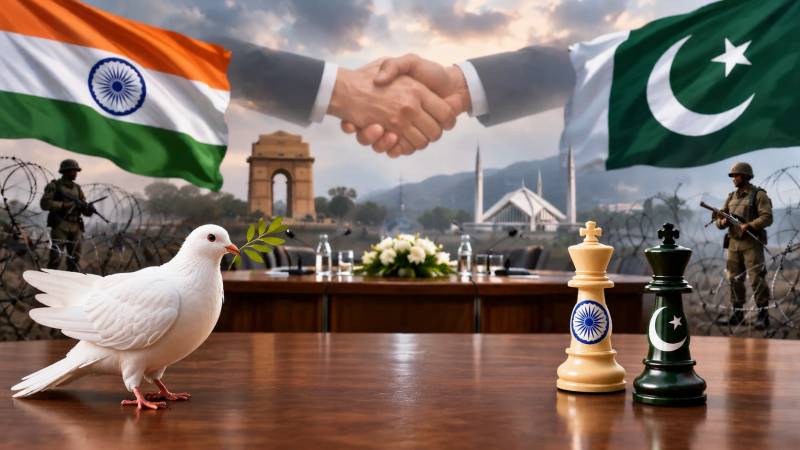
There was a time, in the not-so-distant past, when innovation and creativity were the hallmarks of the Indo-Pakistan peace process. Track-I, Track-II and Track-III diplomacy were central to the peace process, and until the 1990s and early 2000s, the two countries remained engaged at both official and unofficial levels in seeking a breakthrough in the normalisation of relations. However, following the Mumbai terrorist attacks in November 2009, the Pulwama incident in 2019, the Pahalgam attack in 2025, and the promulgation of the Jammu and Kashmir Reorganisation Act on 5 August 2019, New Delhi and Islamabad reversed the course of the peace process, leading to one of the worst standoffs in their bilateral relations.
What is a peace process, and how is it considered an innovative way of managing and resolving complex conflicts? How did the Indo-Pakistan peace process, which for years remained a source of optimism and hope for improving relations between New Delhi and Islamabad, reach a point where the two neighbours witnessed a steady deterioration in bilateral relations, accompanied by the erosion of trade, commercial, travel and communication links? To what extent has the Modi regime contributed to the deterioration of relations with India's only western neighbour, Pakistan? And why has Indian civil society remained largely silent in the face of the aggressive designs of the BJP government towards Islamabad?
According to ScienceDirect.com, "A peace process is defined as a formal process in which warring parties decide to settle their incompatibility through agreements that may regulate one issue at a time or build upon previous agreements. Peace processes can take various forms depending on the conflict context and may involve multiple phases and different aims beyond immediate conflict termination." According to the Berghof Foundation, Berlin, a "peace process means a series of talks, agreements and activities designed to end war or violence between two groups. Peace processes may include formal and informal mechanisms, and involve a multitude of actors often over a long period."
A viable peace process requires several essential elements, including political will, determination, a timeline, a win-win approach and a shared vision. The examples of the Arab-Israeli peace process, the Northern Ireland peace process, and the peace processes in Bosnia and Herzegovina and Sri Lanka demonstrate how conflicting parties, despite years of armed hostilities, eventually agreed to initiate dialogue and negotiations. The Indo-Pakistan peace process is a case study that centres on a range of contentious issues, including Kashmir, Sir Creek, water-sharing, trade and the Siachen conflict.
The prevailing standoff in Indo-Pakistan relations provides a valuable opportunity to relaunch the peace process by resuming dialogue, which was disrupted following the Mumbai terrorist attacks. However, a breakthrough requires reciprocity, political will and determination on both sides. When the Composite Dialogue was launched between India and Pakistan in 1997, it encompassed all major bilateral issues, ranging from Kashmir and the Siachen Glacier to nuclear proliferation, terrorism, Sir Creek, water-sharing and trade. For nearly two decades, the Composite Dialogue formed the core of the peace process and gave considerable impetus to Track-I diplomacy. However, with the gradual deterioration of Indo-Pakistan relations following the Mumbai terrorist attacks in November 2008, the Composite Dialogue also suffered a setback. When the BJP returned to power in 2014, with Narendra Modi as Prime Minister, his antagonism towards Pakistan became increasingly evident. Blaming Pakistan for cross-border terrorism, he brought the dialogue process with Islamabad to a halt.
For nearly two decades, the composite dialogue provided a framework for addressing Kashmir, Siachen, Sir Creek, water disputes, terrorism and trade. Its suspension has deepened the diplomatic standoff between the two neighbours.
The question of how to revive the Indo-Pakistan peace process needs to be examined from three perspectives. First, as long as the Modi regime remains in power, the prospects for a meaningful peace process with Pakistan appear limited because, for domestic political consumption, sustaining animosity towards Islamabad remains politically advantageous for New Delhi. While India does not feature as a major issue in Pakistani general elections, the situation is different in India. The BJP frequently invokes the Pakistan factor to mobilise domestic political support. However, in the 2024 Indian general elections, the BJP, despite its anti-Pakistan rhetoric, failed to secure an outright majority. The Modi regime continues to seize every opportunity to malign Pakistan and use it to generate popular support.
Unfortunately, the absence of a peace process in Indo-Pakistan relations comes at the expense of trade and development. However, a peace process cannot be initiated automatically. It must emerge organically, with ownership by the political and economic elites of both countries. The reality is that conflict has become a source of political and economic sustenance for the power elites in India and Pakistan. For them, the continuation of conflict provides justification for increasing military expenditure, without recognising that such a policy is detrimental to the interests of ordinary citizens.
Second, the constituency supporting the Indo-Pakistan peace process remains limited. Despite the progress made during the Composite Dialogue in the late 1990s and its positive impact on bilateral relations, hardline elements on both sides managed to derail the dialogue process, which had gained momentum following the Lahore Declaration of February 1999.
At present, Indo-Pakistan relations are at their lowest ebb. Following the revocation of Article 370 of the Indian Constitution and the subsequent reorganisation of Jammu and Kashmir, diplomatic relations between the two countries were downgraded, while air, road, rail and trade links were suspended. Visa issuance has also become highly restrictive, effectively freezing bilateral relations, with little indication of an imminent resumption of the peace process.
When mistrust, suspicion, hatred, anger and antagonism become defining characteristics of Indo-Pakistan relations, there is little room for sanity and reconciliation. The recent news conference by Pakistan's Federal Minister for Climate Change and Environmental Coordination, Musadik Malik, in New Delhi, on the sidelines of the SCO Civilisational Dialogue Forum, is a case in point. He emphasised that both countries needed to adopt a pragmatic approach and take steps to eliminate the longstanding atmosphere of mistrust and suspicion. He also maintained that India's allegations of Pakistan sponsoring cross-border terrorism lacked credible evidence and that India's decision to suspend the Indus Waters Treaty was unfair and illegal.
Ultimately, the only way to revive the peace process is by restoring travel, trade and communication links. India's suspension of the Indus Waters Treaty is detrimental to efforts aimed at establishing peace and stability in the region. Both countries must recognise that meaningful damage-control measures to normalise Indo-Pakistan relations cannot be undertaken without political will and determination on the part of New Delhi and Islamabad.
Reviving the peace process is the need of the hour, provided the Modi regime reverses its anti-Pakistan rhetoric and stops blaming Islamabad for sponsoring cross-border terrorism. Furthermore, India needs to reverse the measures introduced through the Jammu and Kashmir Reorganisation Act of 5 August 2019 and restore statehood to Jammu and Kashmir. India's suspension of the Indus Waters Treaty, which the author argues is contrary to international legal principles and relevant international judicial decisions, also needs to be reversed. Nearly two decades of damage to Indo-Pakistan relations cannot be undone overnight. A serious consideration of the military and non-military confidence-building measures proposed and agreed upon a couple of decades ago is essential to reviving the peace process between the two countries.
The revival of Track-I, Track-II and Track-III diplomacy is also essential to giving the peace process a fresh start. Currently, all three tracks remain frozen. Official dialogue under Track-I is not taking place, while unofficial engagement under Track-II, traditionally facilitated by individuals and institutions with the support of official channels, is also largely absent. Track-III diplomacy, which involves purely unofficial initiatives, has also come to a standstill. This track was institutionalised through initiatives such as the Indo-Pakistan People's Forum for Peace and Democracy, launched in Lahore and Delhi in the mid-1990s.
However, despite the prevailing pessimism in Indo-Pakistan relations, the prospects for reviving the peace process should not be dismissed. The future of more than 1.8 billion people in South Asia depends, to a considerable extent, on dialogue between India and Pakistan. The future of SAARC also hangs in the balance because of the Indo-Pakistan standoff. On these grounds, both New Delhi and Islamabad must adopt a pragmatic approach towards peace so that future generations do not have to carry the burden of historical animosities and can move forward.