

The recent emotionally charged speech delivered by Khyber Pakhtunkhwa Chief Minister Sohail Afridi in the provincial assembly has spotlighted the intensifying frictions in Pakistan’s civil–military relations, portraying military operations in Pashtun regions as part of a longstanding cycle of exploitation. By aligning himself and his party as staunch supporters of Imran Khan and dismissing secretive decisions imposed from above, Afridi issued a stark warning that continued encroachments could ignite outright resistance.
This episode illuminates profound structural fissures in Pakistan’s governance, where the military extends far beyond its role as a guardian of borders to wield ultimate influence over the nation’s direction.
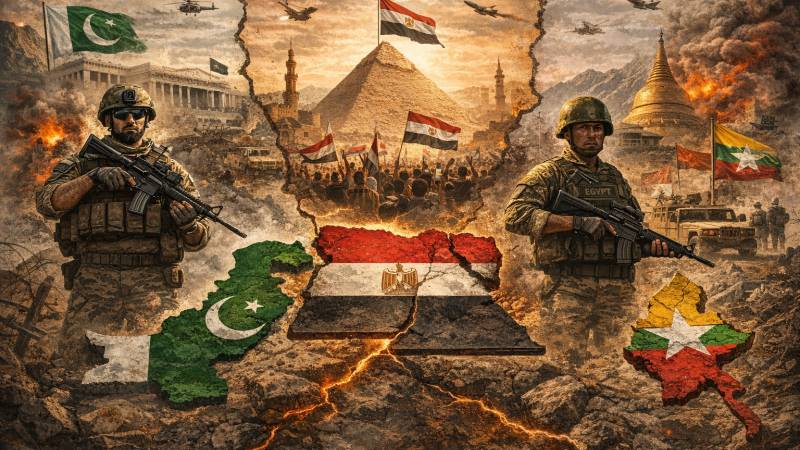
Such dynamics are far from isolated, resonating across other post-colonial nations where armed forces have similarly overstepped into realms of politics, economics, and ideology, often under the guise of preserving unity or stability. Egypt and Myanmar, alongside Pakistan, offer compelling parallels, each shaped by inherited colonial frameworks that bolstered military hierarchies, lingering ambiguities in national identity, and strategic global positions that have insulated their militaries from external accountability.
Yet, the paths these countries have taken over the past two decades diverge significantly, influenced by the interplay of ethnic divisions, population dynamics, and the evolving mechanisms of societal pushback. This exploration delves into the patterns of military ascendancy in these three states, emphasising how insurgent landscapes, ethnic undercurrents, and the bedrock of resistance have moulded their respective fates.
At its core, the narrative reveals that military might, while formidable, encounters varying degrees of sustainability and backlash depending on a society’s ethnic mosaic, youthful energy, and capacity for organised dissent.
Pakistan: Hybrid Control Amid Ethnic and Digital Resistance
In Pakistan, the military’s grip on power has not waned but rather morphed from overt dictatorships to a more nuanced hybrid system. Following eras of direct governance under figures like Ayub Khan, Yahya Khan, and Zia-ul-Haq, the period after 2008 introduced a façade of civilian-led democracy, where elections occur, and parliaments convene, yet pivotal choices in defence, diplomacy, and even domestic policy remain firmly in the hands of military headquarters in Rawalpindi.
The real peril emerges from political opposition that harnesses ethnic bonds and democratic mandates, outstripping the immediacy of armed threats
The dramatic downfall of Prime Minister Imran Khan in 2022, widely viewed as engineered by the establishment, ignited a wave of division and crackdowns on his Pakistan Tehreek-e-Insaf party, culminating in a profound erosion of trust in the system. The elections of 2024, riddled with claims of rigging, only deepened this scepticism, rendering democratic processes increasingly theatrical.
As the mid-2020s unfolded, legal amendments solidified this imbalance, granting the army chief greater autonomy and shielding top brass from judicial scrutiny, while the military’s economic empire ballooned through vast holdings in property development, transportation, farming, and industry. This created an interlocking web of influence that sustains itself independently of civilian oversight.
Amid this consolidation, resistance has begun to crystallise around ethnic narratives, particularly in Pashtun-dominated areas like Khyber Pakhtunkhwa and the erstwhile tribal regions, where repeated security campaigns since the early 2000s have led to widespread upheaval, loss of life, and forced relocations. Afridi’s address captures this sentiment, decrying a legacy of undervalued Pashtun sacrifices and signalling a readiness for provincial pushback that could redefine centre–periphery relations.
What sets Pakistan’s insurgent challenges apart is their containment, preventing rebels from establishing lasting footholds. In the rugged expanses of Balochistan, groups like the Baloch Liberation Army and Baloch Liberation Front launch sporadic strikes against state assets, personnel, and foreign investments, but these remain confined to remote pockets. This allows the government to secure cities, roads, and bureaucratic hubs.
Similarly, in the north-west, outfits such as the Tehreek-e-Taliban Pakistan rely on hit-and-run tactics and coercion rather than outright administration, even as their activities surged following shifts in neighbouring Afghanistan. This managed chaos actually bolsters the military’s rationale for its expansive role, framing unrest as a perpetual security imperative rather than a symptom of governance failures.
However, the real peril emerges from political opposition that harnesses ethnic bonds and democratic mandates, outstripping the immediacy of armed threats. Pakistan’s strikingly young population, with half under 23 years old, amplifies this through pervasive digital connectivity. Smartphones have democratised information, enabling parties like Imran Khan’s to craft compelling stories of institutional overreach that spread virally, fostering a Pashtun-led and youth-fuelled movement against perceived marginalisation.
Unlike the contained skirmishes in Pakistan or the subdued unrest in Egypt, Myanmar’s military hubris has birthed a multifaceted war that exposes the perils of imposing uniformity on an inherently diverse populace
In terms of territorial control, the Pakistani military maintains firm dominance over approximately 80 per cent of the country’s landmass, including all major urban centres like Karachi, Lahore, and Islamabad, key transportation corridors such as the Karakoram Highway and the China–Pakistan Economic Corridor routes, and administrative districts across Punjab and Sindh provinces. Insurgent activities are largely restricted to less than 20 per cent of peripheral areas, such as parts of Balochistan’s Makran division and isolated valleys in Khyber Pakhtunkhwa, where militants operate covertly without holding formal governance structures.
Egypt: Consolidated Autocracy Through Homogeneity and Economic Embedment
Turning to Egypt, the story unfolds as one of unyielding military consolidation, rooted in a foundation of cultural and ethnic uniformity that facilitates unchallenged authority. Since the Free Officers’ revolution in 1952, the armed forces have formed the state’s unassailable core, with the fleeting democratic experiment sparked by the 2011 Arab Spring swiftly quashed by Abdel Fattah el-Sisi’s 2013 takeover, which reinstated military primacy behind a thin veil of electoral politics.
Over recent years, this regime has fortified its position through massive investments in armament, including multibillion-dollar deals for advanced vehicles, unmanned systems, and infrastructure enhancements in volatile areas like the Sinai Peninsula. At the same time, it has positioned Egypt as a regional powerhouse through defence exhibitions and proposals for collaborative Arab security initiatives.
Economically, the military’s tentacles reach into everyday essentials, overseeing everything from infrastructure projects to consumer goods manufacturing, weaving its influence into the fabric of society and ensuring dependency on its benevolence. Egypt’s relative homogeneity, where the vast majority identify as Arab Muslims, plays a pivotal role here, muting the potential for ethnic-based uprisings and allowing the military to project itself as an impartial steward of the nation.
While divisions along religious or ideological lines, such as between Islamist factions and secular elements, persist, they lack the geographic anchors that could sustain prolonged rebellions. This stability is further cemented by adept handling of demographic pressures.
Egypt’s large, youthful populace lives in a densely packed environment, but the state has mastered suppression through pervasive monitoring, mass detentions, and domination of online spaces. What once served as tools for revolutionary fervour, social networks, have been repurposed into instruments of control, exemplifying how authoritarian regimes can evolve to neutralise threats rather than succumb to them.
Border fortifications and international engagements, from African diplomacy to counter-terrorism alliances, reinforce this edifice, making Egypt a model of resilient military rule where opposition is systematically dismantled before it can gain traction. Notably, the Egyptian military exercises near-total territorial sovereignty, controlling over 95 per cent of the nation’s land, including the densely populated Nile Delta and Valley regions, major cities like Cairo and Alexandria, and strategic zones such as the Suez Canal and Sinai Peninsula, with only minor pockets of unrest in remote desert areas quickly contained through superior firepower and intelligence networks.
Myanmar: Fragmentation and Territorial Erosion in Ethnic Diversity
In stark contrast, Myanmar presents a cautionary tale of military ambition unravelling into national disintegration, exacerbated by profound ethnic cleavages that have turned overreach into outright fragmentation. The Tatmadaw’s seizure of power in 2021, intended to reassert control after a decade of tentative reforms, instead plunged the country into chaos, eroding the very state it sought to preserve.
The ensuing conflict has seen the junta cling to urban strongholds and aerial superiority, but at the expense of vast rural and border territories now under the sway of ethnic militias and people’s defence units. By the mid-2020s, attempts at legitimacy through manipulated elections faltered amid boycotts and violence, with voting suspended in numerous areas due to ongoing strife, while economic ruin and humanitarian disasters compounded the regime’s isolation.
As post-colonial landscapes continue to evolve, the ability of these systems to adapt or fracture will not only define their internal trajectories but also shape the broader future of authoritarian governance
Myanmar’s mosaic of more than 135 ethnic communities fuels this volatility, blending widespread anti-dictatorship sentiment with demands for autonomy, resulting in patchwork governance where groups like the Arakan Army administer their enclaves with parallel institutions. This not only undermines central authority but also hinders any unified vision for the future, as alliances among rebels remain fluid and often self-interested.
The radicalisation of Myanmar’s younger generations, scarred by brutality, has been a driving force, with digital platforms, despite intermittent blackouts, enabling resource sharing, strategic coordination, and global outreach. Vulnerable populations, such as the Rohingya, endure amplified perils amid the turmoil, highlighting how repression can backfire, galvanising rather than pacifying society.
Unlike the contained skirmishes in Pakistan or the subdued unrest in Egypt, Myanmar’s military hubris has birthed a multifaceted war that exposes the perils of imposing uniformity on an inherently diverse populace. Regarding territorial control, the Myanmar military holds sway over roughly 40 per cent of the country, primarily encompassing central urban hubs like Yangon, Mandalay, and Naypyidaw, as well as key industrial zones and some internal waterways.
It has ceded effective authority over about 60 per cent of the territory, including extensive border regions with Thailand, China, and India, vast rural heartlands in Shan and Karen states, and critical trade arteries such as the Myawaddy–Mae Sot crossing, where ethnic armed organisations now impose taxes, provide services, and maintain order.
Comparative Insights: Diverging Trajectories of Military Dominance
When weaving these threads together, the divergences become illuminating, particularly in how ethnic composition intersects with territorial control and resistance mechanisms. Egypt’s near-monolithic ethnic makeup, with over 90 per cent Arab Muslim identification, enables a form of autocracy that withstands challenges with relative ease, as the military’s control over 95 per cent of territory faces no geographically rooted ethnic insurgencies.
Instead, opposition is ideological and urban-centric, easily quelled through a security apparatus that monitors a population where youth comprise about 60 per cent but are demographically concentrated in controllable Nile-adjacent areas. In contrast, Pakistan’s ethnic diversity, encompassing Pashtuns at 15 per cent, Baloch at 3 per cent, and others, manifests in contained insurgencies that allow the military to retain dominance over 80 per cent of the land.
Yet this comes at the cost of eroding legitimacy, as digital mobilisation among a median age of under 23 reaches over 70 per cent smartphone penetration, turning ethnic grievances in peripheral zones into nationwide political narratives that challenge the hybrid regime’s façade.
Myanmar, with its 135-plus ethnic groups, including the Bamar at 68 per cent, but minorities controlling armed forces, exemplifies the extreme. Military territorial hold has shrunk to 40 per cent, as ethnic fragmentation aligns with geography, enabling rebels to seize 60 per cent of land through sustained warfare.
Youth radicalisation, with a median age around 29, is amplified via resilient social media networks that coordinate across divides, resulting in higher governance costs and state incoherence.
Granularly, the economic roles diverge factually as well. Egypt’s military controls 20 to 30 per cent of the economy through state-owned enterprises, embedding it sustainably without ethnic backlash. Pakistan’s conglomerates account for 10 to 15 per cent of GDP, fuelling resentment in ethnically marginalised provinces like Balochistan, where resource extraction benefits the centre.
Myanmar’s junta, weakened by sanctions and war, sees its economic influence plummet to under 10 per cent effective control, as rebel-held areas develop parallel economies. Demographically, Egypt’s 105 million people, with 25 per cent under 15, are urbanised at 43 per cent, aiding surveillance.
Pakistan’s 240 million, with 35 per cent under 15 and 37 per cent urban, leverage federalism for ethnic resistance. Myanmar’s 55 million, with 24 per cent under 15 and 31 per cent urban, fragment into rural strongholds.
Insurgent geography further differentiates these cases. Egypt’s minimal threats are confined to 5 per cent of the land in Sinai. Pakistan’s are in 20 per cent peripheral zones without rebel governance. Myanmar spans 60 per cent with an active rebel administration.
These fact-based variances underscore ethnicity as the linchpin. Homogeneity sustains low-cost rule in Egypt, contained diversity breeds legitimacy crises in Pakistan, and deep fractures precipitate territorial collapse in Myanmar. Youth and technology amplify pushback where control slips.
Conclusion: Comparative Lessons on the Sustainability of Military Rule
This comparative lens on Egypt, Myanmar, and Pakistan underscores a spectrum of military endurance, from Egypt’s fortified stability born of ethnic unity and comprehensive territorial dominance that minimises resistance costs through adaptive repression, to Pakistan’s resilient yet beleaguered hybrid model where contained insurgencies and substantial military-held territory are increasingly challenged by ethnic–political mobilisation and digital forces eroding public trust.
Myanmar’s descent into fragmentation is driven by profound ethnic divisions that have drastically reduced military territorial control and escalated governance costs amid ongoing civil strife.
These nations illustrate that while armed forces can capture power with force, sustaining it in societies marked by diversity, vitality, and interconnectedness demands more than coercion. It requires addressing the grievances that fuel rebellion, as unchecked dominance in fragmented contexts leads to higher fragility.
As post-colonial landscapes continue to evolve, the ability of these systems to adapt or fracture will not only define their internal trajectories but also shape the broader future of authoritarian governance.