

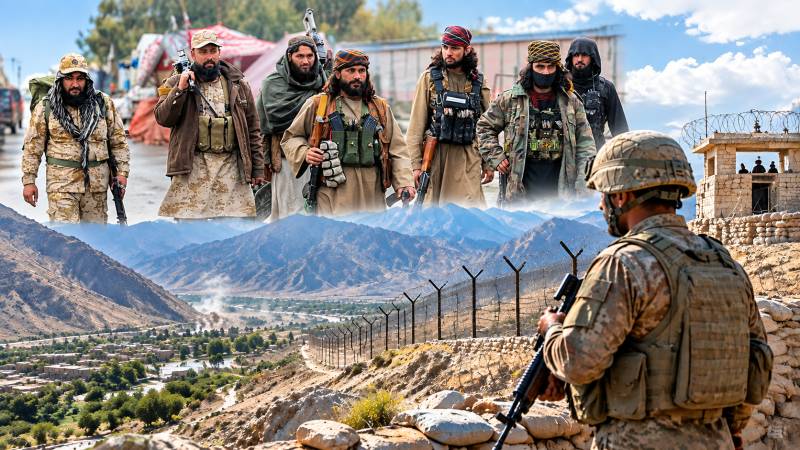
The latest Pakistan-Afghanistan border clashes mark a dangerous turn in a crisis that has steadily worsened since the Taliban returned to power in Kabul in 2021. The immediate trigger was the deadly terrorist assault in Kohat by militants linked to the Tehreek-e-Taliban Pakistan, followed by further violence in Hangu. Pakistan responded with precision strikes against terrorist hideouts inside Afghanistan, continuing its policy that major attacks traced to sanctuaries across the border will invite direct reprisals. The confrontation widened when drones were launched from Afghanistan towards Pakistani territory and border positions came under attack. Pakistan intercepted the drones and struck locations it said were connected with these operations. The conflict has therefore moved beyond strikes against TTP hideouts to Taliban military assets involved in hostile activity against Pakistan.
Prime Minister Shehbaz Sharif's address to the UN General Assembly on Friday provides an opportunity to place this campaign in its wider context. Pakistan's case is that it is defending itself against cross-border terrorism, but the danger developing inside Afghanistan extends well beyond Pakistan. TTP may principally target Pakistan, but Afghanistan also contains a wider militant environment involving ISKP, Al-Qaeda and groups threatening China and Central Asia. If these networks are allowed to consolidate, their ambitions may eventually extend towards Russia, the Gulf, Europe and America.
History offers a stark warning. The Afghan jihad of the 1980s was not Pakistan's enterprise alone. It was a shared geopolitical project against the Soviet occupation involving the United States and its Western allies, Saudi Arabia and other Muslim countries. Pakistan became the principal frontline state because of geography. Once Soviet forces withdrew in 1989, however, most international stakeholders departed, leaving Afghanistan and Pakistan to deal with the consequences.
Afghanistan subsequently descended into civil war and warlordism. The Taliban emerged from this chaos and Al-Qaeda found sanctuary under their rule. In 1998, Saudi intelligence chief Prince Turki Al-Faisal travelled to Kandahar in coordination with Pakistan to persuade Mullah Omar to surrender Osama bin Laden to a neutral Islamic authority. Mullah Omar initially appeared receptive but later repudiated the understanding. Three years later came 9/11 and another Afghan war lasting two decades.
The circumstances today are different, but the parallel is disturbing. Mullah Hibatullah Akhundzada's Taliban have repeatedly been asked to take verifiable action against the TTP. Pakistan has tried bilateral diplomacy as well as mediation involving China, Türkiye, Qatar and Saudi Arabia. Yet the central issue remains unresolved: Afghan territory continues to be used by militants attacking Pakistan. Pakistan certainly did not rush towards confrontation after 2021. During the chaotic Western withdrawal, it kept its diplomatic mission functioning and facilitated evacuations. It advocated humanitarian assistance, supported the release of Afghanistan's frozen assets and urged the international community not to abandon the Afghan people. This came after Pakistan had already hosted millions of Afghan refugees for four decades.
The present crisis between Pakistan and Afghanistan is not merely a bilateral dispute; it reflects a wider security challenge emerging from militant networks operating in a region that has repeatedly shown how instability in Afghanistan can produce consequences far beyond its borders.
Islamabad also tried almost every peaceful channel available. Religious scholars and tribal delegations travelled to Afghanistan. Senior officials held repeated talks with the Taliban. Trade concessions and economic connectivity were encouraged. Türkiye and Qatar mediated after serious clashes, Saudi Arabia facilitated contacts, and Pakistan participated in China-mediated talks in Ürümqi even after relations had deteriorated sharply. Pakistan's demand remained limited: Afghan territory should not be used by the TTP and allied organisations to attack Pakistan. As terrorism continued, Islamabad increasingly concluded that the problem was not Taliban capacity but Taliban willingness. Accommodation consequently gave way to deterrence.
The present policy of reprisals has emerged from this experience. Its purpose is to establish that terrorist attacks originating from sanctuaries across the border will carry consequences. But air strikes alone cannot constitute an Afghanistan strategy. They must form part of sustained military, economic, diplomatic and internal security pressure aimed at denying terrorist organisations the space from which they operate. Pakistan should therefore maintain strict border controls and prevent the return of the permissive movement that characterised earlier decades. The repatriation of undocumented Afghan nationals should continue in an orderly manner, while restrictions on transit and trade provide additional leverage. Economic cooperation should expand when Kabul acts against terrorism; continued tolerance of terrorist sanctuaries should carry tangible costs.
Internal counterterrorism is equally important. Intelligence coordination, policing, border surveillance and operations against local facilitators must accompany action across the frontier. This is especially important in Balochistan, where Pakistan already confronts a separatist insurgency. With uncertainty surrounding Iran, Islamabad cannot allow Afghan-based terrorist groups, Baloch militants and hostile external actors to develop mutually reinforcing pressures along its western frontier.
India's expanding engagement with the Taliban adds another consideration. Afghanistan has every right to maintain normal diplomatic and economic relations with India. Pakistan's concern arises only if Afghan territory, militant organisations or security relationships become instruments of strategic pressure while Pakistan simultaneously confronts an enduring security challenge on its eastern border. Pakistan therefore needs to resolve the Afghan terrorist threat sooner rather than later. The objective should not be another prolonged Afghan war or punishment of the Afghan people. It should be to dismantle terrorist infrastructure, deny anti-Pakistan groups sanctuary and create sufficient pressure on the Taliban leadership to make continued support or tolerance of these groups prohibitively costly.
This requires a stronger diplomatic campaign as well. China fears extremist threats to Xinjiang and its nationals; Russia and Central Asia fear militant spillover; Gulf states have suffered from Al-Qaeda and Daesh; and Türkiye and Qatar have invested heavily in Afghan diplomacy. Europe and America have the greatest historical reason not to assume that terrorism flourishing in Afghanistan will remain geographically contained. This should be the larger message Pakistan carries to the United Nations. Islamabad is not asking the world to fight Pakistan's war. It is asking the international community to recognise a danger while there is still time to contain it. After 1989, Afghanistan was neglected until its chaos produced consequences far beyond the region. After 2021, international attention again moved elsewhere while Pakistan and Afghanistan's other neighbours were left to absorb much of the fallout.
Pakistan must now sustain a coherent combination of reprisals, border control, economic leverage, internal counterterrorism and international diplomacy until there is verifiable change on the ground. The international community, meanwhile, should make clear that normal engagement with the Taliban must be accompanied by measurable action against transnational terrorist networks. Pakistan is bearing the immediate cost because geography places it on Afghanistan's frontline. But the central lesson of 9/11 is that terrorism nurtured in Afghanistan does not necessarily remain there. Recognising that lesson now may prevent the world from learning it again at a far greater cost.