

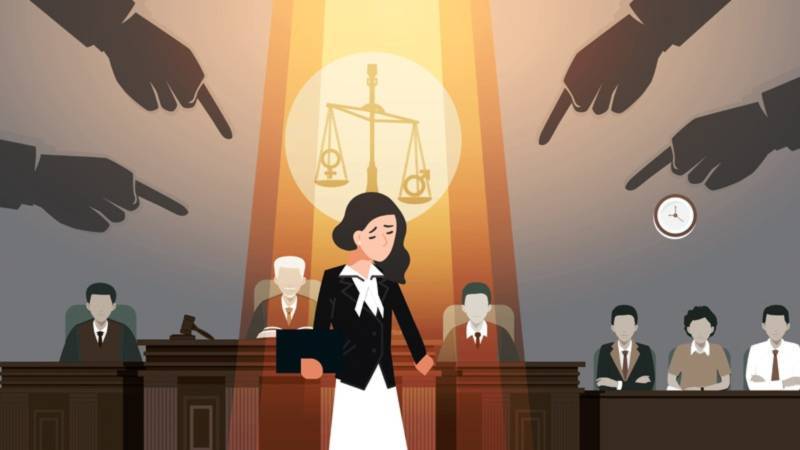
There is a particular kind of work that rarely makes anyone popular. It involves sitting with a family whose son has not come home, filing petitions that may never be heard, and standing up in court for a journalist, a blasphemy accused, or a person with no friends in high places. Lawyers who do this work are not paid in applause. They are paid, if at all, in the quiet satisfaction of having made the system answer a question it would rather avoid.
This is the work for which two Pakistani lawyers, Imaan Mazari-Hazir and Hadi Ali Chattha, are known. They are also now at the centre of a case that should concern anyone who cares about how this country treats those who test its institutions, whatever they think of the lawyers themselves.
What Has Been Reported
According to reporting by JURIST, drawing on UN and Amnesty International statements, the couple were convicted under the Prevention of Electronic Crimes Act 2016 (PECA) in a case concerning social media posts that were alleged to be “anti-state” and to contain false information. Reports say they received concurrent prison sentences totalling 17 years each, along with substantial fines.
After about eight months in detention, the Supreme Court of Pakistan granted them bail. On the 17th of September 2026, hours after that bail was granted, they were re-arrested in a separate matter. That case relates to an alleged illegal protest in March 2025 and, as reported, includes charges under several sections of the Pakistan Penal Code as well as section 7 of the Anti-Terrorism Act. UN experts have since called for their release and for the charges to be dropped, saying they see no justifiable basis for them. They have also expressed concern about the speed of the proceedings and about procedural fairness.
The best security rests on public confidence in the law, and that confidence depends on a legal system seen to treat everyone by the rules
I want to be careful here. These are allegations and rulings, some of which are likely to be tested on appeal. Nobody writing from outside the courtroom can say how any of this will end, and this article does not try to. The courts will decide, and they should be left to do so free of commentary on guilt or innocence.
But there is a separate question that can be asked without prejudging a single verdict. It is not whether these two individuals are right or wrong. It is whether the way we handle cases against lawyers who work on sensitive matters is one we would be comfortable defending, in front of our own citizens and in front of the world.
A Fair Word for the State
Let us start with what is true and important. Lawyers are not above the law. Nobody is. If a lawyer incites violence, blocks a road in breach of a lawful order, or commits a crime, the state is entitled, indeed obliged, to act. Pakistan has suffered terrible violence, and its institutions are right to take security seriously. A legal profession that claimed immunity from every consequence would not deserve public trust.
International standards recognise this balance. The UN Basic Principles on the Role of Lawyers, adopted in 1990, say that governments must ensure lawyers can perform their duties without intimidation, hindrance, harassment, or improper interference. They also say that lawyers should not be identified with their clients or their clients’ causes as a result of discharging their functions. But nothing in them prevents the prosecution of a lawyer who actually breaks the law.
So the issue is not immunity. It is proportion, process, and pattern. And those are three things on which every reasonable person, including the government’s own supporters, should want the system to look good.
Three Questions Worth Asking
First, proportion. A protest-related allegation, such as blocking a road or chanting slogans, falls on the ordinary end of public order offences in most legal systems. Pakistan’s Penal Code has sections designed for exactly that. Adding section 7 of the Anti-Terrorism Act, which is designed for serious acts of terrorism, to an allegation of this kind stretches that law in a way that deserves scrutiny. The Supreme Court itself has long said that the Anti-Terrorism Act should be reserved for conduct that actually creates terror or insecurity, not applied to every disturbance. If a law built for bombers is used against demonstrators, the risk is not only unfairness to those accused. It is that the word “terrorism” gradually loses the weight it ought to carry.
Second, process. The detail that has drawn the most attention is the timing. A court grants bail, and within hours the person is arrested again, in another case. Courts and prosecutors may have perfectly good procedural reasons for this in a given instance. Multiple cases do exist, and an accused person may genuinely face several allegations. But the effect, when viewed from outside, is that a judicial decision to release someone can be neutralised almost instantly. That may not be the intention, yet it can undermine confidence in the principle that bail, once granted by the country’s highest court, means something.
Article 10A of our Constitution guarantees a fair trial and due process. The International Covenant on Civil and Political Rights, which Pakistan ratified in 2010, requires the same in its Article 14. Fair process is not only about what happens inside the courtroom. It is also about whether the whole sequence of arrests, charges, and hearings looks like the even-handed application of law.
Third, pattern. UN experts have said that the cumulative picture suggests the legal system is being used as an instrument of harassment to punish the couple for their work. Whether or not one accepts that characterisation, and the state is free to contest it, it is a serious claim made by serious people, and it is worth taking seriously for its own sake. A government confident in its cases has every reason to welcome transparency. If the proceedings are sound, they will withstand scrutiny.
The Broader Worry: Speech and PECA
There is also a larger issue lurking behind this one, which concerns how we police speech online.
Pakistan’s Constitution protects freedom of speech under Article 19, subject to reasonable restrictions. That phrase matters. Restrictions are legitimate when they are clear, necessary, and proportionate. Under international law, the test is similarly demanding: a law that limits expression must be precise enough for people to know what is forbidden, and it must be aimed at a real and serious harm.
Offences defined by phrases like “false information” or statements considered “anti-state” can struggle to meet that standard. They depend on who decides what is false, and what counts as hostile to the state. A citizen may not know in advance whether a post is lawful. A lawyer, whose job is to criticise how power is exercised, may be especially exposed. In a healthy system, criticising a policy, a court, or an institution is not a crime. It is part of how institutions improve.
That is not an argument against regulating genuinely harmful content. Defamation, incitement, and fraud are real, and online harassment is a serious problem, particularly for women. It is an argument for drafting the law carefully, so that it catches the harm without catching the critic.
Why Lawyers, Specifically
One might ask why lawyers deserve particular attention. Is a prosecution of a lawyer more worrying than that of anyone else?
In one sense, no. Every accused person is entitled to the same fairness. But lawyers occupy a special structural position. They are how everyone else reaches the courts. If the families of the missing, the accused journalist, the member of a persecuted minority, or the labourer wronged by a powerful employer cannot find a lawyer willing to take their case, then their rights exist only on paper. The right to counsel means little if counsel is afraid.
Pakistan has a proud history here. The lawyers’ movement of 2007 and 2009 was one of the most remarkable episodes in the country’s modern life: black-coated advocates marching for the independence of the judiciary and the supremacy of the Constitution. Many of today’s judges and politicians benefited from that movement. It would be a strange irony if the profession that did so much to defend the courts were now to feel unsafe inside them.
What Pakistan Can Do
Constructive criticism should come with constructive proposals. Here are five that do not require anyone to concede anything about any individual case.
First, the Supreme Court or the relevant bar councils could issue clear guidance on cases involving lawyers, ensuring that arrests relating to professional work are reviewed promptly by a judge and that the lawyer has immediate access to counsel and family. This echoes the Basic Principles and would simply apply them.
Second, Parliament should review the “false information” and “anti-state” language in PECA, and in particular the provisions used in this case. The goal would be to tighten definitions, build in safeguards against misuse, and require that any prosecution involve a clear and demonstrable harm. A parliamentary committee, with input from the bar, journalists, technology experts, and the government’s own law officers, could do this well.
Third, courts could consider developing practice directions on how to handle situations where a person granted bail faces other pending cases. For example, prosecutors might be required to disclose all pending matters at the bail stage so that the court can decide the whole picture at once. This would protect the state’s legitimate interests while avoiding the appearance that bail is being undone by a second arrest.
Fourth, the government should clarify, ideally through guidance to prosecutors, when the Anti-Terrorism Act may be invoked in cases arising from protests. Such guidance would restate what the courts have already said: that the Act is for genuine terrorism, not for ordinary public order disputes.
Fifth, Pakistan should engage fully with the UN experts who have written to it. It currently sits on the UN Human Rights Council, elected in 2025 for a term that began this January, and it has often called, with justification, for human rights to be applied “universally and equally.” There is no better demonstration of that principle than answering questions about our own practice, openly and in detail. A reasoned, public reply is a sign of strength. Silence, or a dismissive one-line response, is not.
Why It Should Matter Beyond the Courtroom
It is tempting to treat all of this as a story about two people, or about a profession. It is also a story about confidence.
Pakistan wants investment, trade preferences, and a respected voice in the world. The country enjoys access to the European Union’s GSP+ trade scheme, which is linked to implementing core human rights conventions. Beyond trade, though, there is something more basic. Citizens need to trust that the law is applied fairly and that if they ever find themselves on the wrong side of power, someone will be able to stand up for them.
That trust is built slowly and lost quickly. Every visible act of fairness adds to it, such as a bail order that holds, a charge that fits the conduct, or a lawyer who can defend an unpopular client without fear. Every episode that looks otherwise draws it down, regardless of intent.
A Closing Thought
Whatever the final outcome in these cases, one principle should be beyond debate: a lawyer who defends the unpopular, the accused, or the powerless is performing a public service. That does not make any individual lawyer right in every case, and it does not shield anyone from accountability. It simply means the bar for treating such a person unfairly should be very high, and the system’s willingness to demonstrate its fairness should be very visible.
Pakistan does not need to choose between security and rights. The best security rests on public confidence in the law, and that confidence depends on a legal system seen to treat everyone, even its sharpest critics, by the rules.
If we can show that, we will have given the strongest possible answer to those who doubt us. If we cannot, the doubts will grow. The choice, as it so often is, lies with us.