

Muhammad Ali Jinnah’s address to the National Assembly of Pakistan (First Constituent Assembly) on August 11, 1947, outlined his foundational vision for Pakistan as an inclusive, democratic state, emphasizing complete religious freedom, equality of citizenship, and the strict elimination of bribery, corruption, and communalism. With all the emphasis at his command in a clear strident voice he declared "You are free. Free to go to your temples, mosques, churches or any other places of worship in this State of Pakistan. You may belong to any religion, caste or creed that has nothing to do with the business of the state. In his very first speech to the lawmakers of Pakistan the father of the nation had very clearly stated that religion has got nothing to do with the business of state and followers of all religions are equal citizens and all religions will enjoy the same rights as the Muslim citizens.
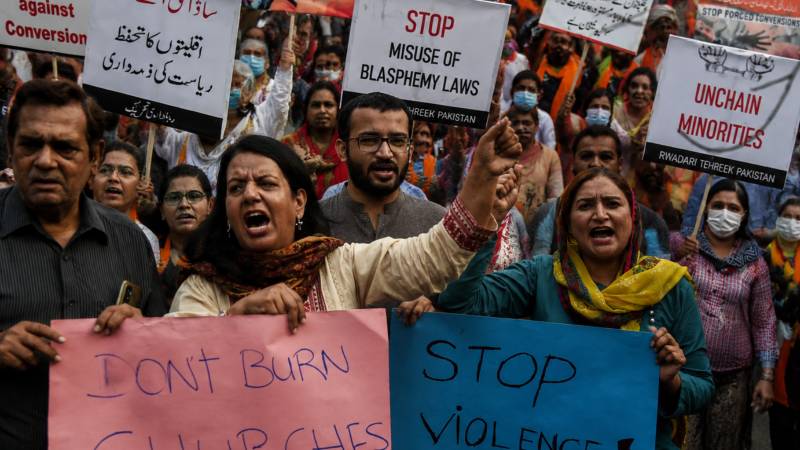
We celebrate 11t August as religious minorities’ day on every 11th August with great fanfare and blow our own trumpet to emphasize all the great rights enjoyed by religious minorities but this is far from the actual facts. Religious minorities in Pakistan including Christians, Hindus, Sikhs, Ahmadis, and Shia Muslims—face severe systemic challenges, including societal discrimination, targeted mob violence, misuse of strict blasphemy laws, and forced conversions affecting young non-Muslim girls. Despite constitutional safeguards, these marginalized groups struggle for legal protection, social equity, and physical safety. Our constitution states clearly that a non-Muslim cannot hold the office of Prime Minister or President of Pakistan, this clause is in direct contravention of the charter of human Rights and the charter of the United Nations. Many non-Muslims in our armed forces have made the ultimate sacrifice for this country and if they can die for Pakistan why on earth can’t they hold any office if elected?
Despite constitutional safeguards, these marginalized groups struggle for legal protection, social equity, and physical safety.
The Islamic Republic of Pakistan has a dominantly overwhelming Muslim Majority and minorities are a very small proportion of the Population. Out of almost twenty five million population 96 percent practice Islam while hardly 4 percent practice other religions with Hinduism and Christianity being the most prominent minority religions. With such a small number in population a non-Muslim does not stand a chance of being elected to the highest offices of the land so why do we have to become the laughing stock of the world by imposing such discriminatory restrictions on religious minorities? Among other issues, the major dilemmas currently faced by Pakistani minorities are threats of persecution, forced conversions along with religious violence. On May 13 2015, a group of six unnamed assailants targeted a bus carrying Pakistanis belonging to the Ismailia community – a minority Shia sect. The attack resulted in deaths of 43 civilians, whereas the assailants escaped unscathed. This was not an anomaly or an exception, rather the rule. Attacks of such nature have been frequent in the past few years where extremist right wing militant groups have targeted members of the minority communities, including Shias, Hazaras, Christians, Hindus, Ahmadis, and now the Ismailia community.
The responsibility of the attack was accepted by Jundullah, a sectarian group, threatening of further attacks in future against groups whom they considered Kafirs (infidels/Non-Muslims). The state has drastically failed to protect minority groups in a Muslim dominated country leading to mass exodus and forced migration of these communities from the country. In February, 2015, a Shia mosque was attacked in Peshawar killing more than 20 people. In March, 2015, similar attacks targeted a Church in Lahore, killing 12, and a Bohra mosque in Karachi wounding12. The situation regarding minority rights and their protection has worsened over the past few years with right wing Islamist groups succeeding in mobilizing angry rural youth and encouraging them to attack minority communities. This situation does not only stem from the narrative built by radical groups, but is also compounded by the state constitution that is responsible for structural prejudice against the minority groups. Although most of the Pakistanis have become victims to terror related attacks, the religious minorities, especially Ahmadis, Shias, Christians, and Hazaras have come under religion related attacks from fundamentalist groups. Lashkar e Jhangvi (LeJ) a banned militant outfit is mostly responsible for attacks on Shias at large whereas Jundullah has been involved in persecution of Hazara Shias. Tehrik e Taliban Pakistan, the country’s most notorious militant outfit, has been involved not only in attacks on Christians but also in all major cities of Pakistan in general. Many members of minority communities particularly Hindus, are leaving for safer lands.
Our constitution states clearly that a non-Muslim cannot hold the office of Prime Minister or President of Pakistan, this clause is in direct contravention of the charter of human rights and the charter of the United Nations.
Between January 2013 and June 2014, 3,753 Pakistanis from minority groups, especially Hindus, surrendered their passports and obtained long-term visas for India. The situation for Christians is also dire. Gregory (2012) mentions a number of prominent anti Christians attacks in the past 15 years including an attack on a Christian Church in Murree in 2002 killing 7, execution of 7 Christian workers in a welfare organization in Karachi in September 2002, two minor girls, aged two and a half and seven, raped in Lahore in 2004, Samuel Masih being the seventh person to be murdered on conviction of blasphemy in 2004, a Christian social worker and his driver killed in Peshawar in 2005, a Christian stonemason severely beaten by a mob in 2006 for drinking out of a communal glass, a young Christian man gang raped by 30 men for refusing to convert to Islam and in 2009 a mob burning down more than 40 homes in Gojra, among other incidents.
These incidents direct towards the notion that violence against Christians is not limited to one region or city, rather widespread throughout the. In Sindh, where the Hindu minority is based, the incidents of persecution are far less compared to those against Christians in Punjab. This is because Punjab is more radicalized than Sindh. Two months after Salman Taseer was shot, Pakistan’s only Christian minister was also shot dead outside his house in Islamabad for campaigning for free speech.
With our minorities under the cruel yoke of religious intolerance and discrimination, it is a time that the state of Pakistan should prompt the lawmakers to examine where law, policy and public culture continue to fall short of the standard articulated on Aug 11, 1947. Jinnah did not ask minorities to be grateful for protection; he described equal citizenship as a fundamental principle. Pakistan cannot honor that principle through speeches alone. It will honor it when every citizen, regardless of faith, can claim the same dignity, security and political belonging.