

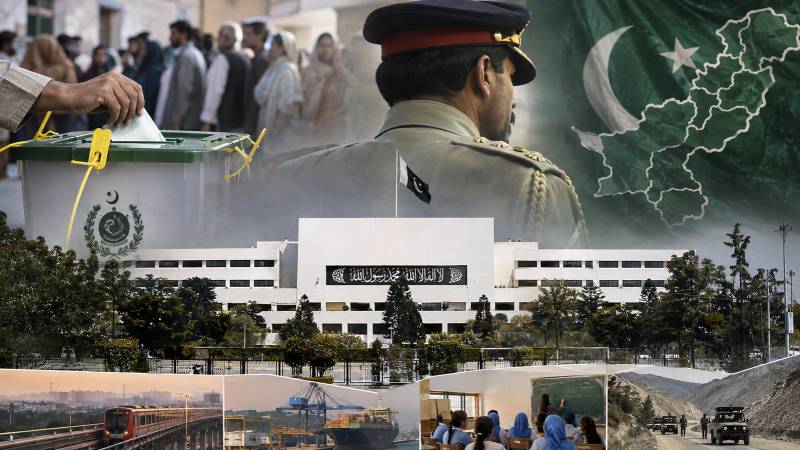
The campaign to redraw provincial boundaries is a diversion from Pakistan's real crisis: an unaccountable system in which the establishment exercises decisive power, political elites protect their interests and ordinary citizens pay the price. Those who govern must either seek a genuine electoral mandate or stop hiding behind civilian government with no real powers or mandate.
Pakistan's biggest problem is not the size of its provinces. It is the concentration of power in unaccountable hands, the capture of public institutions by entrenched interests and the systematic exclusion of citizens from decisions about their own future. For decades, the military establishment has exercised decisive influence over national security, foreign policy and, at critical moments, the country's political direction. Civilian governments, in turn, have frequently accommodated this arrangement, protecting their own political interests rather than challenging the concentration of power.
The latest campaign for new provinces is another manifestation of this dysfunctional system. Senior ministers are talking about fundamentally redrawing the country's political and administrative map as though it were a routine exercise in improving service delivery. Interior Minister Mohsin Naqvi says the existing system has collapsed and needs a reset. Defence Minister Khawaja Asif has floated the idea of twelve provinces. A referendum is being presented as the solution.
But who has authorised this exercise? Where is the government's policy proposal? What national consultation has taken place? And why is a country struggling with political legitimacy, economic stagnation, insecurity and institutional decay suddenly being asked to treat the number of its provinces as an urgent national priority?
The public statements have been extraordinary. Naqvi has advocated a referendum, arguing that the people should decide whether new provinces are needed. Khawaja Asif has spoken of creating as many as twelve provinces. Rana Sanaullah has defended the referendum proposal, while other government ministers have insisted that the debate must proceed.
PPP Chairman Bilawal Bhutto-Zardari has rejected any attempt to divide Sindh against the wishes of its people and warned of serious consequences. The resulting exchanges have exposed deep divisions within the governing coalition. Khawaja Asif has questioned Bilawal's moral authority, while government ministers have accused him of political opportunism. President Asif Ali Zardari and Prime Minister Shehbaz Sharif have meanwhile promised to resolve differences through dialogue.
There is an even more revealing detail. Despite all the ministerial declarations, no formal government proposal for a referendum had been initiated in the Prime Minister's Office or the Ministry of Parliamentary Affairs, according to reporting on 22 November. This is political theatre masquerading as policymaking. Ministers are making grand announcements about restructuring the federation without having put a serious proposal through the machinery of government. The public is being drawn into an increasingly acrimonious debate while the country's fundamental governance failures remain unaddressed.
The real question is not whether Pakistan should have twelve provinces or four. It is who governs Pakistan, on whose mandate and with what accountability. Consider the record of devolution. The 18th Amendment was supposed to bring government closer to the people by transferring substantial responsibilities and resources to the provinces. Yet the provinces have largely replicated the centralised structures they inherited rather than empowering citizens at the local level.
A World Bank assessment published in July 2026 provides a revealing measure of this failure. The share of total government expenditure undertaken by local governments fell from around 10% in 2005 to less than 5% in 2024. More than 80% of provincial expenditure in FY2022–23 went towards recurrent costs. The World Bank also found that district spending continued to reflect historical allocations rather than poverty levels and gaps in public services. Power was transferred from Islamabad to provincial capitals, but it was not meaningfully transferred to citizens.
And this failure is not confined to Sindh, Balochistan or Khyber Pakhtunkhwa. Punjab, Pakistan's largest province and the political stronghold of the PML-N for much of the past two decades, offers an equally revealing example. The development model repeatedly showcased by the PML-N relied heavily on foreign borrowing and large infrastructure projects, with Chinese financing and contractors playing a central role. Lahore's Orange Line Metro Train had an approved cost of $1.626 billion and was financed principally through a loan from China's Exim Bank, alongside contributions by the Punjab government. The $2.889 billion Multan–Sukkur motorway was financed through a Chinese government concessional loan and executed by China State Construction Engineering Corporation.
These projects delivered infrastructure, but their political visibility was far greater than their contribution to the fundamental challenges of productivity, education, industrial competitiveness and export diversification. Borrowing to build infrastructure is not inherently wrong. The question is whether such investments generate sufficient economic and social returns to justify their costs and whether they form part of a coherent development strategy.
The geographical distribution of development spending was equally revealing. An analysis of Punjab's 2016–17 budget found that Lahore received Rs134 billion, approximately 58% of the district-based development allocation of Rs229 billion. No other district received more than 3%. Multan, the largest city in southern Punjab, received only 3%. This was one budget year, not proof of the distribution in every year, but it illustrates the extraordinary concentration of development resources in the provincial capital.
The education record offers another measure of the gap between political claims and outcomes. According to the Pakistan Bureau of Statistics, Punjab's literacy rate increased from 64.01% in 2017 to just 66.25% in 2023. Female literacy rose from 56.67% to 60.19%. In rural Punjab, female literacy was only 46.88% in the 2023 Census. These figures represent some improvement, but hardly the transformation that decades of political dominance and grand development claims would lead the public to expect.
The economic consequences of this development model were borne by the entire country. Pakistan's current account deficit reached $19.2 billion in FY2017–18, an exceptionally large external imbalance. The PML-N's record of debt-financed consumption and infrastructure expansion, without a commensurate improvement in export competitiveness and domestic productivity, left the country vulnerable to another balance-of-payments crisis.
But the PML-N's responsibility did not end with its earlier record. Its return to power as the leading party in the Pakistan Democratic Movement (PDM) coalition in April 2022 was followed by another disastrous phase of economic management. The replacement of Miftah Ismail by Ishaq Dar as finance minister in September 2022 was a consequential political decision. It reflected the PML-N leadership's dissatisfaction with the politically unpopular adjustments required to stabilise the economy.
Dar's insistence on controlling the rupee rather than allowing a market-based exchange rate, combined with administrative restrictions on imports and prolonged delays in restoring the IMF programme, aggravated the foreign-exchange crisis. The IMF's own assessment records that attempts to tightly control the exchange rate and introduce additional import-management measures contributed to a sudden stop in financing inflows, severe import compression, rising inflation and economic contraction. The programme eventually expired in June 2023 without completion of its ninth review.
Those who exercise disproportionate influence over the country for decades are now proposing another structural reset without accepting responsibility for the failures of the existing system. They want to redraw the map without changing the rules governing the exercise of power.
The PDM government inherited serious vulnerabilities, including the consequences of the previous government's expansionary policies, the global commodity shock and devastating floods. But it cannot escape responsibility for its own decisions. The removal of Miftah, the return of Dar and the reversal towards administrative exchange-rate controls helped turn an already precarious situation into an acute economic crisis. By May 2023, inflation had reached 38% year on year, while industrial production and household purchasing power were under severe pressure.
The economic collapse was not simply an external shock. It was also the result of political choices made by a government unwilling to sustain difficult but necessary economic adjustments. Ordinary Pakistanis paid the price through inflation, lost jobs, reduced incomes and deteriorating living standards. Sindh illustrates the same failure of accountability from another direction. The PPP has governed the province continuously since 2008. Yet the 2023 Population Census puts its literacy rate at just 57.54%. Of 16.89 million children aged 5–16, approximately 7.82 million, or 46.29%, are out of school. These figures are not the consequence of the province being too large to administer. They are evidence of a prolonged failure to deliver basic public services and hold those responsible to account.
Balochistan offers an even more striking illustration. The Planning Ministry identifies eleven of Pakistan's twenty poorest districts in the province. Despite its natural resources and substantial mineral potential, large sections of its population remain deprived of basic infrastructure and economic opportunities. Its history of centralised control, security-driven policies and political marginalisation cannot be explained by the size of its provincial boundaries especially because it has been effectively ruled by the establishment for the past 550 years.
Nor can the security crisis in Khyber Pakhtunkhwa be resolved by administrative restructuring. The resurgence of the Tehreek-i-Taliban Pakistan following the Afghan Taliban's return to power in 2021 has exposed the consequences of national security policies and strategic calculations made at the centre. Provincial governments do not control Pakistan's foreign policy, cross-border militant networks or the national security framework. Dividing KP would not address any of these problems.
The common thread running through these failures is the concentration of power without corresponding accountability. Punjab's debt-financed and geographically concentrated development model, Sindh's failure to deliver basic public services, Balochistan's chronic deprivation and KP's worsening security situation are different manifestations of a dysfunctional governing structure.
The responsibility does not rest with one political party alone. The PML-N has to answer for its economic and development record, the PPP for its prolonged governance of Sindh, and successive civilian governments for their failure to empower local institutions, reform taxation and build a productive economy. But the establishment cannot escape its own responsibility for decades of dominance over national security, foreign policy and political outcomes. The civilian political class and the establishment have different degrees of power, but neither can claim to be beyond accountability.
Creating more provinces without changing this political culture will simply multiply the number of political fiefdoms, ministerial positions, bureaucratic hierarchies and opportunities for patronage. Pakistan does not need more chief ministers and secretariats. It needs governments that can educate children, provide basic services, generate productive employment and use public money responsibly. There is a fundamental political contradiction in the current campaign. Those who have exercised disproportionate influence over the country for decades are now proposing another structural reset without accepting responsibility for the failures of the existing system. They want to redraw the map without changing the rules governing the exercise of power. They want to reorganise the state without first securing the consent of its citizens through a credible electoral mandate.
This brings us to the question that should dominate the national debate: why are general elections not the first item on the agenda? If the political and administrative system has collapsed, as the Interior Minister claims, the logical response is to return to the people. Pakistan needs genuinely free, fair and credible general elections in which voters can choose their representatives without manipulation, coercion or predetermined outcomes. An elected Parliament must regain its authority. A government must derive its legitimacy from the electorate rather than from arrangements negotiated behind closed doors. Those who win an electoral mandate must be allowed to govern, and those who exercise power must be answerable to Parliament and the public.
There is, however, another option for those who believe that the establishment alone has the competence and authority to govern Pakistan and determine its future. They should stop hiding behind a nominal civilian government, abandon the pretence of parliamentary democracy and assume direct responsibility for governing the country.
This is not an endorsement of military rule. It is a challenge to the hypocrisy of the present arrangement. Those who exercise decisive power cannot indefinitely enjoy the privileges of control while shifting responsibility for failure to civilian politicians. They cannot influence political outcomes, determine national security and foreign policy, and then disclaim responsibility when the consequences become damaging.
If the establishment believes that elected politicians are incapable of governing, it should stop using them as a political shield. It should openly own the decisions it wants to make and the consequences that follow. The country has had enough of a system in which power is exercised behind the scenes while accountability is left to those who possess the least authority.
The choice is stark: hold genuinely credible general elections and allow the people to decide who governs Pakistan, or drop the civilian façade and take direct responsibility for governing the country. What cannot continue is the charade of a government that claims authority it does and cannot not fully exercise, a Parliament that is denied the authority it constitutionally possesses, and an establishment that wants the power to decide everything without being held responsible for anything.
Pakistan does not need more provinces to conceal the failures of its governing structure. It needs an end to concealed power, manufactured mandates and selective accountability. Until that happens, every proposed administrative reset will be little more than rearranging the furniture while leaving the rot in the foundations untouched.