

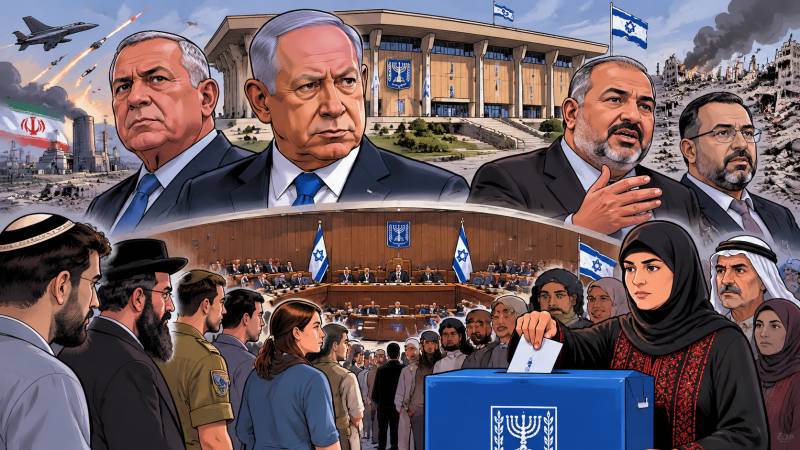
The elections of 27th October 2026 in Israel manufactured a new crisis where the Arab parties Joint List and Raam became the king maker and dilemma for the Opposition alliance to form a government continues to extend beyond their understanding and political maneuvering. The results shocked the Netanyahu led Likud Party and its Right wing alliance that aimed to continue the government and his policies towards the Palestinians and the regional security architecture. The 2026 Israeli elections are watched carefully across the globe due to the Iran War as the elections witnessed the downfall of the Israeli Prime Minister Benjamin Netanyahus political career. He accused the opposition parties of providing space to the Palestinians and Hezbollah and Hamas through their policies if they form the government and will provide relief to the Iranian regime.
Netanyahu presented himself as the defender of the Israelis against the Iranian threat and continuity of his rule will ensure the end of the Iranian threat and end of Hamas and Hezbollah in the region. But the opposition parties called for a change as they called Netanyahu a disgrace to the Israeli state and his personal goals have affected the Israeli security as he wanted to use the IDF before the elections to strike the Iran, and the aerial exercises in Syria and Iraq near the border of Iran was aimed to provoke Tehran for the war. The Israeli Elections for the 120 seat Knesset (Israeli Parliament) was held on 27th October 2026. The total voters registered are 7.3 million voters including 1.2 million Arab voters, and the parties in the parliament gets proportional representation in Knesset. The results of the Elections were shocking for the Netanyahu elections as the Arab turnout of over 70% surprised everyone which resulted the 19 seats for Joint List and Raam in Knesset, and 53 to Netanyahu alliance and 48 for the Eisenkot bloc.
The domestic issues dominated the mainstream Israeli politics more than the foreign policy issues which became a major reason of Netanyahus downfall. The first major factor is the use of security forces to gain political objectives has not been new but this time Netanyahu remained unsuccessful to achieve the objectives despite his immense efforts to convince the IDF Chief to initiate strikes on Iran which may result a new conflict with Tehran, as IDF Chief Eyle Zamir wanted political authorization from all parties before the strikes as he viewed it the exploitation of IDF for the political gains. The second factor is the laws to incorporate Haredi community under compulsory military service. These laws are aimed to bring them in compulsory military conscription of students who are studying Torah which is traditionally left out of service. In 2014 Knesset passed the Bill to include them in compulsory service but the protests has delayed it until the first conscription until 2024 as the number of Haredi increased from 3,000 to nearly 2 million.
The third factor is the mass protests on the Judicial reforms in which Knesset passed a law in July 2023 to abolish the Supreme Courts ability to review government actions on grounds of reasonableness, but it was repealed by the Supreme Court on 1st January 2024. The opposition parties protested the law as it will influence the Supreme Court and its decisions and will pave way for the further annexation of territories in West Bank and Gaza. The fourth important factor is the Israel deterioration of its ties with the west since the beginning of the Gaza War as the mass protests across the western world has compelled the governments to condemn and criticize the Israeli policies. The Anti-Semitic laws are questioned and the Jewish influence has considered a threat to the Jews around the globe.
The fifth factor is distortion of the image of the Israel since Gaza War, which is portrayed as an evil force violates international laws and carries genocide in Gaza. Prime Minister Netanyahu and his close advisors Gallant, and Smotrich are associated with war crimes and genocide in Gaza and West Bank as well as Israel's expansionist policies. Meanwhile, in order to improve its image the changed and moderate leadership is needed and that can be done with the cooperation with regional states to resolve the issues. The issue of International Criminal Court (ICC) arrest warrant for the Netanyahu and his associates as well as the recent UN Inquiry on the day of Israeli election accused Israeli forces of committing extermination, torture, and rape as crimes against humanity in West Bank and genocidal acts in Gaza. The report highlights that IDF killed 1800 Palestinians in West Bank, and injured 10,940 since October 2023. Whereas IDF has killed 1431 in Gaza since ceasefire in October 2025.
Netanyahu’s political decline reflects a deeper domestic crisis, fuelled by the politicisation of national security, controversial judicial reforms, and growing opposition to compulsory military service exemptions for the Haredi community.
The final factor that contributed a major role is the massive turnout of the Arab population in the elections as the Arab parties Raam and Joint List (a coalition of Arab parties) viewed the continuation of the Netanyahu a threat to their survival as the Likud and its far right alliance wanted to reduce the number of seats for the Arab population and deprive them of their rights. Some hardliner sections in the government even called to exterminate the Arabs from Israel in order to save the Jewish identity of the state. The results of the elections shocked the Netanyahu bloc and the Netanyahus accused of foreign interference from Qatar, Turkey, Egypt as well as other states including Iran of influencing the Arab voters. They also accused Arab parties of bribing the voters for the highest turnout in Arab population centers causing a massive change of results in Israeli elections.
The Shin Bet and Mossad has opened the investigations to find the foreign interference and malpractices in the elections. Meanwhile, the Israeli Jewish parties ignored the real determinants which forced the increased turnout and tilt of Arab voters towards the Arab parties. As the Arab parties focused on the domestic issues facing the Arab voters including the demolition of houses, increased crime rates, lack of facilities in Arab localities and the racist policies of state towards Arab population. The Israeli government led by the Netanyahu blamed Arab population for the violence in the region and questioned their loyalty towards state and called them sympathizers of the Palestinian groups of Hamas.
The Arab voters also faced the security dilemma in the war situation due to non-availability of bomb shelters in the Arab centers of population. The Arabs viewed the harassment of Shin Bet police units created for maintaining law and order in Arab population centers were harassing the Bedouin people and their development funds were diverted to these new police units further increased their tilt towards the Arab parties. Meanwhile the restrictions and ban on Arab leaders in the country and the parties from both the government and oppositions hesitation to include them in government further alienated them and forces the Arab voters to the Arab parties as they views the Jewish parties as a threat to their survival and development in the country.
The recent crisis questioning the loyalty of its Arab citizens will to vote for their favorite parties reflects Israeli double standards and exposed their democratic values. Even though the elections results provides an opportunity to the Israeli politics to come out of their racial policies and include the Arab parties to devise new policies aimed to strengthen their image as a democratic country and establish cordial ties with the Palestinians and neighboring states.
The hung parliament is best suited for the Netanyahu as he remains seated as Prime Minister and his advisors Smotrich and Ben Gvir continues their racist and expansionist policies in the West Bank and Gaza as well as in Lebanon and Syria and will pursue their policy of denuclearization and regime change in Iran. The Netanyahu puts Eisenkot in a dilemma through questioning the Eisenkot formation of alliance with Arab parties a threat to the Israeli security despite ignoring his own efforts to form an alliance with the Mansour Abbas Raam party in 2021 when he became part of the Bennnet government.