

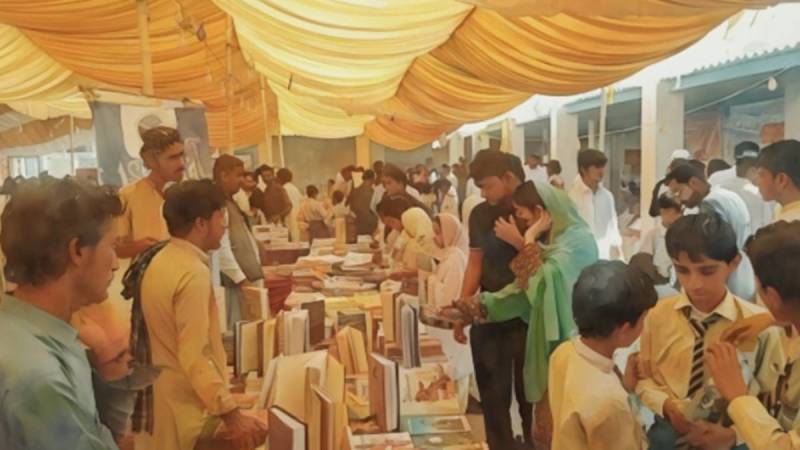
Two claims circulate through Balochistan’s digital bloodstream with the force of revelation. The first insists the province is being “sold,” its resources traded away while its people watch powerless. The second, less political and more surprising, declares that Balochistan is where Pakistan’s books sell best, that its young people read more hungrily than anyone else in the country. The first claim is emotionally intelligible and politically useful to those who repeat it. The second is the more radical truth, because it shatters the caricature of a violent, backward, ungovernable society and reveals a generation intellectually alive, curious, and increasingly capable of judging the distance between a promise made and a promise kept.
The fiscal record dismantles the selling narrative. Balochistan generates a small fraction of its own revenue yet operates on a budget exceeding nine hundred billion rupees, with the overwhelming majority supplied through federal transfers and the National Finance Commission Award. Per capita, those transfers rank among the most generous in the federation. The claim that the province is being sold collapses against the arithmetic of subsidy.
The more damning truth is that this extraordinary infusion has not produced proportionate human development, because the provincial development machinery converts allocation into abandonment with remarkable consistency. The Auditor General found last fiscal year that development spending reached only thirty-six per cent of allocation. One hundred and ninety-eight schemes worth 17.02 billion rupees were abandoned or left incomplete, and the report attributed the wreckage to “wrong priorities and allocation of funds on political grounds.” This is not a province drained by the centre. It is a province whose own governing class controls the purse strings, fails to absorb the funds, and profits politically from a narrative that blames someone else.
The Baloch youth are not waiting for permission to think – they are buying books by the sack-load and building an intellectual life that no security briefing can contain
Against that record, the book fairs acquire a weight their celebrants may not fully intend. At the Ata Shad Literature Festival in Turbat, organisers reported that students bought nearly three times as many books as at comparable festivals in Lahore, Karachi, and Islamabad, with more than 3.5 million books sold and visitors carrying away sacks rather than bags.
A four-day fair in Gwadar in 2025 recorded sales above 2.8 million rupees, over a million of it on Balochi-language titles alone. A festival in Kech later broke those figures. These are the statistics of a generation that reads, compares, and looks in books for what institutions have failed to supply: a coherent account of its own history, dignity, and rights. The Baloch youth are not waiting for permission to think. They are buying books by the sack-load and building an intellectual life that no security briefing can contain.
Demographic Shifts and Digital Access
The demography explains why this matters now. The 2023 census counted 14.89 million people in Balochistan, 42.9 per cent below the age of fifteen and 18.56 per cent between fifteen and twenty-four. Youth literacy stands at sixty per cent, up sharply from 2018, though still seventeen points below the national figure, and female youth literacy at forty-four per cent.
Household smartphone ownership reaches ninety-eight per cent, the highest in the country, while individual internet use sits at forty-three per cent. A young person in Turbat or Gwadar does not need a lecture on structural injustice. He or she can read, cross-check, and reach a verdict. When provincial assembly members accuse one another on the floor of selling government jobs, the reading generation draws its own conclusion about what honour means in practice.
Here the Baloch ethical vocabulary becomes the working grammar of political judgement rather than a decorative tradition. The Mayar, in its varied and locally interpreted forms, places at its centre qual: a person is bound to remain true to his word. Etbar, trust, is not a mood but a reciprocal obligation, and to break one’s word is not merely to err but to become be-ghairati.
This standard applies to institutions exactly as it applies to men. A provincial government that announces a scheme and then fails to release the funds, or pledges transparent recruitment and then fills posts through patronage, is not simply inefficient. It is dishonoured, and it is understood as such. Administrative control, in this grammar, purchases nothing. Reciprocity purchases everything.
Submitting to Verification
What follows is not a plea for more dialogue, still less for more operations. It is a demand that the state submit its own word to verification, and that the provincial government do so first, because the most immediate betrayals of the word occur closest to home.
The finance department should publish development spending at scheme level, by district and sector, updated quarterly, with the gap between allocation and release reported independently. Complaint and remedy mechanisms for recruitment, service delivery, and land disputes should be measured by resolution rates and timelines rather than by their existence. Consultation with students, professionals, women, and rural youth should feed directly into budget priorities, with published explanations of which recommendations were adopted and why. None of this requires a grand bargain. Each element is a small test of whether the state can keep a small promise, and credibility is rebuilt only by the accumulation of kept words, never by a single ceremony.
The claim that Balochistan is being sold will keep its emotional purchase for as long as the province’s representatives can deflect attention from their own performance. The more unsettling proposition is that the province is not being sold but squandered, and the squandering is visible in every abandoned scheme and every job traded in the corridors of the assembly.
Yet the book fairs tell a story the tragedy cannot contain. They reveal a generation that has not surrendered its curiosity, that reads not as an escape from politics but as preparation for it. Such a generation will not be satisfied with the transfer of blame. It will ask the only question a culture of honour recognises: when you gave your word, did you mean it? A state that answers with evidence rather than assertion, scheme by scheme and quarter by quarter, will find that authority in a politically conscious society is never possessed. It is earned, word by kept word.