

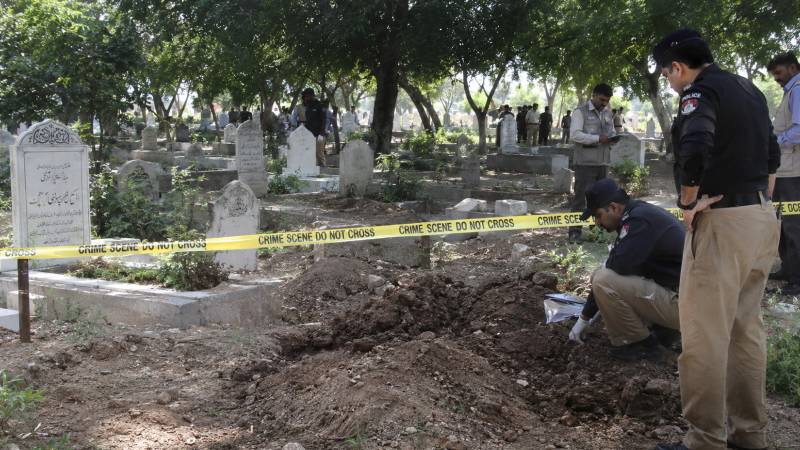
Eating a corpse or sexually abusing one is still not a specific criminal offence in Pakistan. Fifteen years after Bhakkar, Parliament has run out of excuses. In April 2011, police walked into a house in Darya Khan, a small town in Bhakkar district, and found the body of a recently buried girl. Some of her limbs had been cooked in a curry. The two brothers who lived there, Muhammad Arif and Farman Ali, had been digging up graves in the local cemetery. Investigators said they had eaten parts of almost 150 bodies.
As a law student, this is the part that still shocks me. When the case reached court, there was no law specifically addressing what they had done. There still isn't. Pakistan's Penal Code contains no offence of cannibalism (eating human flesh) and no offence of necrophilia (engaging in sexual acts with a dead body). Neither term appears in it. This is not ancient history. In September, people in Peshawar caught a 19-year-old pulling a body out of a grave. Locals said he had been digging up girls' graves for a month. In October, police in Vehari arrested a man who had dug up two graves and was found with human remains. Each time, we are horrified for a day before the police reach for the same outdated provisions of an 1860 penal code.
The provision they use most frequently is Section 297, which deals with trespassing on burial grounds. It protects people's religious sentiments and feelings, rather than the body itself, and carries a maximum sentence of one year in prison. The Bhakkar brothers were sentenced to two years each and released by 2013, only to be rearrested following protests on the highway. In April 2014, police raided their house again and found a child's head.
This time, the state invoked the Anti-Terrorism Act, and the brothers received 12-year prison sentences each. That sounds like justice, but it was a legal shortcut. In Ghulam Hussain v The State (2019), the Supreme Court held that terrorism involves violence intended to intimidate the public or the government in pursuit of a political, religious or ideological objective. Two disturbed men eating human remains in their home is horrifying, but it does not constitute terrorism. The only substantial punishment in Pakistan's most notorious cannibalism case came from applying a law that did not fit the crime. In July this year, reports emerged that the brothers had served their sentences and been released.
Necrophilia fares no better. In 2011, Muhammad Riaz, a worker at Karachi's Paposh Nagar graveyard, confessed to sexually abusing the bodies of 48 women over eight years. Police invoked the provisions relating to rape and outraging modesty, which were designed to protect living victims. In 2024, a man in Korangi dug up the body of a woman who had been buried the previous evening. Her son's FIR (the first formal complaint lodged with the police) invoked precisely the same provisions. Thirteen years later, nothing had changed.
Some argue that laws addressing such crimes are a luxury reserved for wealthy countries. South Africa offers a counterexample. It is a developing country that faces many of the same challenges as Pakistan, yet its Sexual Offences Act of 2007 explicitly criminalised sexual acts with a corpse under Section 14. It did not leave judges to stretch existing rape provisions to cover an entirely different offence. It introduced a clear, specific legal provision.
The only real punishment in our most famous cannibalism case came from bending a law that didn't fit. Two disturbed men eating human remains was horrifying, but it was not terrorism. The state resorted to a legal shortcut because the actual offence did not exist.
Our neighbours, which inherited the same 1860 penal code, demonstrate what happens when such legal gaps remain unaddressed. In India, a man in Karnataka murdered a woman and subsequently raped her body. The High Court acquitted him of rape because the law presupposed a living 'person'. In February 2025, the Supreme Court declined to intervene, observing that no one had demonstrated that necrophilia was a criminal offence under the applicable law. In Bangladesh, a Dhaka morgue assistant whose DNA was found on the bodies of several women received a sentence of one year and seven months. England, meanwhile, has had a specific offence since 2003 and expanded its scope this year.
Pakistan's Parliament is aware of these legal gaps. In September 2024, a Senate committee unanimously approved Senator Samina Mumtaz Zehri's bill seeking to criminalise necrophilia through an amendment to Section 377, which carries a maximum sentence of life imprisonment. A second bill cleared the same committee in 2025. As far as I can establish, neither has become law. A bill seeking to criminalise cannibalism was still stuck in a National Assembly subcommittee as of 2020, and nothing has come of it since.
Religion offers no excuse for inaction either. A hadith in Sunan Abi Dawud states that breaking the bone of a dead person is like breaking it while they are alive. Senator Zehri's bill also cites this hadith. Article 14 of our Constitution guarantees the dignity of the human person. What is missing is political will. The victims are dead, their families remain silent out of shame, and the dead don't vote. Judges cannot fill this legislative gap. Article 12 of the Constitution prohibits the punishment of anyone for an act that was not a criminal offence at the time it was committed. This is an important constitutional safeguard, but it also means that every year Parliament delays action is another year in which perpetrators in such cases cannot be prosecuted under a specific law addressing their conduct.
The state cannot claim that these crimes occur beyond its reach, either. They take place in public graveyards and government morgues (facilities where bodies are kept before burial or post-mortem examinations). Riaz worked at the very graveyard where he preyed on the dead. Many graveyards have neither night guards nor functioning CCTV cameras. If someone records such abuse and shares the footage online, our cybercrime legislation, the Prevention of Electronic Crimes Act (PECA), offers no specific protection against the recording or circulation of such material.
What I am asking for is not complicated. Parliament should introduce two clearly defined criminal offences: necrophilia and cannibalism, each carrying serious penalties. The legislation should also require evidence of intent and forensic reports before charges are brought, helping prevent its misuse in disputes over land and property. Provincial governments should make CCTV surveillance, entry registers and background checks mandatory at graveyards and morgues. PECA should also be amended to criminalise the recording and circulation of such abuse. None of this will undo what happened in Darya Khan or Paposh Nagar. But it can help protect the next grave. The dead cannot speak for themselves. The least the living can do is write one law for them.