

Every policy distributes risk.
Punjab's wheat transition was presented as a technical reform: reduce fiscal exposure, expand private participation, and move procurement away from an overextended state. Parts of that argument were valid. The old procurement structure had become increasingly expensive, inefficient and difficult to sustain. But reforms are not judged only by their stated objectives. They are judged by how risks, protections and losses are distributed once the system begins operating.
And in Punjab's wheat transition, nearly every organised participant entered the harvest season with some form of protection, flexibility or policy access.
Except the farmer.
That outcome was not necessarily planned. But neither was it accidental.
Private aggregators received subsidised financing structures, free public storage and operational support from Food Department personnel. Banks retained the ability to limit participation or withdraw where collateral and release conditions appeared uncertain, and that is exactly what happened.
The flour milling sector and the import trade each operate within structures that offer their own forms of insulation when domestic procurement weakens. Lower farm-gate prices reduce raw material costs for mills. Instability in domestic supply generates demand for import financing, storage and logistics linked to external supply.
None of this required coordination or conspiracy.
It is simply the logic of organised interests operating in a policy environment where access is unequal.
The farmer has no equivalent institutional presence.
Pakistan's farmer organisations remain politically visible during moments of acute crisis, but structurally weak during policy formation itself. Aggregator rules, financing structures, benchmark mechanisms, storage conditions, procurement timelines and import decisions are usually designed inside institutional rooms where the farmer has little direct representation. The grower learns the terms of transition largely through notifications, announcements and market behaviour after the system has already been structured.
That absence matters.
Policy does not need to openly target farmers in order to disadvantage them. It merely needs to ignore the constraints under which they operate.
If Pakistan wants wheat reform to endure, farmer representation cannot remain episodic, emotional or crisis-driven
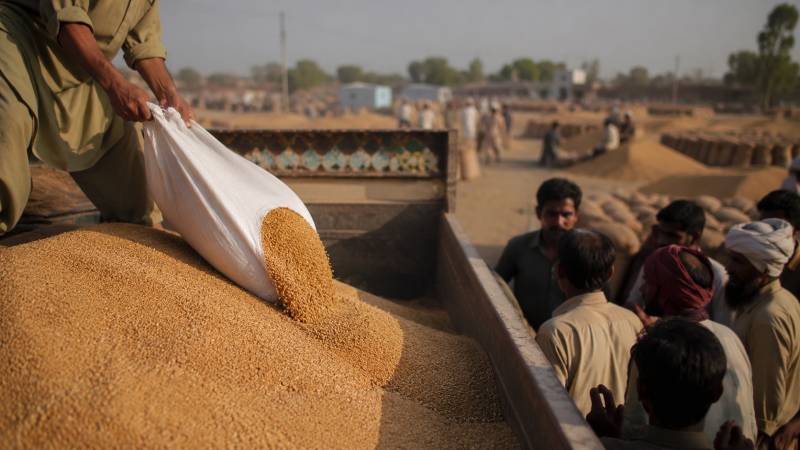
The wheat farmer enters harvest carrying timing pressure, input debt, seasonal credit obligations, labour payments, transport costs and storage limitations simultaneously. Unlike the bank, he cannot delay participation until conditions stabilise. Unlike the aggregator, he does not operate with a structured margin. Unlike the flour mill, he cannot pass price volatility downstream. Unlike the importer, he cannot shift supply decisions across borders or time them around domestic shortages.
He sells when the crop is ready because biology leaves him no alternative.
In commodity markets, the participant forced to transact under time pressure almost always possesses the weakest bargaining position.
This asymmetry has a political logic. Urban consumers are concentrated, vocal and politically immediate. A rise in flour prices generates instant public pressure: media coverage, political criticism, inflation anxiety, and administrative response.
Rural losses operate differently. The farmer in Vehari selling wheat below cost does not produce the same concentrated political reaction as rising bread prices in Lahore or Karachi. That asymmetry shapes policy more deeply than governments often acknowledge.
When wheat imports entered Pakistan in large volumes ahead of the 2024 harvest, the decision was presented largely as supply management. But it also had a distributive effect: imported grain helped suppress domestic prices during harvest, moderating pressure on urban food inflation while transferring much of the adjustment cost onto producers.
The same structural logic shapes how benchmark prices function in practice.
The official wheat price may be described as an indicative reference rather than a legal floor. But in a thin procurement environment, an indicative benchmark does not behave like a neutral signal. It becomes the psychological anchor around which private buyers organise their offers.
Traders and mills know that if the state is not operationally defending the benchmark, farmers under liquidity pressure will be forced to accept less. The announced number then functions less as a floor for farmers and more as a ceiling used by stronger buyers to resist paying more.
That is not a minor semantic distinction. It is the difference between policy language and market reality.
For a farmer with no storage and a loan falling due, a benchmark without a buyer is not protection. It is a number printed above a market he cannot access.
When prices later rose above the official reference, the state's response was swift: enforcement teams intercepted wheat movement between provinces, with consignments redirected to state-linked storage at the official rate. The farmer encountered the state most forcefully not as a guarantor of fair price, but as a gatekeeper of access, movement and grading.
This pattern is not unique to wheat. Sugarcane growers regularly face delayed payments because the sugar sector possesses stronger institutional influence than the producer supplying the crop. Across Pakistan's agricultural economy, the weakest participant in the production chain carries the largest share of adjustment pressure.
Wheat is now reproducing the same structure.
The point is not that banks, aggregators, mills or traders are villains. Banks are expected to protect depositors and lend only where risk is bankable. Aggregators cannot replace decades of state infrastructure without financing, storage and predictable rules. Flour mills operate under consumer price pressure. Traders respond to the margins created by the market before them.
The problem is that the system was redesigned without giving the farmer an equivalent seat in determining how risk would be allocated.
That is the political economy of wheat. The most exposed participant had the least influence over the design of the transition.
The long-term consequence is already visible. Punjab Crop Reporting Service data, corroborated by Food and Agriculture Organization crop monitoring assessments, indicate that wheat acreage in Punjab fell by roughly 5.5 per cent between 2023–24 and 2024–25 — a reduction of close to a million acres — a shift attributed in part to misalignment experienced at harvest.
That shift did not occur because farmers lost interest in wheat. It occurred because they recalculated the risk. When producers repeatedly experience suppressed returns, delayed procurement, policy uncertainty and losses without institutional protection, they respond rationally. They reduce acreage, lower investment and move towards alternative crops.
That response may appear gradual. Over time, it reshapes national food security.
If Pakistan wants wheat reform to endure, farmer representation cannot remain episodic, emotional or crisis-driven. It must be built into policy formation before procurement rules are finalised, before financing schemes are announced, before aggregator margins are approved, before import decisions are taken, and before benchmarks are presented as protection.
The farmer's body should not appear only after the harvest collapses.
It should be present when the rules of the harvest are written.
Systems built without the participation of those carrying the greatest exposure rarely distribute outcomes fairly for long. In Haroonabad, in Vehari, in every district where the grain was stacked, and the buyer did not come, that lesson has already been paid for. The question is whether it will be learned in time for the next harvest.