

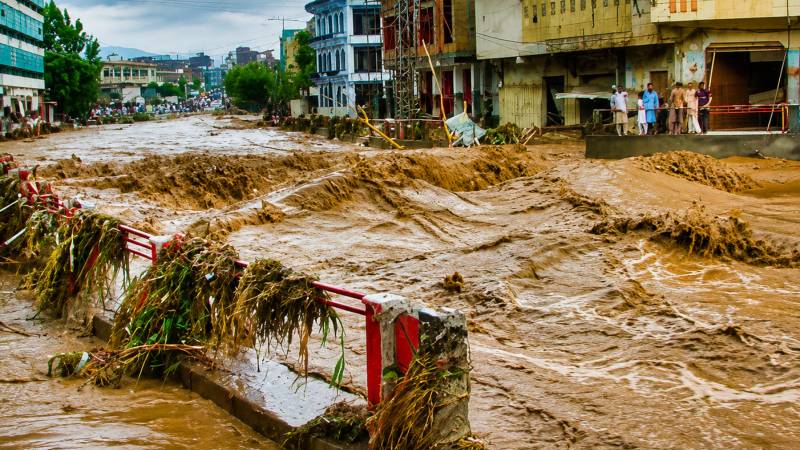
The monsoons have returned, bringing the same crisis that Pakistan undergoes almost every year: families abandoning their homes, children wading through contaminated water, crops destroyed, roads washed away, and public officials promising that lessons will be learned, but the real tragedy is that many of these losses are no longer unforeseen or unpredictable.
For the past few years, despite having a low share in global greenhouse gas emissions, Pakistan stands at the face of the climate crisis, with more intense rainfalls, glacial melt, heatwaves, and prolonged droughts. We are justified in demanding climate finance, compensation for loss and damage, and greater accountability from the developed world, but international injustice cannot excuse domestic negligence.
We continue to approve housing schemes on riverbanks and floodplains. Cities are being expanded at the expense of wetlands, agricultural land, mangroves and green spaces. Roads, hotels and commercial developments are pushed into mountain landscapes without adequate consideration of slope stability, water flows or downstream impacts. We are not simply failing to adapt to climate change; however, in many places, we are actively increasing our exposure to it.
Pakistan has no shortage of policies and action plans. Our climate and disaster management documents already call for resilient infrastructure, ecosystem protection, improved zoning and better land-use planning, which are informed by scientific evidence. The problem is not an absence of policy or science - it is the refusal to enforce policy when it conflicts with political influence, speculative real estate, and short-term revenue gains.
For the past few years, despite having a low share in global greenhouse gas emissions, Pakistan stands at the face of the climate crisis, with more intense rainfalls, glacial melt, heatwaves, and prolonged droughts.
All our major cities illustrate the cost of this approach. For Karachi, mangroves are the first line of defense against natural disasters. Yet they are repeatedly placed under pressure from urban expansion and housing development. Despite commendable efforts by the Sindh Forest Department to increase the mangrove forest cover, a study by WWF-Pakistan estimates that between 2010-2022, almost 200 hectares of mangrove forests were cleared around Karachi, for residential and recreational projects, such as the DHA Phase 8 and Airmen Golf Club, and expansion of industries in the Korangi Creek Industrial Park and along the coast near Port Qasim.
Islamabad faces an equally serious risk. The Margalla Hills are not simply a scenic backdrop to the capital but are an integral part of its watershed. Deforestation and tapering natural springs for development in the hills would make the water reach the city faster and in greater volumes. I am certain that Islamabad will flood again. When it does, extraordinary rainfall will be blamed, while the steady degradation of the landscape that protects the city will receive far less scrutiny. The same pattern is repeated across the country, where nature is still treated as an obstacle to development rather than the infrastructure that makes development possible.
This approach has a massive human cost, leading to economic and social costs. Vulnerable communities bear the consequences of decisions made by developers, authorities and political actors who remain largely insulated from the resulting risks. Private gains are secured. Public losses are socialised.
When Pakistan goes to the COP31 meeting in Antalya this November, it will rightly demand justice, finance and reparations for losses caused by climate change. That case is legitimate. Wealthier countries must provide substantially greater support, particularly in the form of grants rather than further debt. But our credibility will be weakened if we seek international finance for resilience while continuing to authorise development that destroys resilience at home.
This is not an argument against economic growth. It is an argument for competent planning. We know what needs to be done: rivers need room; wetlands store water; mangroves protect coastlines; forests stabilise soil; mountain ecosystems regulate entire watersheds. We have the policies and the scientific evidence. About time we start considering nature as an integral pillar of our growth, and not treating it as an afterthought. Pakistan is entitled to demand climate justice from the world. But responsibility does not end with our emissions profile. The floods are not only exposing our climate vulnerability. They are exposing the consequences of development decisions we continue to make despite knowing better.