

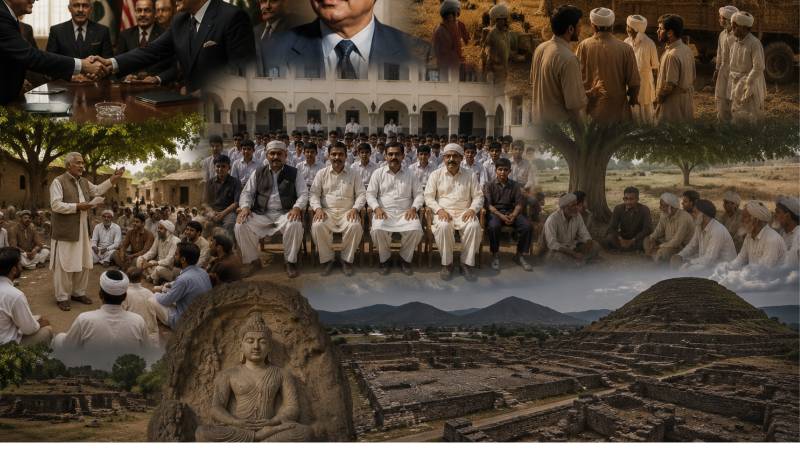
In the early 1960s, the Cold War reached a village in Taxila not through a treaty, military alliance, or diplomatic conference, but through sacks of wheat. At Gangu Bahadur, in Union Council Usman Khattar, nearly a hundred children were studying in a deteriorating mud structure. Their parents wanted education, but the village lacked the resources to build a proper school. In October 1961, the village acquired an unexpected connection to American Cold War diplomacy when Orville L. Freeman, the U.S. Secretary of Agriculture, visited Pakistan and saw the conditions in which the children were being taught.
What followed was a small but revealing episode in the history of development, diplomacy, and rural Pakistan. American agricultural surplus, mobilized as an instrument of international cooperation, entered the village in the form of wheat. But wheat alone could not build a school. It required a local actor capable of translating an international programme into a functioning institution. That person was Malik Muhammad Shafi, a young, educated rural leader who understood that external assistance could become meaningful only through local organization, political negotiation, and community effort.
Taxila is usually encountered through its ancient past: Buddhist monasteries, Gandharan sculpture, Hellenistic remains, and archaeological sites excavated and made internationally famous by British archaeologists, above all Sir John Marshall. Yet alongside this celebrated archaeological landscape developed another Taxila: a living twentieth-century society formed through villages, businesses, roads, schools, local councils, and the ambitions of its inhabitants. Its history cannot be understood through ruins alone. Communities living among and around those ruins were building a modern society and negotiating new forms of education, politics, commerce, and public welfare.
Shafi’s story survives largely through a remarkable family archive preserved by his nephew and son-in-law, Tahir Suleman. A heritage enthusiast and successful businessman with particular expertise in numismatics, Suleman deserves recognition for keeping the family papers intact, organized, and accessible to researchers. The collection contains letters, photographs, newspaper clippings, architectural drawings, certificates, and official documents relating to Shafi’s public activities. These materials recover not simply the biography of a local leader but a history of how international development programmes and Cold War diplomacy intersected with local aspirations.
Born on 14 August 1932 into a respected Taxila business family, Shafi belonged to a generation for whom education offered a route beyond the limitations of rural life. He received his primary education in Taxila before continuing at a missionary school in Rawalpindi. After matriculation in 1950, he attended Gordon College, completing his FA and BA. In 1958 he completed an MA in Economics at Forman Christian College, Lahore, and also pursued higher studies in English. He remained closely connected to his family enterprises, including Pindi Hazara Transport Cooperative Society and Dawn Auto Stores in Rawalpindi. These activities gave him practical experience in administration, transport, finance, and organizational management.

His entry into public life coincided with Ayub Khan’s Basic Democracies system, introduced in 1959. Although the system was partly designed to consolidate authoritarian political control, it also created a new arena for local representation and development. At twenty-eight, Shafi was elected Chairman of Union Council Usman Khattar in 1960 and was re-elected in January 1966.
His position brought him into contact with Ayub Khan, who regularly travelled through Taxila to Rehana, his ancestral town. Family memory further holds that Shafi’s name was considered for a ministerial position but ultimately passed over in favour of a Sindhi candidate. Whether or not this can be independently corroborated, it reflects the extent of his remembered proximity to the political establishment. It was in this setting that the Gangu Bahadur school brought local politics into contact with international development.
When Secretary Freeman visited the village in October 1961, he encountered children studying in a poor rented mud building. The episode reflected the wider logic of American development diplomacy during the Cold War. U.S. agricultural surpluses could serve economic purposes while simultaneously supporting international cooperation and demonstrating the practical benefits of American engagement abroad. In Gangu Bahadur, however, the geopolitical significance of the programme was secondary to the immediate question of whether children would have a proper place to study.
Wheat alone could not build a school. It required a local actor capable of translating an international programme into a functioning institution.
Approximately Rs. 5,000 worth of wheat was made available for the project. Rather than conventional cash assistance, the commodity became a form of local purchasing power. Some wheat was distributed to labourers as food for their families, while the remainder was sold and the proceeds used for construction costs and wages. Thus wheat performed two functions: it supported the workers building the school and generated funds for construction. An international commodity entered the village economy and, through local decisions and labour, emerged as a permanent institution.
According to the family records, the proceeds of the continued American wheat assistance ultimately supported the construction of four schools and the digging of two wells. The significance of the programme therefore extends beyond Gangu Bahadur. What began with one inadequate school became a wider programme of rural infrastructure. Education and water addressed the basic material conditions necessary for community development.
Shafi’s contribution was crucial precisely because American assistance did not construct these institutions by itself. As Union Council chairman, he could communicate with government departments, engage with representatives associated with the American programme, organize local participation, and negotiate the practical requirements of construction. The surviving correspondence concerns such mundane but decisive matters as cement, transportation, accounting, construction materials, school management, and permissions.
These details expose the distance between the rhetoric of international development and its practical implementation. Programmes could allocate commodities and governments could endorse projects, but someone still had to organize workers, obtain materials, transport them, account for resources, and mobilize the community. Shafi was the person who helped make that happen.

Photographs preserved in the archive make this transformation unusually visible. They show the proposed design, the construction site, local workers, and the completed school and inauguration ceremony. A bilingual plaque commemorates cooperation between Wheat Associates U.S.A. and Union Council Usman Khattar. Yet the photographs do not depict villagers simply as passive recipients of American generosity. They appear as workers, organizers, participants, and beneficiaries. The programme may have originated within an international system, but its physical reality was locally produced.
Shafi’s story therefore offers a way of understanding the Cold War from below. Conventional Cold War history emphasizes presidents, diplomats, military alliances, and international institutions. At Gangu Bahadur, however, geopolitics became material. It arrived as agricultural surplus, entered a village economy, was handled by labourers and officials, and became schools and wells. American policymakers could regard wheat as an instrument of diplomacy; Shafi could regard it as an opportunity to build institutions his community needed. The same commodity consequently acquired different meanings at different levels of the political system.
This does not make Shafi either a passive beneficiary of American policy or an uncomplicated local hero. His importance lies in his capacity to appropriate resources generated by a larger political system and redirect them toward local purposes. He worked within Ayub Khan’s authoritarian political order, yet used the institutional space available to pursue concrete developmental objectives. Development could simultaneously serve Cold War diplomacy, strengthen state institutions, and satisfy genuine community aspirations.
The story also changes how modern Taxila should be understood. Its twentieth-century history belongs not only to archaeology but to the successive generations who built schools, roads, businesses, transport networks, political institutions, and social organizations. Shafi was part of a generation that inherited a landscape made famous by archaeology but sought to create a future within it through education, enterprise, and public service.
The archive preserved by Tahir Suleman makes this history recoverable. Its letters, photographs, newspaper cuttings, drawings, certificates, and family papers preserve precisely the forms of evidence that conventional political histories often overlook. Suleman’s work as custodian deserves particular recognition because, by keeping the archive intact and accessible, he has allowed a fragment of Taxila’s twentieth-century history to move from private memory into historical scholarship.
At Gangu Bahadur, Shafi was the crucial agent in that process. Through his enterprise, wheat became more than a commodity and more durable than an aid programme: it became schools and wells. His story offers a broader lesson about the Cold War and development: international programmes acquired local meaning through people who could translate external resources into institutions their communities needed.
Malik Muhammad Shafi died in Taxila on 30 March 2001. Yet almost nothing in the public landscape records his contribution. There is no road, signpost or institution bearing his name. What remains are the fragile scraps of paper preserved in a family archive—letters, photographs, newspaper clippings, drawings, and certificates. Yet Shafi and those who worked with him live on in a less visible but more enduring legacy: the generations of educated young people of Taxila whose opportunities were made possible by the schools they helped establish. Their greatest monument, therefore, is not a name carved in stone, but the educated youth of Taxila.