

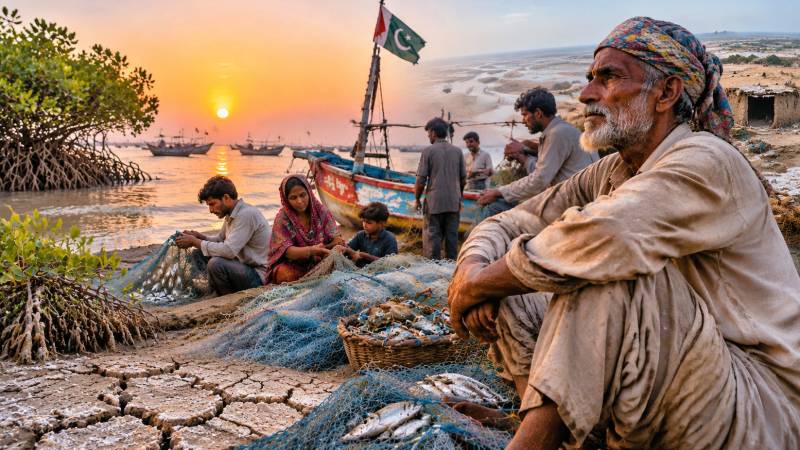
On World Fisheries Day, observed globally on 21 November, Sindh confronts a contradiction that has become structural. The province holds roughly 71 percent of Pakistan’s marine fisheries resources and has long supplied between half and two-thirds of the national marine catch, yet the communities that harvest those waters endure simultaneous ecological collapse, market exploitation, and cross-border imprisonment. From Manchar Lake down to the sediment-starved mouth of the Indus and the Zero Point jetty on Badin’s Sir Creek border, storages and diversions justified as national progress have starved the lower basin of freshwater and silt while dumping untreated drainage and sewage into remaining water bodies. Paired with an unmarked maritime boundary that turns ordinary fishing into a detention risk, non-inclusive upstream development has systematically devastated fisherfolk livelihoods across the entire lower Indus corridor.
That devastation registers most sharply along the coast, where multidimensional poverty now exceeds 80 percent. The inversion is striking: whereas coastal strips elsewhere typically outperform the interior through fisheries, ports, trade, and tourism, Sindh’s coast has become a zone of concentrated deprivation. Communities living atop the bulk of the country’s marine wealth are absorbing the full cost of water decisions taken far upstream.
The productivity of Sindh’s coastal shelf depends on freshwater and silt passing Kotri Barrage, yet releases into the delta have fallen over the past fifty years from around 140 million acre-feet to roughly 14 million, with recent assessments putting dry-season inflows nearer 20 percent of historical volumes. Clause 7 of the 1991 Water Accord recognised the need for minimum escapage below Kotri to check seawater intrusion, yet neither the 10 million acre-feet seasonal figure once sought by Sindh nor the later 5,000-cusecs year-round recommendation has been enforced. As a result, seawater now penetrates 84 kilometres up the Indus estuary and creek salinity reaches 50 parts per thousand. Experts estimate that nearly 3.5 million acres of agricultural land in Badin, Sujawal, and Thatta have been lost to sea encroachment since 1956, while Keti Bandar has been relocated three times as earlier town sites disappeared beneath the tide.
At Zero Point in Ahmed Rajo (Badin), this water crisis collides with the wreckage of the Left Bank Outfall Drain. After tropical cyclones and scouring collapsed the Cholri Weir in 1998–99; a structure built to protect productive coastal lakes, or dhands—the World Bank accepted a "no-action" decision on reconstruction. Seawater now surges 41 to 43 kilometres inland, turning the drainage corridor into a destructive tidal creek, salinising the Cholri and Pateji dhands, and flooding coastal talukas whenever high tides meet outbound drainage surges. For the indigenous Mallah families who anchor their boats there, both freshwater inflows and the brackish fisheries that once sustained them have vanished.
From the freshwater-starved Indus Delta to the disputed waters of Sir Creek, Sindh’s fishing communities are being pushed towards ecological ruin, economic exploitation and geopolitical insecurity by decisions that deny them their share of water, land and marine resources, turning the very waters that once sustained their livelihoods into a source of displacement, poverty and imprisonment.
The same stretch of coast places fishers inside one of South Asia’s most unforgiving geopolitical zones. Sir Creek’s shifting mudflats leave no visible demarcation, and artisanal boats; often without reliable navigation equipment, easily drift across the line at night. Pakistan’s National Commission for Human Rights recorded in February 2026 that hundreds of Indian and Pakistani fishers are arrested annually. Although intermittent repatriations occur, detentions routinely stretch into years due to slow nationality verification and a largely inactive bilateral judicial committee on prisoners. An eleven-year-old minor has been held among ten fishers whose families received no confirmation of whether they were alive, brothers have died waiting for one another, and one Pakistani fisher died of COVID-19 in an Indian jail even after completing his sentence. Back home, wives and mothers receive no subsistence allowance and are forced into piecework or begging, even as arrests continue; most recently on 25 October 2026, when India's Border Security Force apprehended four more Sindh fishermen and seized their fibre boat in the same waters.
Against this backdrop of ecological and geopolitical vulnerability, the proposal to carve coastal Sindh into a separate province acquires a sharper meaning. Presented as administrative reform, it risks functioning as the largest land-grab scheme yet aimed at the coastal strip. Customary access and residual tenure held by indigenous Mallah and neighbouring communities are already fragile. Drawing a new administrative or provincial boundary across this landscape, that also unconstitutionally and against will of the local people, would accelerate the formal transfer of remaining usable land, mangroves, and tidal flats into titles held by interests far removed from the water, stripping coastal residents of their last residual claim to the resources that still sustain them.
Pakistan Bureau of Statistics data placed FY2025–26 seafood exports at USD 482 million; nearly USD 86 million below the Ministry of Maritime Affairs’ preliminary claim, while overall export volume edged down. Roughly a third of the catch is still sold unprocessed, and high-value European markets remain largely closed nearly two decades after the original hygiene ban. Measured against the 2025 FAO theme of dignity and decent work and its Voluntary Guidelines for Securing Sustainable Small-Scale Fisheries, Sindh’s April 2026 amendment in relevant legislative instrument, raising fines for illegal trawling, remains incomplete without closed-season income protection and public cold-chain investment.
Local resilience efforts show what is possible when communities are supported. The Delta Blue Carbon partnership has reported more than 101,000 hectares of mangrove restoration alongside thousands of jobs, while women-led mud-crab fattening pilots in Badin and Kharo Chhan have demonstrated that household incomes can recover even on saline land. Yet those gains remain exposed to the very basin-wide hydraulic and border pressures that World Fisheries Day is meant to confront. Without enforceable environmental flows below Kotri, operational sewage treatment, and a humanitarian boundary arrangement in Sir Creek, the Mallah crews at Zero Point will continue to mark 21 November not as a celebration of coastal livelihoods, but as a ledger of everything withdrawn from them.