

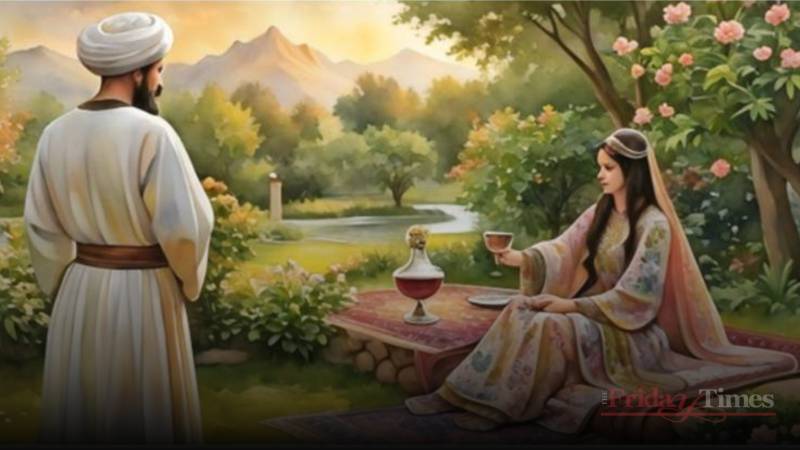
As I explored the poetry of Hafez of Shiraz in the original, in translations and commentaries, I was delighted and surprised to know that Friedrich Nietzsche, the 19th-century German philologist/philosopher, admired Hafez. And I was disappointed that Allama Mohammed Iqbal, 20th-century South Asian poet/philosopher did not. What did Nietzsche find so admirable in Hafez, a poet from a different culture and tradition? In contrast, why did Allama Iqbal viciously criticize Hafez, a criticism he had to withdraw in face of a huge backlash from prominent Muslim writers and ulema?
These questions intrigued me. I have refrained from discussing, evaluating or passing judgement on their philosophies, though some references and comments are unavoidable; their views and attitudes towards life, music, and poetry were coloured by their philosophy and world view and vice versa. Unlike Nietzsche’s references to Hafez, I have used secondary sources for Iqbal; his criticism of Hafez was removed from subsequent editions of his works. I have focussed on a few key themes: 1) The ‘Dionysian’ ecstasy- wine and intoxication (real and metaphorical). 2) The meaning of life, and the role of music, poetry and the arts; 3) Tragic view of life (Amor fati), acceptance/affirmation of life, with all its joys and suffering and 4) Contempt for religious puritanism, hypocrisy and ascetic denial of life. Ghazal numbers for Hafez refer to the Khanlari Edition of the Divan.
Real versus Metaphorical Wine and Intoxication: The Dionysian and the Rend
Nietzsche admired Hafez because he sensed ecstasy and Dionysian joy in his poetry. Interestingly, Nietzsche disapproved of drinking alcohol. Like Iqbal, he thought it dulled the senses, reducing human capacity for endeavour, the drive towards self-overcoming (will- to- power). His “Dionysian” spirit—named after the Greek god of joyful celebration and ecstatic affirmation of life – did not rely on wine or alcohol. He saw a deeper, more positive kind of intoxication in Hafez.
In one of his poems dedicated to Hafez, Nietzsche praises his ecstatic lyricism, which he found “intoxicating”; he wonders why Hafez needed to drink wine: “To Hafiz: A Water Drinker’s Question”-(Kanani Vol 2-p-297-298)
“The intoxication of all intoxication you are
What need do you have to ask for wine?”
The traditionalist view is that all references to wine in Hafez are metaphorical. Dick Davis, Hamid Dabashi and Leonard Lewisohn argue that Hafez uses wine in both registers. His beliefs in erotic spirituality and the religion of love (madhab-e ishq) allowed him to indulge in and celebrate worldly pleasures and express it in the richly ambiguous symbolism of his lyrical poetry:
“Ashiq-o rind-o nazar bazam-o mi goyam fa’sh
Ta badani ke be chandi’.n hunar araasta-em
(I am a lover, a rind and an ogler, and I say it openly;
So all may know with how many merits I am adorned. Ghazal 305/ 2: Transl: Reza Saberi)
The rend that populates Hafez is a deeply sensitive, joyous person, an inspired, “pious rake,” as Leonard Lewisohn and others have explained in Hafiz and the Religion of Love in Classical Persian Poetry. He is far from the dissolute, debauch or a drunkard that Iqbal probably understood him to be. He drinks to drown out any trace of self-importance or selfishness, and dislikes hypocrisy:
“Ba mey-parasti az a’n naqsh-e khud bar aab zadam
Ki ta khara’b kunad naqsh-e khud parastidan”
(Through my enthusiasm for wine, I have thrown the book of my good name into the water;
but doing that ensures that the handwriting in my book of grandiosity will be blurred; Ghazal #385/; Transl: Leonard Lewisohn/Robert Bly)
“Ja’m-e mey gi’ram-o az ahl-e riya du’r shudam-
ya’ni az khalq-e jeha’.n paak dili baguzinum”
(I will take the cup of wine and stay away from hypocrites;
That is, of the people of the world, I will choose the one with a pure heart- Ghazal 347/ 4, Transl: Reza Saberi)
Iqbal was not amused by all these lyrical outpourings. For him, the poetry of Hafez represented drunkenness, dissolution and inaction, a sign of decadence and a slavish escapism. In verses severely critical of Hafez, which he removed later from Asrar-e Khudi due to backlash, Iqbal had this to say:
“Aan faqih-e millat-e meykhwargaan
Aan faqih-e ummat-e becharegaan
Bugzar az jamish ki dar meenay-e khweish
Chun mureedan-e Hasan darad hasheesh
Mehfil-e u khur-e abra’r nist
Sagher-e u qa’bil-e ahra’r nist
Bi niya’z az mehfil-e Hafez guzar
Al hazar az gu safinda’n al hazar”
(That jurist of the wine-drinking nation,
That imam of the helpless congregation;
Pass by his goblet, for in its crystal,
Like for the disciples of Hasan, lurks hashish;
His gathering is unfit for the righteous,
His cup is not worthy of the free,
Pass aloof from the gathering of Hafiz)
Iqbal was categorical in his rejection and condemnation of erotic spirituality, the shahedbaazi and nazarbaazi that animate poetry of Hafez. If the intoxication and drunkenness was only metaphorical, as many Sufi and religious interpreters argued, why would Iqbal be critical? After all, in his Masnavi Javid Nama, his guide was Rumi, whose poetry also contains symbolism of the metaphorical wine and intoxication. Iqbal felt that “the spiritual wine, once his (Sufi’s) proud possession, no longer intoxicates him with love of God, but rather has become an excuse for lethargy and inaction”, argues M. Mir, in his defense.
Perhaps, Iqbal and Nietzsche each saw through this fog of the real and metaphorical wine in Hafez, but in fundamentally different ways: Iqbal was right about the wine being often real, but wrong to condemn the entire corpus and sensibilities of Hafez as induced by ‘drunkenness.’ At the same time those who criticized Iqbal and defended Hafez did so for all the dubious reasons!
Three Characters in Search of Meaning of Life
“It is only as an aesthetic experience that the existence and the world are eternally justified.” Nietzsche, Birth of Tragedy
His religious beliefs and love of God did not prevent Hafez from enjoying love, beauty and bliss in this world:
“Man adam-e behashti-am amma dar in safar
Ha’li asir-e ishq-e jawanan-e mehwasham”
(I am a man from Heaven, but on this path I see,
My love of youth and beauty have made a slave of me: Ghazal 329/3: Transl. Dick Davis)
Nietzsche recognized the “blissfully mocking” art of Hafez as truly ‘immortal’:
“For there is no necessary anti-thesis between chastity and sensuality…. this holds good for all those well-constituted, joyful mortals…. like Hafez and Goethe” p. 535, Basic Writings of Nietzsche
His admiration for Hafez appears at least a dozen times in his books. “An art prompted by gratitude and love... blissfully mocking like Hafiz.” (The Gay Science); “..that accommodating and playful surrender to the affects, as Hafiz and Goethe taught it, the bold dropping of the reins, that spiritual-physical licentia morum (moral license).”(Beyond Good and Evil); “The highest and most illustrious human joys, … come, as is reasonable, only to the rarest and best-constituted men .. It is probable that with such perfect and well-constituted men ( i.e. Hafez and Goethe) the most sensual functions are finally transfigured by a symbol-intoxication of the highest spirituality: The Will to Power) . This admiration was not superficial, or a “whimsical” love of things Persian, as Hamid Dabashi notes in Persophilia.
Nietzsche found in the poetry of Goethe and Hafez key elements of his toolkit for struggle against Nihilism and Western Romanticism. He may have found a soulmate in Hafez:
“Dar i’n zama’na rafiqe ke khali as khalal ast
Surahi-ye mey-e nab o safina-e ghazal ast”
(In these times, the friend who is without blemish,
Is a flask of clear wine, and a book of songs. Ghazal #46; Transl. Peter Avery)
Nietzsche had serious doubts about the capacity of reason to comprehend the ultimate reality:
“that our moral judgments and evaluations too are only images and fantasies based on a physiological process unknown to us”- Nietzsche, Daybreak
He might have heard echoes of this insight in numerous couplets of Hafez who -though a Muslim and a believer- could still harbour an open, skeptical, and questioning attitude towards life:
“Wuju’d-e ma muamma-eest Hafez
Ki tehqi’q-ash fusoon-ast-o-fasa’na”
(Hafez, our existence is an enigma (puzzle), Our answers are only fables and myths. Ghazal #418 / 9 Transl: Geoffrey Squires (Reza Saberi))
Iqbal, rooting for a more action-oriented Islam, was likely unimpressed by this attitude.
Motreb, Moghanni and the Dionysian Versus The Rod of Moses
“Without music life would be a mistake. The Germans even think of God as singing songs” (Nietzsche, Twilight of the Idols, Maxim 33)
Iqbal seems to suggest that the spiritual and carnal are distinct modes of ecstatic experience. He advocated for the spiritual. For Nietzsche and Hafez, there was no such distinction
Nietzsche learned to play music in early childhood and composed music as a teenager. Even when struck by the brain disease at the age of 45 that took his sanity and ultimately his life a decade later, he reportedly could still play Beethoven. For him, music’s power was inaccessible to rational language and thought. In Hafez, Nietzsche probably saw this “Dionysian” element- the chaotic, non-rational, and purely instinctual joy of music?
“Muba’sh be mey-o mutrib ke zer-e ta’q-e sepher
Bad-een tara’na gham az dil bedar tawa’ni kard”
(Do not be without wine and minstrel because, beneath the arch of heaven,
With this song you can rid the heart of sorrow- Ghazal# 137 /2; Transl: Peter Avery)
Interestingly, the appellation ‘hafez’ was commonly used, not just for a person who has memorized the Qura’n, but also for a professional musician or singer; musical techniques were transmitted orally from one generation to the next. Dick Davis says Hafez chose his takkhallus, or pen name to signify both these meanings. Hafez also recited and sang his own ghazals, and thought highly of his own voice and singing talents:
Ze chang-e Zohra shunidam ki subh-dam mi guft
Ghula’m-e Hafez-e khush lehja-o khush awa’zam
(At dawn, I heard the lute of Venus saying:
‘I am the slave of the sweet voiced and sweet singing Hafez’: Ghazal # 325/ 9; Transl: Reza Saberi)
The motreb (minstrel), and moghanni (singer, minstrel) appear very frequently in his ghazals. For Hafez, as for Nietzsche, music holds the key to the ecstatic experience that takes you beyond your ordinary self:
“Mutrib kuja’st ta hama mahsul-e zuhd-o-ilm
Dar ka’r-e chang-o barbat-o awaaz-e nay kunam”
(Where’s a musician, so that I can give, The profit I once found, In self-control and knowledge, for a flute’s songs,
And a lute’s sweet sound- Ghazal # 343 /2); Transl: Dick Davis,)
Nietzsche famously expressed his love of dance as a Dionysian art:
"I would only believe in a God who could dance." (Nietzsche, Thus Spoke Zarathustra, the Dance Song)
Dance and music were not proscribed by the God that Hafez believed in. Nietzsche may have sensed this in Hafez’s ghazals:
“Bar sar-e turbat-e ma ba mey-o-mutrab beneshee.n
Ta ba-buyat z lehad raqs kuna.n barkhezam”
(Sit at the head of my tomb with music and wine,
That at your scent, I may arise dancing out of my grave; (Ghazal# 328 /4; Transl: Peter Avery).
“Chu dar dast ast raudi khush bazan mutrib sarodi khush
Ke dast afsha’n ghazal khwaneim – o pa ku’ba’n sar andazeim”
(A fine lute’s in your hand, my friend, so give us a fine song;
We will wave our hands and stamp our feet, and dance, and sing along)-Ghazal # 367 /4; Transl: Dick Davis
According to Zafar Anjum, Iqbal also loved music, often sang his ghazals, and learned to play the sitar. Hafez, Iqbal, and Nietzsche therefore shared some similarities but also had fundamental differences.
Iqbal’s poetry contains often contradictory views on the importance and purpose of arts. Take the following examples from his collection Zarb-I Kalim (The Rod of Moses):
“Sheir se roshan hai jaan-e Jibraeel-o Ahrman
Raqs-o-mauseeqi se hai soz-o-suroor-e anjuman
Faash yun kartra hai ik Cheeni hakeem israr-e fun
Sheir goya rooh-e mauseeqi hai raqs iska badan”
(Poetry illuminates the soul of Gabriel and Ahriman
Through dance and music comes the pathos and ecstasy of life
A Chinese sage had characterised the secret of arts thus
'Poetry is the soul of music, and dance is its body.')
This almost sounds as if Iqbal is totally in sync with Nietzsche and Hafez. Except that he is not:
Cho.r Europe ke liye raqs-e badan ke kham-o pench
Ruh ke raqs mein hey Zarb-e Kalim-ullahi
Sila us raqs ka hay tishnagi-ye kaam-o-dehan
Sila is raqs ka darweshi-o-shahenshahi"
(Leave behind the twists and turns of the bodily dance for Europe,
In the dance of the soul lies the Strike of Moses’ Staff!
The reward for that (bodily) dance is thirst in mouth and eyes,
The reward for this (spiritual) dance is both poverty and kingship!")
Iqbal seems to suggest that the spiritual and carnal are distinct modes of ecstatic experience. He advocated for the spiritual. For Nietzsche and Hafez, there was no such distinction: music, dance and poetry were fundamental life forces. Iqbal also preferred a moralizing, didactic art, a means for a higher end:
“Keh gaye hai.n sha’yeri juzweist az paighambari
Haa’n suna de mefil-e millat ko paigha’m-e sarosh”
(The sages have taken poetry as part of prophethood,
Yes, announce the Archangel's message to the nation – Iqbal, Ba’ng-i Dara, Jami & Butt)
In a poem titled “Funoon-e Lateefa” (The Fine Arts) he states that moral, psychological and social purpose of art and poetry was missing not only in Hafez, but the entire corpus of Persian (Ajam) poetry:
“Hai sheir-e ajam garche tarab-naak-o dil a’wez
Is sheir se hoti nahee.n shamsher-e khudi tez”
(The Persian verse, though ecstatic and alluring,
Cannot sharpen the sword of the Self: Iqbal, Zarb-I Kali’m)
Life is short: Amor Fati, tragic artist, rend and mard-e kamil
“The tragic artist is no pessimist – on the contrary, he says yes to all that is questionable
and even terrible; he is Dionysian.” (Nietzsche, Twilight of the Idols)
Hafez also seems to share Nietzsche’s ideas of ‘amor fati’ – the love of one’s fate – or the ‘tragic’ worldview; in this view, suffering and joy, pain and pleasure are deeply intertwined, to be happily endured:
“Muqa’m-e aish mayasser nami showad bi ranj
Bale ba hukm-e bala basta-and ahd-e alast”
(If there is no sorrow, there can be no happiness,
And when the world was made, men knew this, and said yes; Ghazal # 20; Transl. Dick Davis)
Nietzsche must have also sensed an appreciation and celebration of the here and now – the evanescent world while it lasts – in the poetry of Hafez:
“Ha’sil-e kaar gah-e kaun-o-maka’n ein hama nist
Baada pesh aar ke asba’b-e jeha’n einhama nist”
(The stuff produced by in the factories of space and time, Is not all that great.
Bring some wine, because, The sweet things of this world are not all that great)
“Panj roze ki dar in marhala mohlat daari
Khush beya sa’yi zama’ni ki zama’n einhama nist”
(Before you go to the grave, take it easy, give yourself time,
Because time is not all that great- Ghazal # 75; Transl: Robert Bly, Leonard Lewisohn)
For Nietzsche as for Hafez, the first step for any meaningful engagement with life, was to recognize its fleeting, apparent purposelessness, to stare into the abyss, as Nietzsche put it. Iqbal saw these utterings as signs of pessimism, passivity and decadence.
Nietzsche’s Critique of religion: of the Dionysian, Zahid and Mard-e Momin
Even while acknowledging Nietzsche’s debt and influence, Iqbal had a rather patronizing and condescending attitude towards him, parroted by many of Iqbal’s admirers.
“Agar hota wo majzub-e firangi is zamaane mein
To Iqbal us ko samjhataa maqam-e kibriya kya hai”
(If that European ‘Majzoob’ had lived in my time,
Iqbal would have explained to him the exalted station of the Holy Prophet-Thoughts of Iqbal, Javid Iqbal/Brig. Taimur Afzal Khan)
Nietzsche’s critique of religion and Christianity was directed at its ascetic denial of life. He otherwise thought highly of the ‘manly’ spirit of Islam, and of the “wonderful Moorish cultural world of Spain” (Anti-Christ page 497). This may be another reason he admired Hafez, who was also critical of the ascetic orthodox, puritanical Islam:
“Chuna.n bezad rah-e Islam ghamza-e sa’qi
Ki ijtinaab ze sehba magar Suheib kunad”
(And when our serving boy’s all smiles and winks, He slaps Islam’s austerity so hard that even Sohayb wouldn’t shun, The red wine that he serves to me- Ghazal # 183/ 4: Transl. Dick Davis)
Iqbal, despite his own often critical view of Islamic orthodoxy, probably thought that with this ‘wine and the serving boy’ stuff, Hafez had gone a bit too far for his liking.
Can rendi inspire revolutions?
For a mind wrestling with critical, existential issues, Iqbal expresses conflicting, often contradictory ideas and emotions in his prose and poetry. “Iqbal was all over the place” Nadeem Farooq Paracha argues in his scholarly article.
Leonard Lewisohn thinks that Iqbal’s judgement of Hafez was typical of the educated elites of early 20th Century in Iran and Pakistan, who “deplored the religious and sacred aspects” in poetry of Hafez and regarded it as “socially decadent and intellectually backward”. Despite enjoying a reputation as a great poet in Urdu/Persian, Iqbal saw himself, not as a poet, but a crusader and social reformer, hoping to rejuvenate Islam, as argued by M Mir in “Iqbal- Poet and Thinker”; poetry for him was useful only as a weapon in this crusade. Could this have clouded his judgement of the aesthetic principle that animated the lyrical and poetic genius of Hafez? Iqbal clearly did not see his ‘Mard-e Momin’ there.
Should good art first and foremost satisfy an aesthetic criterion- touch the heart and senses? Or should it be explicitly propagandist and an agent for social, moral and revolutionary change? Using poetry as guide to action can have unforeseen consequences. Iqbal has been appropriated by Muslim Leaguers, Islamists of all hues, agitators of anti-Ahmadiyya campaigns, as well as Islamic modernists. Was Iqbal also wrong to think that poetry of Hafez only encourages dissipation, inaction and decadence? If so, why would it continue to animate political life in Iran in the 20th and 21st Century?
Karimi-Hakak and Bill Wolak give three examples: The student agitators and poets in the uprising against the Shah recited/quoted Hafez in 1978. In 1979, after the Islamic revolution, Iranian writers demonstrated against the regime with a banner that had a line by Hafez (Ghazal # 165); Years later, the reformist President Khatami, forced to resign, stood up in parliament and instead of a speech, recited a ghazal by Hafez, and left (Ghazal #371)
Was Hafez more modest and insightful about what future generations may learn and seek from his poetry, as the lines from a ghazal inscribed on his grave suggest?
“Bar sar-e turbat-e ma choon guzari hjimmat khwah
Ki ziyarat gahe rinda’n-e jeha’n khwahad bood”
(Should you pass by my shrine when I am gone, Ask for soul-power, spirit-force, and espirit,
For all the world’s pious rakes and holy reprobates will be pilgrims to my tomb-Ghazal #201; Transl. Lewisohn)