

In 1918, when the First World War was coming to an end, the already depleted Ottoman Empire was facing defeat and rebellions. The Ottomans, headquartered in Istanbul, had sided with Germany in the hope that their empire would be able to restore its rule over at least some of the territories that it began to lose from the 19th century onwards. But the Ottoman armies were routed by allied forces led by the British. When the British facilitated Arab tribes in Arabia to rise up against the Ottomans, Dr Ansari, a member of the All India Muslim League (AIML) invited some ulema to an AIML session in Delhi. The ulema agreed to attend.
But not all AIML leaders were so thrilled by this. For example, an AIML leader Choudhry Khaliquzzaman feared that the party’s program would be overshadowed by the emotion of ‘jihad’ being popularised by the ulema and the Pan-Islamists. He warned Dr Ansari of the dangers of Islamising politics. But Khaliquzzaman was unable to keep AIML from joining the ‘Khilafat Movement’(Caliphate Movement) that aspired to dissuade the British from dismantling the Ottoman caliphate. Once Khilafat became a powerful symbol in the minds of India’s Muslims, the ‘modernist’ leadership of the AIML was marginalised. The ulama, as the custodians of religion, came forward to lead the Muslims of India. According to the Pakistani historian Mubarak Ali, many Muslim leaders who had started their political careers as moderates, were won over by the ulema and became ‘maulanas with beards.’
However, men such as the barrister Muhammad Ali Jinnah who had once been a member of Indian National Congress (INC) before joining the AIML, took Khlaiquzzam’s line. In 1919, when the INC leader Mohandas Karamchand Gandhi was planning to bolster the Khilafat Movement with INC’s own anti-British programme, Jinnah wrote to Gandhi warning him that the movement would unleash religious passions and that the Hindus and Muslims would lose the political and economic gains that they had negotiated with the British.
The Khilafat Movement soon turned violent. By 1924, the once united Muslims and Hindus began to fight each other. The defeated Ottomans were overthrown by secular Turkish nationalists, and the leader of the nationalists, Mustafa Kemal, abolished the caliphate and declared Turkey a republic. The INC emerged from the movement badly bruised and so did the AIML. The resultant vacuum created by their retreat was filled by radical Hindu nationalist and Islamist groups, before the INC and AIML were able to retrieve their bearings.
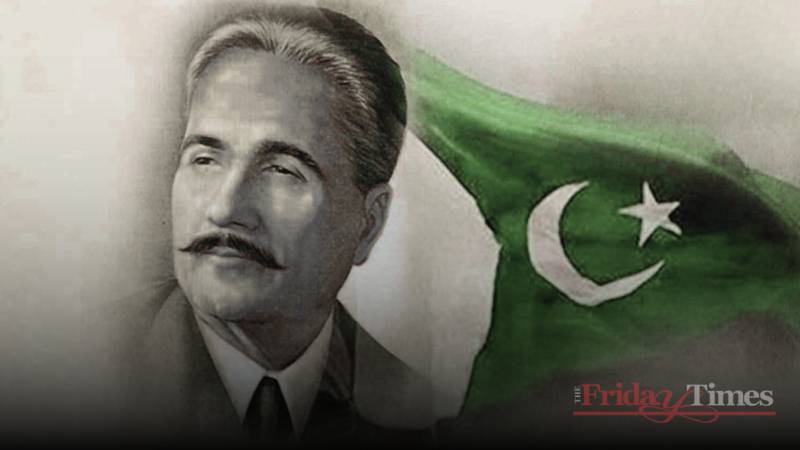
Another casualty was ‘Islamic modernism’ that had been gaining a lot of currency among the Muslim elites, middle-classes and students, before being sidelined during the Khilafat Movement by radical Islamists, ulema and Pan-Islamists. It was poet and philosopher Muhammad Iqbal who would come to the rescue of this fading idea, first initiated by the likes of Sir Syed Ahmad Khan. Muhammad Iqbal was a man of considerable intellectual prowess. He had initially supported and then joined the Khilafat Movement, but his stay in it was brief. He dropped out after accusing its leaders of being overly sentimental. He then derided the Ottomans for being “a shame to Muslims.” In fact, he believed that the fall of the caliphate could be catalytic to the emergence of a renaissance in Islam. He also applauded the take-over of Turkey by Mustafa Kemal.
But to this day many modernists debate whether Iqbal was really part of the Islamic modernist current. He was accepted as one largely due to the manner in which he was appropriated by mid-20th-century modernist Muslim scholars. But from the late 1970s onward, he began to be appropriated by the anti-modernists as well, and by the postmodernists. The fact is: across his career as a philosopher and poet, Iqbal seamlessly moved from left to right and back again. He was an impact writer. His prose was weighty and his poetry rather breathtaking. He liked being appreciated. It was always tough to pin him down or pigeonhole him. Once when he wrote an ode to communism, he began being championed by the left as a ‘Bolshevik.’ But after he was knighted by the British Crown, he rushed to clarify his position by stating that he wasn’t a communist but a reasonable and logical Muslim.
The pigeonholing began in earnest after his demise in 1938. On the one hand, he was hailed as a rational modernist who played a major role in giving Islamic modernism a political dimension. Decades later, he began being glorified as a fiery anti-colonialist who applied a rejuvenated understanding of Islam to inspire Muslims to create an Islamic state powered by Sharia laws. Iqbal’s brilliant but mercurial poems and writings appeal to both the views. But it was the modernist Muslim politicians and intellectuals who beat their Islamist counterparts in the race to shape Iqbal according to their political needs.
Iqbal had joined the AIML, many of whose leaders were graduates of Sir Syed’s educational institution in Aligarh. Iqbal’s contemporaries in the AIML saw him carrying forward Syed’s legacy. Iqbal was born in Sialkot, Punjab. His ancestors were from a Hindu clan in Kashmir who had converted to Islam during the reign of the 16th-century Mughal emperor Shah Jahan. Iqbal got his initial education from a madrassa before moving to a school and then to a college in Sialkot. In 1897, he received his bachelor's degree from a college in Lahore and then a master's degree from the Punjab University. In 1905, in Munich, Iqbal earned a PhD in philosophy from the Ludwig Maximilian University. Iqbal became increasingly aware of the changes that were sweeping across India’s Muslim community during and after the Khilafat Movement.
By the late 1920s, a Muslim middle-class had emerged. Many teachers, lawyers, professors, military officers and bureaucrats were recruited from this class by the British. But in the aftermath of the Khilafat Movement, this class began to feel insecure. As a consequence, some of its segments hurried out to support the radical Islamist groups that had become prominent during the movement; whereas the rest wondered what course Muslim politics would take after the AIML had been weakened by infighting, and the hopes of communal harmony and anti-British politics raised by the Khilafat Movement had eroded. Iqbal became the intellectual product and expression of this existentialist turmoil. More than just an expression, he became a possible answer. He often wrote about his despondency over the rising strife between the Hindus and Muslims of India. Even before the Khilafat Movement had begun to implode, Iqbal was convinced that the Muslims of India required a new expression; one which should emerge from ‘individual autonomy’ and was not chained to the worldviews of the self-appointed guardians of Islam.
Iqbal was conscious of the fact that the Muslim community in India was evolving with two competing sets of ideas: one encouraged the community to embrace ‘Western’ education and modernity to regenerate itself; and the other explained the community as part of a Muslim ummah striving to cleanse itself and move towards the formation of a global caliphate. Iqbal tried to uniquely merge the two tendencies to come up with a complex synthesis which would go a long way in adding a political dimension to Islamic modernism, and eventually become an important building block in the construction of what would become Pakistani nationalism.
Iqbal the Islamic socialist and qalandar perished with the overthrow of the Bhutto regime in July 1977
Iqbal thought highly of Sir Syed. He praised Syed for being the first Muslim (in India) “to glimpse the positive character of the age which was coming.” But in his attempt to create the aforementioned synthesis, Iqbal was somewhat critical of the ‘excessive’ use of rationalism (in matters of faith) that Sir Syed had championed. Iqbal explained that this did not mean he (Iqbal) was advocating irrationalism, but too much rationalism in this context could create cleavages in a community with a shared religion.
Iqbal may have comprehended the theology that Sir Syed had constructed as being intolerant towards the theologies of Syed’s opponents, but Syed’s opponents had also refused to tolerate his ideas – even when on numerous occasions, Syed had agreed to find a common ground between their theologies and his. Nevertheless, Iqbal saw Syed’s insistence on being ‘rational’ in matters of faith as overt, and a deterrent to achieving a more meaningful exchange between Syed’s followers and those that Syed had accused of being irrational. Iqbal believed that this caused disunity among the Muslim community of India.
But Iqbal had also turned his attention towards those who had opposed Syed’s modernist propensity. He agreed that the Muslims of India were part of a larger global Muslim community, and that Islam cannot be separated from the community’s everyday life. Nevertheless, Iqbal believed that this idea was being upheld by men who wanted to retain a stagnant status quo. Iqbal maintained that the only way the distinctiveness of the community could be realised was through a jolting rejuvenation of Islam and an ‘ethical education of the Muslim masses.’
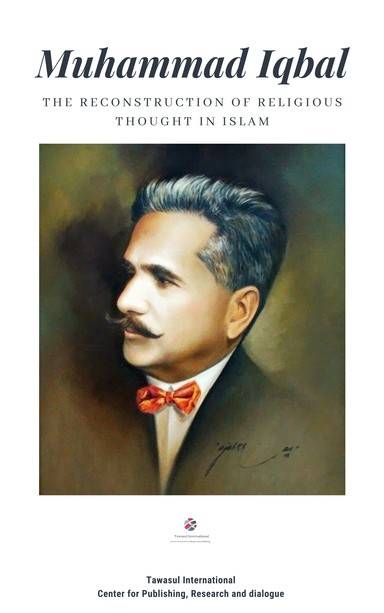
In his magnum-opus, The Reconstruction of Religious Thought in Islam, Iqbal claimed that he was reevaluating Islamic thought to make Islam and modernity find a common ground. However, to him, it had to be a ground on which Islam would play a more prominent role, but without dismissing the role of modernity the way most ulema were doing. The Islam that Iqbal was moulding was, as he put it, “according to the modern spirit of the times.”
But who was Iqbal talking to? There was an economic and intellectual Muslim elite that had adopted modernity. Then there were the Muslim ‘masses’ who were largely illiterate. Iqbal was from the elite. His treatises were aimed at intellectuals and political leaders from his own class because they were the ones constructing a nationalism for Muslims in India as a way to counter Hindu ‘majoritarianism.’ There was always more than one Iqbal. One was a rationalist, and the other a romantic. Perhaps this is why he is cherry-picked so conveniently by the modernists and the conservatives, the leftists and the rightists, the secular and the Islamists.
Islamic modernists of the mid-20th century pointed towards The Reconstruction of Religious Thought in Islam as an example of his rationalism. But a close study of this book suggests that by the early 20th century, Iqbal wasn’t as much of an admirer of the rationalist philosophers as his 19th-century modernist predecessors had been. Nevertheless, many of his ideas were still rooted in modern Western philosophy.
Instead of rationalists such as Descartes (d 1650) and Spinoza (d 1677), and empiricists such as John Locke, Iqbal first seemed to have landed on latter-day Enlightenment thinkers such as David Hume (d 1776). To Hume, sensory perceptions that trigger emotions were the primary sources of thought formation. Consequently, Iqbal then began to venture more closely towards the European ‘idealists,’ especially the Germans Immanuel Kant (d 1804), Friedrich Hegel (d 1831) and Friedrich Nietzsche (d 1900). He was able to explore their works in depth when he was studying philosophy in Munich.
To Iqbal, the early Muslims' self (khudi) was thus a product of a dialectic exchange between a pre-Islamic disposition (thesis) and Islamic revelations (antithesis), thus producing a synthesis in the shape of a fully self-actualised person (Muslim)
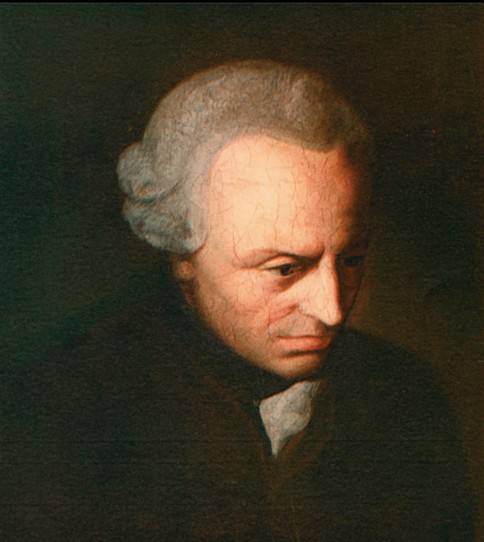
Kant’s ideas were still somewhat in the mould of previous Enlightenment thinkers. He claimed he was a rationalist, but in a 1784 essay “What is Enlightenment?” Kant saw the spread of deist and proto-secularist ideas as somewhat worrying. Kant was not a very religious man, but he had grown up in a family of staunch Christians. He noticed how his parents had used their deep belief in Christianity to cope with the challenges that their life of modest means had posed. To Kant, the complete erosion of religion (as some radical Enlightenment thinkers were proposing) could be devastating for a lot of people. He wrote that he ‘‘found it necessary to make room for religion (in his philosophy).”
To Kant, what lay outside of our minds was subjective, which is then rationalised and objectified in our minds. By this logic, sacred texts are subjective. We conceptualise and rationalise them according to our individual perception of the ‘truth.’ To Kant, reality is subjective, even unknowable. It is only our minds that rationalises it and gives it conceptual meaning. Therefore, according to this disposition, when rationalists (including Sir Syed) were searching for natural laws and reason in the sacred texts, they were just absorbing the subjective and then shaping the subjective into concepts through a rationalising process. In other words, the ‘reason’ that the rationalists posited existed in sacred texts, wasn’t really within the texts but was moulded in their minds and then articulated.
Kant wanted to construct a new system of morality, but not by a rational reading of the sacred texts because, according to him, there was no inherent rationality in them. The rationality in this context was formulated in one’s mind. Therefore, any understanding of religion was the product of the mind. To rationalists and empiricists, reality was objective and existed as is outside the mind; and reason (a product of the mind) had the capacity to study it through empirical means to determine what it was. Sir Syed used the same reasoning to understand natural laws that were objective. To him, they could be understood with the aid of empirical observation and rational speculation. Syed then concluded that these laws were constructed by God and are also present in Islam’s sacred texts.
Spinoza had declared “nature is God and God is nature.” Syed extended this to mean that natural laws were made by a living God and that these laws could only be understood through reason. Nevertheless, to Kant, there were some amicable ethical ideas in Christianity, but they needed to be understood as coming from a person from within and not from a church or a priest. He stated that the rightness of an action is determined by the principle that a person chooses to act upon. If morality (which is subjective) was thoroughly investigated through intellectual reasoning, the conclusion of this process would suggest that the idea of morality itself was reason (because it took shape within the mind).
So, acting in a moral manner was inherently a rational act. Such an act should be based on the understanding of certain logical realisations that could regulate a person’s morality. For example, if one plans to behave in a transgressive manner, he knows that this will lead to stricter laws and thus a loss of certain personal and societal freedoms. This realisation can then discourage one to act in a transgressive manner. Kant also added that a person should ponder, what if it was him or her who was at the receiving end of the transgressive act? This too can dissuade them from acting in a transgressive manner. The subjective needs to be given an objective understanding within oneself for it to regulate his/her behaviour.
In The Reconstruction of Religious Thought in Islam, Iqbal seems perturbed by modernity’s emphasis on secularism. Like Kant, Iqbal too found benefits in religion. Iqbal wanted to ‘reconstruct’ Islam which he thought had been corrupted and weakened by orthodoxy, as well as by the modernists. He attacked the ulema and the clerics for fossilising Islam, but he also questioned the speculative methodology of the modernists in matters of Islam. To Iqbal, such speculation could lead to the erosion of faith, and undermine its importance in those who were being taught to rationally explore the holy texts. In this, Iqbal sounds very much like the medieval jurists who pleaded an end to the speculative methodologies of the Mu‘tazilites.
Iqbal saw no reason for Muslims to adopt secularism. All they needed to do was to rejuvenate their faith with new ways of thinking that could compete amicably with modern ideas and find for the Muslims a place of pride in the modern world. To initiate this, Iqbal took a Hegelian route
The 10th-century founder of the Ash‘arite school of Islamic jurisprudence Abu al-Hasan al-Ash'ari, had insisted that reason must be subservient to revelation. His fellow theologians had feared that too much speculative reasoning could undermine the divine nature of revelation and may also lead to disbelief. But the Mu‘tazilites were theological rationalists. They were exploring Islamic cosmology as a rational occurrence. Like rationalists of the Enlightenment era and Sir Syed, the Mu‘tazilites — centuries before — had posited that rationality was not only a product of the mind, but everything that existed outside the mind, too, was part of a rational order and system. The Mu‘tazilites were not debating the existence of God. They took that as a given and as a rational belief because the universe could not have created itself. It was there because there was a creator. And the creator was ‘the uncreated God.’ To Spinoza, God was the only ‘substance’ with which everything in the universe was made of.
The 20th-century Islamic modernist Dr Fazalur Rahman Malik was of the view that the Mu‘tazilites were unable to produce doctrines that were emotionally satisfying to the common Muslims. He wrote, Mu‘tazilites understood God as an ‘intellectual construct.’ This left little or no room to experience God and revelation on a more ‘spiritual’/emotional level, or as something that directly interacted with and intervened in everyday lives of the people.
According to Rahman, the surge enjoyed by Islamic orthodoxy from the 12th century onwards was a reaction triggered by the ‘the dogma of reason’ which the Mu‘tazilites began to push through political agencies such as (some) Abbasid caliphs. However, to Rahman, the Mu‘tazilites were correct in maintaining human moral freedom and responsibility. But Iqbal was unmoved by such assumptions. In The Reconstruction of Religious Thought in Islam, he wrote that religion was a combination of scholastics and mystics. A blend of the academic and the emotional, reason and faith, mind and heart.
Thus, religion, being both theory and practice, seeks a more intimate contact with a reality in which experience plays a pivotal role in shaping one’s understanding of life. Iqbal acknowledged intuition’s superiority over the rational domain, suggesting that reason alone wasn’t enough to comprehend reality. By intuition, Iqbal meant knowledge derived from an experience felt beyond the recesses of reason.
To Kant, reality is something that we perceive and conceptualise. We can see an apple, we can taste it, we can smell it, we can touch it and we can hear it (when we bite on it). This sensory information is then categorised by the mind to form a concept, and thus emerges the concept of the apple. In itself, the apple may not be how we perceive it. In a way, what we experience as reality around us through our senses, are concepts that our minds formulate.
Things that are conceptualised in this manner in the mind, Kant called them phenomenon. He then spoke about the noumenal. These are things that too exist but are beyond the reach of our senses. Like, for example, radio waves. They are there, but we can’t see them, touch them, smell them, or taste them. But they exist. Does this mean God is noumenal? Since the noumenal cannot be perceived through the known senses, therefore one will never be able to know what God is. By this logic, God exists, but can’t be perceived through the available senses or through reason.
To Iqbal, however, a noumenal entity (such as God) could be experienced through the human senses. He gave the examples of some ancient Sufi masters but could not clearly explain what it was that they had experienced beyond claiming that they had experienced (the presence of) God. To the Mu‘tazilites and Spinoza, a rational approach was the best tool to understand God’s existence. To Syed, a scientific study of natural laws to determine how they operated was a way to appreciate and understand their maker, God. But to the ‘Counter-Enlightenment’ philosophers and the romantics, these were intellectualised ideas of God and His revelations. To be fully appreciated, God and revelations needed to be ‘felt’ on an intuitive level. This is where Iqbal landed as well. Iqbal is never too far away, though, to admit that Islamic thought had failed to keep pace with the Western sciences and philosophies, especially those that appeared during the Enlightenment.
To him, Muslims had become intellectually lethargic, despite having a rich history of intellectual, scientific and political progress. But he added that reviving the tradition of speculative and rational thought in Islam, or the wholesale adoption of Enlightenment philosophies and ideas were not the solutions to the malaise. The Europeans had found the roots of their problems within Christianity. So, they relegated it to the private sphere through secularism. But to Iqbal, as far as the malaise consuming Muslims was concerned, its reasons did not lie in Islam, but in the manner that its followers had deflated the faith’s ‘true soul and spirit.’ Iqbal located this true soul and spirit in the early years of the faith when Muslims were full of passion and intellect.
So, Iqbal saw no reason for Muslims to adopt secularism. All they needed to do was to rejuvenate their faith with new ways of thinking that could compete amicably with modern ideas and find for the Muslims a place of pride in the modern world. To initiate this, Iqbal took a Hegelian route.
The German philosopher Friedrich Hegel wrote about ‘dialectics,’ or an exchange between opposing ideas (thesis and antithesis) that produces a new idea (synthesis) which becomes the new thesis challenged by a new antithesis, producing a new synthesis, so on and on this goes. According to Hegel, this is how history of ideas has evolved, leading humans to continue bettering themselves. Hegel wrote that it was also through the dialectic process that a human could reach a more insightful understanding of him/herself.
To Hegel, this would be the moment of true self-actualisation. The self-actualised person would then become part of a self-actualised society (which too has reached this stage through the dialectic process).
Hegel called the self-actualised society ‘the absolute spirit’ which continues to evolve through the dialectic process. Hegel claimed this ‘absolute spirit’ would evolve until there are no opposites left within itself and merge with the highest manifestation of this process which he called ‘Universal Reason.’ By this he probably meant God, or godlike. To Hegel, the individual held little significance. He spoke more in terms of societies and cultures shaped by dialects evolving towards an ultimate synthesis that he dubbed as Universal Reason.
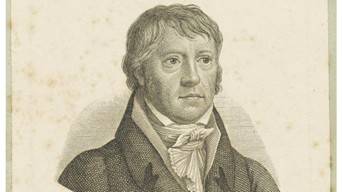
Iqbal, too, set out to create a self-actualised Muslim collective that would come into being through the dialectic process between reason and revelation, science and tradition, physics and metaphysics. Hegel had come to his idea by studying history in an ‘objective’ manner. Iqbal attempted to do the same, but his reading of Muslim history could not be objective because he became heavily invested in romanticising certain aspects of Islam’s early history — especially events that were not known through objective means, but through traditions. As Sir Syed and Chiragh Ali had posited, these were impressions of a past, not history as such.
So, if one was understanding a history, much of which was constructed through subjective sources, then the dialectic process through which this history was being studied, will lack convincing evidence to produce a productive synthesis. This is not to suggest that Hegel’s methodology to build a self-actualised whole was flawless. It attracted many critics who reminded him that historically a thesis and an antithesis has not always produced an enlightened synthesis; and/or it has also produced synthesis that triggered civil strife, war, and bigotry. After all, the Nazis, for example, too, saw themselves as a self-actualised people. Nevertheless, at least I have not come across any of Iqbal’s writings (prose) in which he found any major flaws in Hegel’s ideas. Iqbal was out to create an ‘absolute spirit’ as well, one that would be able to ‘feel’ God’s existence.
To Iqbal, Muslims had lost a ‘self’ that had been conjured in them by Islam and/or by its scriptures, especially the Quran. This self was what had driven early Muslims to excel as a dynamic community. The self was thus a product of a dialectic exchange between a pre-Islamic disposition (thesis) and Islamic revelations (antithesis), thus producing a synthesis in the shape of a fully self-actualised person (Muslim). This dialectic process was present in the community that had first embraced Islam. The community thus, became ‘God’s vicegerents on earth.’ Iqbal saw the process as beginning from an individual and then spreading through him in the community.
But when the synthesis in this case became the new thesis, what was the new antithesis? Iqbal does not have an answer, as if the new thesis (early Islam) was the occasion when the new thesis became so perfect and absolute that it did not produce an antithesis. To Iqbal, what this absolute did experience though, were certain distortions and follies which subdued and weakened the self.
Iqbal called this self, ‘khudi.’ Khudi is a state of self-actualisation that is self-affirming. It nourishes the ego. This ego is not conceited, but a powerful form of self-awareness and self-consciousness. It is driven by intuition that ‘feels’ the presence of khudi as a ‘reality.’ God was the ultimate (and infinite) manifestation of khudi.
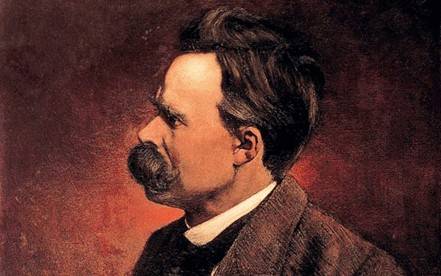
Iqbal looked to create a ‘Mard-e-Momin’ or the ‘New Muslim Man’ empowered by khudi. There is every likelihood that Iqbal’s concept of the Mard-e-Momin was inspired by the idea of Nietzsche’s ‘Übermensch’ or the overman. Nietzsche spoke of a ‘self-overcoming.’ One has to overcome their shame and guilt of desiring power and glory, and that it was okay to envy those who were more powerful. Nietzsche lashed out at Christianity for inducing guilt in people who desired power. Christianity made people weak and meek. Nietzsche encouraged them to seek their desires without guilt and cultivate their envy of others because the others were possibilities of what one could become.
One should then strive and struggle to become what they envy. To Nietzsche, this was a heroic endeavor, that of an Übermensch. Iqbal wrote that a person loses his khudi or the khudi in him becomes weak when the self-affirmation that it encourages is replaced by self-negation. To Iqbal, certain forms of Sufism, for example, look to annihilate the ego. This is a form of self-negation or the rejection of the self.
Self-negation is a source of weakness, lethargy, pessimism and meekness. Iqbal speaks proudly of the ego. To him, the ego is the source of self-affirmation, and this self-affirmation is at the core of khudi. The rejuvenation of khudi is what will construct the Mard-e-Momin and consequently a new Muslim collective.
The ‘heroic’ struggle (to become great) of Nietzsche’s Übermensch included a complete rejection of religion. To Nietzsche, Christianity glorified weakness and meekness and undermined one's heroic strive to become great. Iqbal did not treat religion in this manner. At least not as a whole. He attacked some branches of Islam, such as Sufism, the orthodox, and later, the modernists. But he largely understood Islam as an affirmative faith that (in its ‘true spirit’) awakens khudi which makes a person/community strive to become great. Iqbal claimed that khudi was the highest development in man.
God was infinite khudi, and the khudi in man was finite. Finite khudi cannot exist without the infinite khudi, therefore maintaining a connection with God was vital. Here we see Iqbal stretching to remove himself from his inspirations such as Kant, Hegel and Nietzsche, to posit that what he was suggesting was part and parcel of Islam’s concept of God.
To Nietzsche, God was ‘dead.’ By this he meant that religions had failed to resolve complex problems that had risen in a rapidly mutating modern world where the traditional concepts of God made no sense nor had any purpose. But since Nietzsche despised religion and/or Christianity for reasons already discussed, he did not ask to rejuvenate it. Instead, he passionately pleaded that religion be replaced with a new morality inspired by a pre-Christian past in which men and societies had lived dangerously, strived for greatness, and were unabashed about their desire to attain power. Nietzsche claimed that modernity had ushered the demise of God and that humans were in danger of plunging into a nihilistic state of existence because the idea that there was some supreme being looking over them, had died.
Nietzsche spoke of the creation of an Übermensch who would replace God and stop society’s slide into nihilism. The Übermensch will be mentally and emotionally strong, equipped with the passion and the will to ‘master this world’ by creating his own morality. To Iqbal, Islam was struggling to cope with modernity not because there was an inherent weakness in it or that it had lost its purpose in the modern world. But its followers had. The rejuvenation of khudi was the answer. Nietzsche did not explain what will happen when all humans on the planet reach the mental and emotional state of the Übermensch. Nietzsche hated the ‘herd mentality’ that religions encouraged. But will not a collective of Übermensch believing in the same values and morality become yet another herd?
Iqbal’s Mard-e-Momin was an Islamic Übermensch, but one who will not emerge to replace a bygone God. Instead, the Mard-e-Momin was to become God’s vicegerent in this world who will rejuvenate His subjects by instilling in them the true spirit of Islam. Iqbal had an issue with the purposelessness of the Muslim communities, but not with the idea that these communities would become homogenous once they attain khudi. So, what about the individualism and the ego that Iqbal encouraged as a prerequisite to attaining khudi? Will not the Mard-e-Momin lose his individuality and ego in a homogenous community? Iqbal does not address this question, because he was looking to create a homogenous community that was empowered by khudi and ready to re-establish Islam’s supremacy. Iqbal’s ‘absolute spirit.’
His was an attempt to reenact the features of Islam’s early community in the 20th-century context, or at least how he had imagined this ancient community to be i.e., a community that had attained khudi and then set out to conquer the world. It was a complex philosophy but ripe for cherry-picking. Modernists found things in it that suited their agenda, Islamists found what suited theirs, and even Marxists found things in it which they liked. Eventually, Iqbal began to lash out at concepts that contradicted or suspected his understanding of empiricism, rationalism, metaphysics, science and history. He then declared that life was not a set of concepts. So out went Kant. Because unlike Kant, Iqbal as such was not trying to save reason from theology.
Nietzsche had written with force and his prose was poetic. Iqbal matched this with his own powerful prose and poetry in Urdu and Persian. Like Nietzsche’s tone, Iqbal’s too became increasingly messianic. Nietzsche, though no fan of religion, had accused modernity of ‘killing God.’ He then proposed (in a most dramatic manner) his Übermensch as an alternative to God and of the morality and values that were associated with Him. “God is dead,” he declared. It was the ‘modern world’ that had sent Him packing.
So, Nietzsche conceived the idea of an overman who would rise above Christian morality and values, defy the ‘nihilism’ of modernity, and create his own moral and value systems. In so doing, the Übermensch will never shy away from his lust for power and greatness. Inspired by the glorious empires of premodern pasts, he will strive to attain them, even if this requires the mass dispensing of meek weaklings. No wonder the Nazis were so awestruck by Nietzsche, even though, unlike the Nazis, he wasn’t an anti-Semite.
Iqbal was a Muslim nationalist as well. And he struggled with this because like the ulema and the Islamists, he too understood nationalism and the idea of territorial nation-states as being Western and thus, against the universal disposition of Islam. But he was willing to compromise
But was Nietzsche a philosopher at all? He began as one by critiquing the medieval philosophies (scholasticism) and those of the Enlightenment, but he eventually mutated to sound more like a messianic ideologue. There are certain rules that philosophers have to work with, and frames and paradigms that they have to work in. Nietzsche wanted to break away from these because he found them restrictive. He wanted to cross all emotional and intellectual thresholds (‘the Rubicon’) because he felt that his ideas required such a crossing. He called his ideas prophetic; ideas that could only be understood by future generations. Then he went mad and died.
Iqbal too reached a stage in which he believed that he needed to cross the Rubicon to fully form his ideas. Starting out as a ‘rationalist’ who appreciated the ideas of men such as Sir Syed, Iqbal bemoaned that the Muslims had become a community of superstitious, irrational and ghettoised folk, unable to match the scientific, economic and political might of the West. Then, through a dialectic process, he wanted to navigate a middle-path between reason and revelation, science and tradition, West and East. He did not attack Islam as Nietzsche had Christianity. Instead, Iqbal attacked Islam’s followers for becoming intellectually weak and for losing contact with the true spirit of Islam, and with the faith’s glorious history. To him, Muslims had stopped exploring the true essence and nature of God.
When philosophy shifts to explore things such as essence and spirit or what Kant called the ‘noumenon,’ or things which the available senses cannot grasp, this is when it begins to slide into the territory of metaphysics. To Kant and Hegel, even in this territory, reason had to be an important tool of investigation. But when Nietzsche chose impulse as a tool to formulate a philosophy, he became a romantic. Hegel and Karl Marx were idealists, but both claimed that their idealism was rooted in a rational and objective reading of history. Karl Marx had defined his communism as ‘scientific socialism’ (as opposed to what he dismissed as romantic/utopian socialism).
Nietzsche’s vehicle that carried his idea of an Übermensch was a ‘prophet’ who he called Zarathustra. The prophet announced that he had come to tell the people about the Übermensch. Nietzsche was that prophet, really, and he was also the Übermensch because he had crossed the Rubicon and entered a territory that mortal men and philosophers had feared to tread. Nietzsche never shied away from announcing his own greatness. Like Nietzsche, Iqbal too thought he was onto something ‘great.’ There was never any doubt about his ability to conjure powerful words. When he returned to India after his stay in Munich, Iqbal searched for causes to flex his creative talents.
He wrote moving odes to Karl Marx, Lenin, peasant uprisings, Mustafa Kemal and even to the founder of the Ahmadiyya community. Then, he took it all back. He claimed he was never a communist, nor was he enthused by Mustafa Kemal, and then suggested that the Ahmadiyya must be declared a community separate from Islam. He had once declared the founder of the Ahmadiyya to be “probably the profoundest theologian among modern Indian Muslims.”
Iqbal was often all over the place. He also refused to settle on becoming just another Islamic modernist, even though he did regard Sir Syed as a sage of sorts, but only to then reject Syed’s rationalist theology. So out went Syed as well. Iqbal was critical of the clerics and the ulema, but on numerous occasions, he uncannily arrived at the same conclusions as they had. He also claimed to be anti-colonialist, yet he happily accepted the knighthood bestowed upon him by the British Crown.
In his 1918 book Secrets of Selflessness, Iqbal wrote, “in times of decadence, strict conformity is better than free speculation.” It is written in the style of a poem in which Iqbal defends traditionalism as an antidote to the ‘imbalance’ created by modern decadence and decay. In this, he finally found his true calling. But he did not pursue this as would an archetypal cleric or an Islamic traditionalist. Instead, he conjured his powerful style of prose and poetry, and invested his considerable intellect and emotion in declaring war on rationalism, modernity and intellectual speculation. He also denounced Darwin’s theory of evolution. Sometimes all this appeared in the shape of moving poems, and sometimes as faux-rationalist studies such as The Reconstruction of Religious Thought in Islam.
One can conclude that the sum of Iqbal’s final ‘philosophy’ was that Muslims, ravaged by centuries of decadence and decay, confronted by secularism, modernity, and reformist ideas that were based on the ‘flawed’ speculation of their faith, needed to be rescued by a Mard-e-Momin. The Mard-e-Momin was the embodiment of a powerful intellectual and spiritual energy, and earth-shattering zeal. But the truth is, Mard-e-Momin was not really a new type of a revolutionary Muslim, but a new type of a traditionalist. Iqbal believed he (Iqbal) had crossed the Rubicon in imagining such a man. He felt liberated and went on to reject, dismiss and attack ideas that did not fit the intellectual and emotional framework of his Mard-e-Momin.
In 1919, Iqbal lamented that he wasted his time studying Western philosophy. He claimed that God had given him a ‘powerful mind’ which he should have used to serve Islam. He then plunged into the Khilafat Movement to save the Ottoman caliphate. Then he suddenly withdrew, much to the disappointment of his comrades. In fact, in 1924, when Mustafa Kemal abolished the caliphate, Iqbal praised Kemal and approved the republican route that he had taken. But his romance with Kemal was short-lived. As the Turkish leader began to gradually unfurl his policies of secularising Turkey and began to demolish all symbols of the defeated caliphate, Iqbal turned hostile.
In his 1932 book Javed Nama, Iqbal castigated Kemal for adopting secularism and ‘Westernisation.’ A few years earlier, Iqbal had composed a poem praising Kemal as the embodiment of khudi and more so, of another concept that Iqbal had shaped: Ishq (passion). In The Reconstruction of Religious Thought in Islam, Iqbal explained ishq as a dynamic and creative process that leads to self-actualisation and/or to the attainment of khudi. Iqbal positioned ishq as the opposite of reason. He posited that life should evolve not through rational ideas and behaviour, but through ‘vital leaps.’ By this he meant that only religion could leap over restraints dictated by reason. He added that life should be lived through passionate actions.
Iqbal wrote that it was ishq that had propelled Islam forward in conquering vast regions, but from the moment Muslim rulers began to replace ishq with aql (reason), the faith’s trajectory went south. When Kemal overthrew the Ottomans, Iqbal applauded him as being a ‘tiger’ full of ishq. But by 1932 he was disappointed that Kemal had adopted aql and killed ishq. One wonders, though, why Iqbal couldn’t Iqbal find ishq in the actions of his erstwhile comrades in the Khilafat Movement who were battling British soldiers and the police in the streets?
Iqbal saw aql as an imitation of forces outside of Islam and something that creates a ‘slave mentality.’ To him, Islamic modernists and rationalists had encouraged the imitation of Western ideas that were rational (thus cold and manipulative) and religion-neutral (because they were secular). He also understood the West as a spiritually bankrupt society. But one can ask, what about the 9th- and 10th-century Mu’tazilites, who were active when the West was apparently in the dark ages and Islamic empires were world powers? Who were the Mu’tazilites imitating?
As if faced with such an inquiry, Iqbal had to launch an attack against the long-gone Mu’tazilites too. To him, they were imitating the ancient Greeks. And that, the speculative methodologies of the Mu’tazilites had greatly damaged Islam. How? Of course, by undermining ishq with aql. Then what about dialects between the two? Between reason and tradition that Iqbal had set out to synthesise. Nothing. He was done with synthesis. He now simply wanted nothing short of a modern-day caliphate.
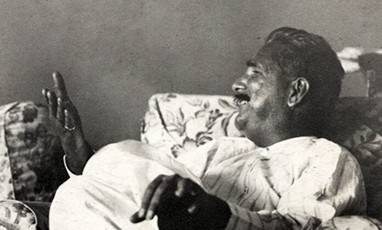
Yet, Iqbal was a Muslim nationalist as well. And he struggled with this because like the ulema and the Islamists, he too understood nationalism and the idea of territorial nation-states as being Western and thus, against the universal disposition of Islam. But he was willing to compromise, because he became a member of the AIML and agreed to contest an election on the party’s ticket. But Iqbal was not a politician. It seems his desire was to become an ideologue. But what kind of an ideologue?
His understanding of politics and international relations was, at best, questionable. This is quite apparent in the manner he comprehends the events in Turkey, and before that, in Russia after the 1917 Bolshevik Revolution. Kemal was a committed secularist and modernist, decades before he abolished the caliphate. But Iqbal chose to only concentrate on the manner in which Kemal defeated the Allies in Gallipoli and then ousted the Ottomans. Iqbal failed to understand the realpolitik behind Kemal’s doings because those would not fit Iqbal’s romantic summations of Kemal’s actions.
A romantic is a misfit in the world of politics. It is a world of amorality and pragmatism. This is why Iqbal is said to have sent an urgent message to the stoic rationalist and modernist Muhammad Ali Jinnah to return to India (from England) and lead the AIML. Iqbal admired Jinnah’s cool and calculated mannerisms. But Jinnah was no tiger powered by the glowing passion of ishq. Jinnah was rational, Westernised and not very demonstrative about his faith. Yet, one should also keep in mind that it was the Rubicon-crossing Iqbal, burning with ishq and thick with khudi, who was knighted by the British. Not Jinnah.
Iqbal’s Pakistan
It was the modernists within the AIML and pro-Jinnah scholars who managed to outwit the Islamists in becoming the keepers of Iqbal’s legacy after his demise in 1938. They presented him as a ‘poet-philosopher extraordinaire,’ a great visionary, and a staunch Muslim nationalist. The Islamists were looking to do the same. Iqbal was never criticised by them, the way Jinnah was. They heaped scorn on Jinnah, calling out his ‘Western’ habits, his lack of Islamic knowledge, his secular disposition, his praise of liberalism, and more so, his insistence on creating a Muslim-majority nation-state.
Most Islamist and ulema groups in India were of the view that the idea of a nation-state was inherently secular. They also bemoaned that if Pakistan were to become a reality, the size of India’s Muslim community would decrease considerably. Most of them were in favour of stopping Jinnah, even going to the extent of allying themselves with the INC.
After Pakistan came into being in 1947, the Islamists who agreed to settle in the new country, wanted to appropriate Iqbal because, according to them, he had drawn a cultural and philosophical roadmap to the construction of an Islamised polity. The Islamists did not view Iqbal as a political thinker as such, and rightly so. He wasn’t one. Instead, they found in his prose and poetry cultural and ‘metaphysical’ ideas through which the Islamists planned to Islamise the society and then, politically, build on the foundations of this society, an ‘Islamic state.’
The AIML (that became Muslim League after Pakistan’s creation), and the time’s modernist intelligentsia exhibited Iqbal as a modern Muslim thinker and political ideologue who had laid the groundwork for a separate Muslim-majority country propelled by an evolved strand of Islam — an Islam that was enlightened, inclusive, and pluralistic. The modernists positioned Iqbal as someone who was anti-theocracy, and an advocate of ‘Islamic democracy,’ in which the parliament will constitute elected members, literate in both secular and theological sciences and philosophies, and would practice ijtihad (independent interpretation of problems not covered by Islam’s sacred texts) through ijma (consensus). Iqbal’s powerful writings also came in handy to proliferate certain myths that were required to construct a Pakistani nationalism.
These included the myth that the seeds of Muslim nationalism in the region can be found in the long Muslim rule in India, even though, the fact is, the idea of nationalism is not more than 300 years old, and that it is a European construct. Not that the mentioned myth was actually ever uttered by Iqbal, but the manner in which he had described concepts such as ishq (a constant, dynamic motion towards something great) was stated to mean Pakistan was the sum and result of hundreds of years of struggle and evolution of South Asian Muslims. Iqbal was also cherry-picked by the early manifestation of the state of Pakistan to repulse attacks by the Islamists.
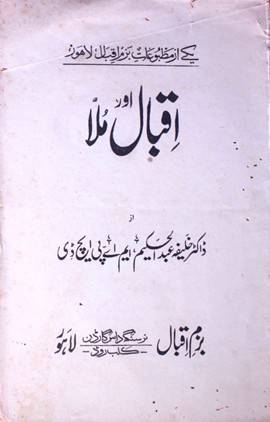
In 1953, when Islamist groups led by Maududi’s Jamaat-e-Islami (JI), and the Ahrar, began a movement in Punjab to demand the ouster of the Ahmadiyya from state and government institutions, the government called in the military to crush the protests. The military distributed pamphlets authored by the scholar Khalifa Abdul Hakim in which he used certain texts from Iqbal’s writings to demonstrate that Iqbal was highly critical of the Islam that was being followed and propagated by the ulema and the clerics. The title of the pamphlet was Iqbal aur Mullah (Iqbal and the mullahs). Of course, the fact that in 1935, Iqbal had advised that the Ahmadiyya should be separated from Islam, was conveniently sidelined. The Islamists couldn’t do much because the state had monopolised Iqbal’s legacy and was using portions of it to suit its aims and interests.
But one can also ask: why was the state using Iqbal to undermine the Islamists and not the founder of Pakistan, Muhammad Ali Jinnah? It was Jinnah who did all the thinking, strategising and legwork required to carve out a new Muslim-majority country. But the Islamists had made Jinnah controversial. So, whenever the state found the need to subdue the Islamists, they evoked (its version of) Iqbal. As mentioned earlier, the intensity of the criticism against Iqbal by the Islamists was nowhere close to what Jinnah had faced. Even the Ayub Khan dictatorship (1958-69) which, one can claim, had almost declared Islamic modernism as a state creed, found it necessary to turn to Iqbal when confronted by the Islamists. The state still enjoyed a monopoly over Iqbal’s legacy. The Ayub regime decided to give shape to an Iqbal Academy in 1962 so that Iqbal’s (cherry-picked) ideas could further bolster the state’s modernist project. The state was still displaying Iqbal as an enlightened Islamic modernist and a Muslim nationalist par excellence.
Some other groups were cherry-picking Iqbal as well. But they were doing so to counter Ayub’s Islamic modernism which they lamented was authoritarian, anti-democracy, and elitist. In 1967, when the Ayub government began to struggle to address economic, social and political challenges triggered by the regime’s hectic pace of industrialisation in the main cities and population growth, the regime’s former foreign minister ZA Bhutto, who had had a falling out with Ayub in 1965, decided to form a progressive political outfit, the Pakistan People’s Party (the PPP). The PPP’s early platform included communists (mostly ‘Maoists’), socialists, and social democrats on the left, and ‘progressive’ members of the landed elites, and ‘liberal’ ulema on the right. Bhutto belonged to the landed elite but described himself as a social democrat. At the centre of the party were ‘Islamic socialists.’ When the polemics between the PPP and mainstream Islamist parties, especially the JI, grew in intensity, the PPP began to claim that its program would follow ‘Islamic socialism.’ During the height of the protest movement against the Ayub dictatorship in 1968, in which the PPP was an active participant (in the erstwhile West Pakistan), the pro-PPP weekly Nusrat began to publish ‘exposés’ on Maududi’s history of being anti-Jinnah. Maududi described the PPP as a party of Godless communists.
In 1969, Ayub was forced to resign. The general who replaced him, Yahya Khan, agreed to hold parliamentary elections in 1970. During the campaigning stage, polemics between JI and the PPP continued to intensify. Maududi warned that Bhutto’s victory would be a victory of ‘atheistic socialism’ over Islam. In response, intellectuals in the PPP such as Safdar Mir and Hanif Ramay began to fill the pages of Nusrat with treatises on ‘Islamic socialism.’ Initially, they described it as a concept similar to ‘Arab socialism’ and ‘Ba’ath Socialism’ that had developed in the Arab world from the 1940s onward.
These were extensions of the Islamic modernism that had emerged in Arab regions in response to colonialism. But Ramay then went on to add that Islamic socialism was not a new innovation but had been first used (as a term) by Iqbal. Indeed, before the Khilafat Movement, Iqbal had praised Karl Marx and the Bolshevik leader Vladimir Lenin, but he was also quick to announce that he wasn’t a communist. It was the Islamic modernist Ghulam Ahmad Parvez who, in the 1930s, began to interpret Iqbal’s writings as being inherently socialist, yet Islamic. Parvez claimed that Iqbal was against the oppression of man-made systems (such as theocracy and secularism) because both contradicted the principles of the Quran. He praised Iqbal for ‘harmonising the Quran with natural sciences.’
Parvez was in the forefront of aiding the AIML in owning Iqbal as an Islamic modernist. But he also turned Iqbal into a socialist of sorts by claiming that Iqbal’s ideas on Islam proved that the faith was socialist in character. There is only questionable evidence of Iqbal ever using the term Islamic socialism himself. But according to Parvez and another admirer of Iqbal, Khalifa Abdul Hakim, Iqbal saw ideologies such as communism as being close to Islam’s concepts of equality and justice.
In fact, Parvez went on to describe Iqbal as a ‘spiritual socialist’ who rejected communism’s emphasis on atheism and materialism but hailed its vision to create a new order based on social justice and economic equality. Also, instead of class-war, Iqbal preached the principles of equality and solidarity in a social system in which the holder of legitimately acquired wealth is the trustee of all that exceeds his own requirements, for the benefit of his less favoured fellow men. Islam, according to Iqbal, visualises a democratic fraternity of dignified individuals, conscious of divine guidance and a centralised welfare organisation, with sufficient scope for individual initiative in thought and action, subject to the limits imposed by the Islamic Shariah.
Parvez then expanded Iqbal’s Islamic socialism to mean an anti-feudal, anti-capitalist, anti-theocracy, and anti-imperialist system. According to Parvez, it synthesised reason and spirituality and Islam and modernity. Ramay and his Islamic socialist colleagues in the PPP adopted this explanation of Iqbal’s ideas and succeeded in placing Islamic socialism at the centre of PPP’s ideological disposition. By the time the PPP became Pakistan’s ruling party (in December, 1971), Iqbal had been turned into a socialist. So, from being peddled by the state as an unflinching Islamic modernist from 1947 till the late 1960s, the state now began to exhibit him as an Islamic socialist. What’s more, the fact that Iqbal had also used the Sufi term ‘qalandar’ for his Mard-e-Momin, the PPP regime started to parade Iqbal as a sophisticated Sufi personality. This was because the Bhutto government had begun to evolve its Islamic socialism as a modern extension of Sufism.
Finally, in 1974, the Islamists too got the space that they were looking for to evoke Iqbal. When a committee of Islamist groups (in and outside the Parliament) began to demand the constitutional ouster of the Ahmadiyya from the fold of Islam, the regime advised calm. PM Bhutto asked, ‘are we to allow cannibalism among the citizens of the country?’ But the Islamists, especially in Punjab, through street protests and violence, cornered the government to allow the tabling of a bill for the ouster of the Ahmadiyya. In September 1974, the Parliament passed the bill and through an amendment, reduced the constitutional status of the Ahmadiyya to that of a non-Muslim community. In the Parliament, the Islamists had often quoted Iqbal’s 1935 essay in which he had advised the separation of the Ahmadiyya from Islam.
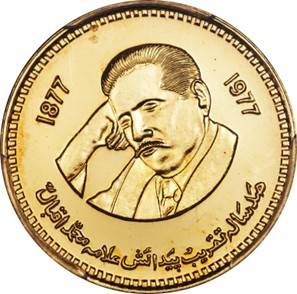
Iqbal the Islamic socialist and qalandar perished with the overthrow of the Bhutto regime in July 1977. Bhutto was toppled in a reactionary military coup by General Zia-ul-Haq. Bhutto was arrested for ordering a murder. He was then tried in a high court and then the Supreme Court, and (in April 1979) hanged. The court trials that led to his hanging were highly controversial. By then, Zia had already signaled that he (Zia) was here to stay. He resolved to turn Pakistan into ‘a true Islamic state’ and began to issue Ordinances to ‘fully Islamise’ Pakistan. He also found enough in Iqbal’s prose and poetry to bolster his ‘Islamisation project.’ Iqbal the Islamist was born.
No more was he a modernist, nor a socialist. In textbooks, seminars and lectures, he became the man who had first envisioned what Zia was striving for. No wonder then, a slogan, “Mard-e-Momin, Mard-e-Haq, Zia-ul-Haq,” was soon shaped by the Zia dictatorship.
This was also when the mainstream Islamist parties began to openly hail Iqbal. Islamists were posted in the Iqbal Academy from where they began to produce literature which ‘debunked’ the notion that Iqbal was ever a modernist. This literature glorified him as an Islamic giant who was anti-modernity, anti-West, anti-democracy, pro-Sharia, and skeptical towards the rational reading of Islamic texts. From a poet-philosopher, Iqbal was turned into a preacher.
Till the late 1970s, ‘experts’ on Iqbal had often comprised modernists, (and later) ‘socialists,’ but in the 1980s, it was an Islamist dictator, Islamist ideologues and theologians who sat up to interpret Iqbal.
And this is the Iqbal that has prevailed. This is understandable because there was always more in his ideas for the Islamists to cherry-pick from than there was for the modernists. What’s more, from the 1990s onward, Iqbal also became a life-coach of sorts, especially for the urban middle-classes. They found in Iqbal the kind of modernity that they were now a part of. A modernity in which spiritualism, Islamic ritualism, and ‘anti-colonialism’ sat comfortably with consumerism, capitalism and pop music. No wonder then, the poster boy of this dichotomous fusion (as opposed to synthesis) was Imran Khan, the former-sporting-star-turned-born-again-Muslim-turned-populist-politician. He often spoke about creating an ‘Iqbal ka Pakistan’ (Iqbal’s Pakistan).
What one still has in textbooks is Iqbal, the ‘visionary’ Islamic ideologue. Iqbal the modernist died with the whole modernist project in the late 1960s. The Bhutto regime tried to salvage this legacy by turning Iqbal into a socialist. But the Iqbal that populists such as Imran Khan glorified, was actually Zia ka Iqbal (Zia’s Iqbal). And this Iqbal is still very much alive, though now more open to critique than before.