

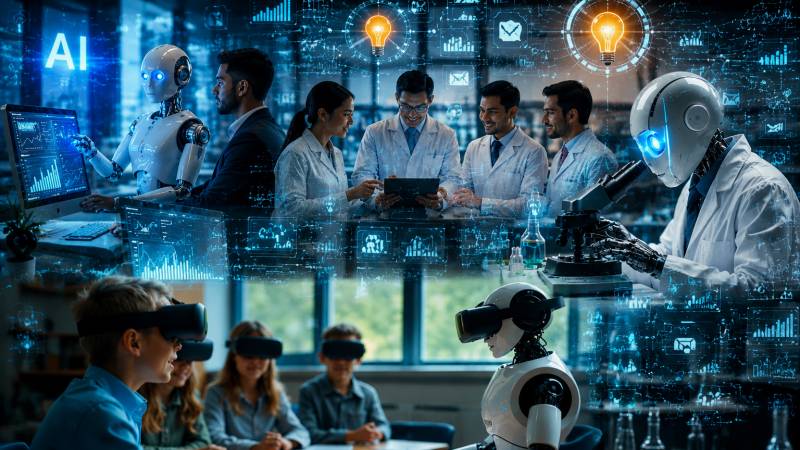
Every few weeks, a new headline claims that artificial intelligence (AI) will replace just another job. Teachers, programmers, designers, writers, and even scientists are commonly mentioned in these predictions. As AI systems become increasingly capable of generating text, analyzing data, and solving complex problems, many people have begun asking a simple question: Will scientists eventually become unnecessary? The answer is no.
Artificial intelligence is changing the way research is done, but it is not replacing science itself. Instead, it redefines what it means to be an effective scientist. The future will belong not to AI alone, but to researchers who understand how to blend human curiosity with intelligent technology. Throughout history, scientific advancement has always been dependent on improved tools. The microscope revolutionized biology. The telescope transformed the study of astronomy. High-performance computers have accelerated modern physics and engineering. Artificial intelligence is simply the latest powerful tool in that long history. Like any other scientific tool before it, AI can process information quicker than humans, but it cannot replace the human mind that decides which questions are worth asking.
Like any other scientific tool before it, AI can process information quicker than humans, but it cannot replace the human mind that decides which questions are worth asking.
During my undergraduate research in computational materials science, I studied hydrogen storage materials using first-principles Density Functional Theory (DFT) simulations. My work included evaluating structural stability, analyzing electronic properties, interpreting computational results, and identifying whether a material could successfully store hydrogen. Millions of calculations were conducted by software that would have been impossible to do by hand. It generated numerical data, electronic structures, and graphical outputs at an incredible speed. However, the software never identified the research question, explained why unexpected outcomes appeared, or decided whether the findings were scientifically meaningful. Those decisions are based entirely on human reasoning, critical thinking, and scientific judgment. This distinction is becoming increasingly important as AI tools become widely available.
Today's AI systems can summarize research articles, help with programming, identify trends in large datasets, and even draft scientific language. These capabilities save crucial time and increase productivity. However, AI does not possess scientific curiosity. It does not propose original assumptions because it really wonders how nature works. It cannot independently challenge established theories, recognize the significance of an unanticipated discovery, or make ethical decisions about how scientific information should be implemented. Science begins with curiosity before it begins with computation. For countries like Pakistan, this distinction is particularly important.
Artificial intelligence should not be considered a threat to our universities but rather a chance to improve research capability. Many Pakistani students are already using AI-powered tools to better their writing, organize data, and comprehend complex subjects. These technologies have the potential to improve education accessibility and research efficiency. However, efficiency should never replace understanding.
Pakistan’s future competitiveness will be more dependent on how well its universities prepare students for the new scientific world.
Students must continue to improve their abilities to analyze evidence, challenge assumptions, understand results, and think independently. Universities should teach students not only how to utilize AI responsibly, but also when to avoid relying on it. Scientific integrity is dependent on honesty, transparency, and unique thinking qualities that no algorithm can replace. The increasing influence of AI also emphasizes the importance of research ethics. As AI-generated content becomes more accessible, universities must prioritize academic integrity, responsible data use, and critical evaluation of information. The goal of education is not only to produce answers fast; it is to cultivate brains capable of asking more intelligent questions.
Pakistan's future competitiveness will be more dependent on how well its universities prepare students for the new scientific world. Investment in AI education should be combined with increased research funding, improved computational resources, multidisciplinary collaboration, and undergraduate research opportunities. Technology alone cannot produce innovation unless it is guided by qualified researchers who comprehend both its strengths and its limitations. Therefore, the conversation should not revolve around whether AI will replace scientists. The more crucial question is whether today's scientists are ready to use AI responsibly.
Those who accept AI as a research partner while maintaining their creativity, scientific judgement, ethical responsibility, and intellectual curiosity will influence the next generation of discoveries. Artificial intelligence may speed up scientific progress, but it cannot replace the imagination that drives discovery or the human determination that converts ideas into breakthroughs. It's not just machines that will shape the future. It belongs to scientists who recognize that the most significant discoveries always begin with a question that only a curious human mind can ask.