

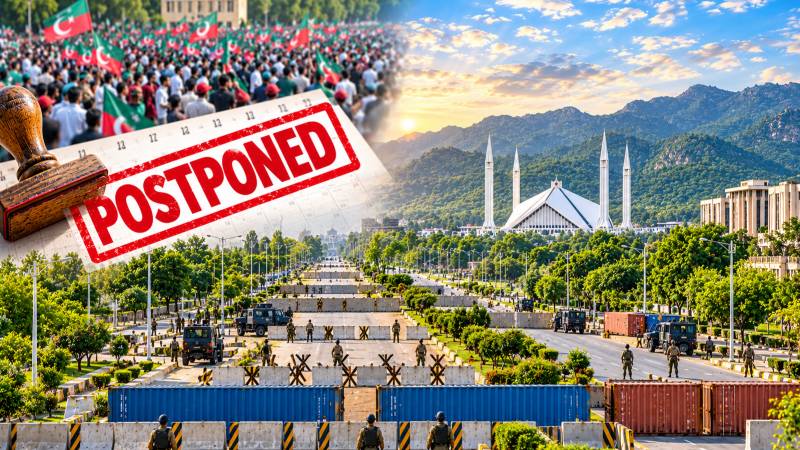
After hearing of the postponement of the long march to Islamabad by Pakistan Tehrik-e-Insaf, I took a sigh of relief. I also posed an honest question to myself who was the winner- opposition or rulers. Some inner voice whispered to me that the distress city of Islamabad was the winner. We have witnessed many anti-government protests both peaceful and violent in the past. In all these protests Karachi, Hyderabad, Lahore, Faisalabad, Rawalpindi and Peshawar used to be the epicenter of public protests or agitations. Islamabad was always spared to deal with such ordeals. The onslaught on Islamabad is a new phenomenon started by Allama Tahir ul Qadri, and followed by others. We remember the long marches and subsequent long sit-ins in the city in 2012, and 2014. We knew the forces backing these sit-ins.
Islamabad foiled two long marches this month. Bravo. Hafiz Engineer Naeem Ur Rehman is no match to the former Amir of Jamaat Islami, Late Qazi Hussain Ahmed in agitational politics, behind-the-scene formation of political alliances, and his robust mentoring of Afghanistan’s Mujahidin. Similarly, the young Chief Minister of KPK, Muhammad Sohail Afridi could not match the political dexterity of his predecessor, Ali Amin Gandapur, in forcing his way to Islamabad. However, Chief Minister Afridi remained focused on the mass mobilization to collect a mammoth crowd in Islamabad notwithstanding apprehensions of bloody clashes.
The PTI friends say that the long march was postponed for a few days as part of their strategy to tire out Islamabad rulers. Now they have given a fresh call for resumption of the long march on 4 October. There are reports they have been trying to win over Moulana Sahib for participation in the march towards the besieged city. They are sanguine the Moulana will join their peaceful long march. The JUI Sindh, under the leadership of the Soomro brothers, remained at a distance from PTI in Sindh during Sohail Afridi’s visit. The question is why Moulana will burn his fingers in the fire ignited by someone else.
Obviously, this is a temporary relief for Islamabad. The arrangements made by the authorities to secure Islamabad would remain in place until 4 October and afterwards, with bridges, roads and highways blocked by containers, and the Islamabad dealing with the logistics of the police forces borrowed from all the three provinces and AJK. There must be a grand convergence of forces in Islamabad. Assuming that there is no progress in talks with the PTI, and the long march is resumed with a renewed force, the capital will remain barricaded until the long march is called off after some compromise between the PTI and the rulers. The containerization of the roads and highways, cities and towns is taking a heavy toll on the economy of the country.
We claim to be a democratic nation; a country governed by democratically elected leaders; we believe the party in power has a genuine parliamentarian majority; we also boast our courts are independent and free from any pressure; we recognize the sanctity of the constitution. We claim to follow the rule of law. No democracy bars people from peaceful protests; no elected leader is insensitive to public protests; no majority party loses confidence in the wisdom of democratic process. No independent court finds itself helpless to enforce its verdicts; no constitution affords thoughtless and person-specific amendments.
The fault does not reside in the system. It resides from top to bottom in the managers whom we have entrusted state affairs without any merit, any institutional check and balance, the rule of law, the independence of judiciary, and efficiency of prosecution and police reforms.
This country has suffered a lot at the hands of imprudent leaders, dishonest bureaucrats, and Generals, self-centered political dynasties and the selfish privileged class, fortune-seekers, industrialists, pseudo financial wizards, unruly and criminal landlords and tribal chiefs. This nation is tired of vapid words and fallacious slogans, futile political and administrative experiments. Its past does not offer much to be proud of, its present is entangled in political polarization, and economic uncertainty and its future offers no hopeful prospects. The blame is shifted to the collapse of the system wiping clean the dirty faces of the managers.
We have many successful nations in the world around us governed by either of the systems we have practiced during the past seven decades. The fault does not reside in the system. It resides from top to bottom in the managers whom we have entrusted state affairs without any merit, any institutional check and balance, the rule of law, the independence of judiciary, and efficiency of prosecution and police reforms. We violated the supremacy of the constitution, and democratic governance with no fear of accountability. No change on this count has taken place.
General elections of January 2008 despite the bitterness created by the assassination of Benazir Bhutto on 27th December produced a relatively stable democratic system. However, the Prime Minister was disqualified by the Apex Court in the fourth year of his term. The transition was smooth. The next elections were held in time, and power was transferred to the winning Pakistan Muslim League (Nawaz) in 2013. With a wrong move of the magic wand, the country found itself in the midst of Panama scandal, agitations and long marches. Prime Minister Sharif was disqualified by the apex court; his successor Khaqan Abbassi was not allowed to rule, and resist the launch of a new political competitor in the arena in 2018. Jahangir Tareen emerged as the king maker, though PTI owed its popularity to Imran Khan.
The PTI regime faced the same road blocks to proper rule, and finally was ousted by a dubious vote of no-confidence in April 2022. Imran Khan fallen proved more powerful than Imran erect. His public following skyrocketed to scare his tormentors. We had heightened political polarization. A sustained campaign of vilification and mudslinging on both sides began embittering the political atmosphere all over the country. The country has not come out of the crisis triggered by the establishment-backed ouster of Mr. Khan. The Form-47 added oil to the injury.
Over 200 criminal cases were registered against the man and his followers in every corner of the country. Since August 2023, he faces imprisonment in adverse verdicts in corruption cases by trial courts. He is allegedly denied visits by his family; medical checkup by his doctor; hospitalization in accordance with the Supreme Court’s judgment. His party’s agitation revolves around these demands underscoring the early hearing of his appeals before Islamabad High Court, Supreme Court, and his hospitalization as per the directive of the Supreme Court.
What are the PTI demands considered as prejudicial to the nation’s interests, and harmful for the country? His four sisters were taken into custody along with their sons and nephews. There is an atmosphere of fear and asphyxiation in the country. People are watching this coercive situation pathetically. In such an atmosphere, no system would take the country to a politically congenial, economically promising and democratically flourishing valley promised by our rulers through small administrative units, and better control, and governance. Free and fair elections, prevention of political interference in the state affairs, continuous constitutional rule, land reforms and empowered local governments will provide panacea to our ills. The state, as Khawaja Saad Rafiq has suggested, should take advantage of this pause in the agitation and hold meaningful talks with the opposition.