

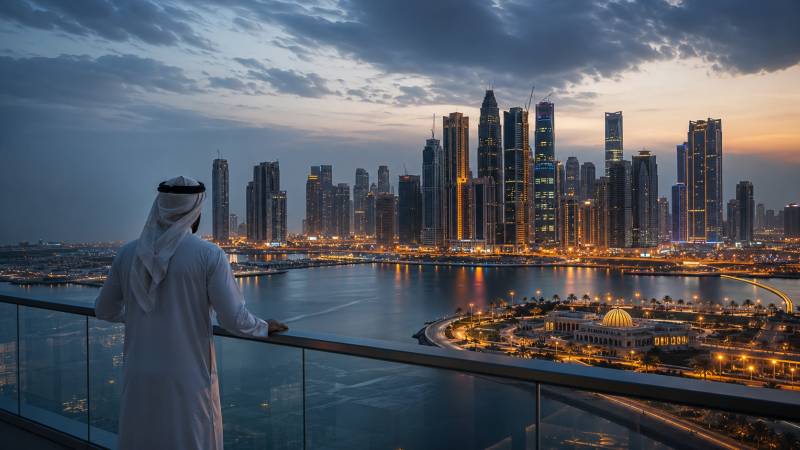
There is a dress code that explains everything. White, pressed, effortless, which is precisely the point. The thobe is the Gulf’s most efficient social text. It does not announce wealth. It announces belonging, which is a different thing entirely, and in the Gulf, the more consequential one.
The Pakistani worker has been here for fifty years. He laid the cable beneath the concrete, poured the foundations of a skyline’s worth of skyscrapers, worked the shift that no one else would take — his labour everywhere, his name, nowhere. The thobe is not a uniform. It is a verdict. And Pakistan, which has sent its men there in their millions, has never once stood up in any room that mattered and said: these men built this. We would like, this time, to discuss the terms.
On April 28th, the Gulf cracked. The United Arab Emirates announced its withdrawal from OPEC and OPEC+, making official what had been structurally true for some time: that the two most powerful Sunni states in the region are no longer building the same future. The world read this as an energy story. It is also a mirror — one held up, at an uncomfortable angle, to a country that has spent decades watching the Gulf reshape itself as though the reshaping were a weather event, and weather, as everyone knows, is nobody’s responsibility. Pakistan is facing a defining moment — the kind that does not announce itself twice — in which the terms of its engagement could, for once, be set rather than inferred.
Two Frequencies, Rarely Read Together
Pakistan does not have one Gulf relationship. It has two, and it has never really confronted the difference. With Saudi Arabia, it is the warmth of a particular kind of remittances of USD 7.6 billion annually, sovereign deposits materialising in moments of fiscal vertigo, and an Islamic solidarity framework that gives the relationship a texture no commercial arrangement can replicate. Pakistan is the only nuclear power in the Islamic world. Riyadh has always understood what that is worth, even when Islamabad has not.
With the UAE, the relationship operates on two simultaneous frequencies that are rarely read together: there is the Pakistani professional class banking, investing, building the kind of quiet prosperity that does not make it into policy papers and there is the Pakistani worker, the man from Khanewal or Jacobabad who builds the towers and staffs the logistics depots and sends money home to a household for whom that transfer is the difference between surviving the month and not. The UAE accounts for over USD 5 billion in annual remittances to Pakistan. One number. Two entirely different relationships with the same economy. One is aspirational. The other is load-bearing.
The UAE sought the return of all its sovereign deposits from Pakistan in March 2026, ending years of emergency financial support. It deported an estimated 15,000 Pakistani Shia workers, according to community leaders cited by Middle East Eye, during the conflict — men who had spent decades building the UAE, expelled without formal charges, without notice, and without the opportunity to withdraw funds from banks they had used for years — and concluded, from Abu Dhabi’s vantage point, that Pakistan had chosen Riyadh over the Emirates the moment it signed the SMDA. The bilateral warmth is not gone. But the financial architecture that embedded Emirati support into Pakistan’s external stability has been quietly dismantled, and Pakistan has no domestic substitute for it. The lesson: a relationship built on dependency rather than reciprocity does not survive the moment one side decides the terms are unfavourable.
Abu Dhabi and Islamabad orbit different suns. One is building a future with deliberate, unsentimental speed; the other is stretching the status quo, leaning on donors, and deferring the kind of planning that would require deep introspection. Abu Dhabi’s post-oil pivot, Masdar, at 65 gigawatts of global renewable capacity, non-oil sectors at 54% of the economy, and a sovereign wealth architecture remaking itself for a decade is not a leap of faith but a calculated transition, financed deliberately on the proceeds of the very resource it is in the process of outgrowing. It is a model Pakistan cannot reach because it requires the institutional infrastructure that Pakistan has been declining to build for thirty years.
But institutional incapacity is only part of the explanation. The deeper anchor is direction. Abu Dhabi’s transition has been inseparable from its Abraham Accords identity — sovereign wealth commitments to Israel, intelligence and infrastructure ties that have deepened through and beyond the ruins of Gaza. To Pakistan, Israel is a clear adversary. It has maintained public Palestinian solidarity since October 2023, alongside Turkey and within the OIC framework, and it has neither the political space nor the institutional appetite to mirror a foreign policy that has made the UAE, in the eyes of much of the Muslim world, something other than what it once was. Abu Dhabi is not simply a model Pakistan cannot reach. It is one Pakistan has been moving away from on two tracks at once: an institutional capacity it has chosen not to build, and a foreign policy identity travelling, with its own coherent logic, in the opposite direction.
The divergence is sharpest when set against India. Where Pakistan has military depth and Islamic standing, India has economic mass and institutional integration. India-UAE trade reached USD 100 billion in 2025, with a target of USD 200 billion by 2032; the UAE has signed a comprehensive economic partnership agreement, a bilateral investment treaty, and a formal Strategic Defence Partnership with New Delhi. Nine million Indians work across GCC states, remitting between USD 38 and 50 billion annually — roughly the same as Pakistan’s entire current account.
The assumption that American bases meant American protection was exposed as exactly that — an assumption
The UAE de-hyphenated India from Pakistan as long ago as 2019, inviting India as Guest of Honour to the OIC over Pakistan’s objections. What Pakistan has that India does not is equally precise: nuclear standing, a defence treaty with Saudi Arabia, credibility in Islamic multilateral forums India cannot enter, and a relationship with Iran that New Delhi has not so much avoided as squandered — its studied neutrality on Tehran, shaped by dependence on American goodwill and a deepening Israel relationship, has forfeited precisely the access point that now commands the highest premium in the region. The two countries are not competing for the same Gulf. They are competing in different registers of the same relationship: Pakistan’s register is the one that matters in the shifting regional order. India is the one that matters once the water finds its own level. The window that is currently open is Pakistan’s. It will not stay that way.
That window has a labour cost compounding with every quarter that passes. An economy reorienting around knowledge sectors and automation has a diminishing appetite for the low-skilled work in which Pakistan has long competed poorly, and increasingly against India, Sri Lanka, and Bangladesh. Over 1.7 million Pakistanis work in the UAE today, concentrated overwhelmingly in construction, manufacturing, and logistics. The highly skilled share of Pakistan's emigration pipeline has remained below ten per cent over five decades.
The towers will eventually build themselves — AI will see to that on a timeline no labour policy has yet acknowledged — and when they do, those workers will return to a country that has not built the domestic infrastructure to absorb them, because the Gulf capital that would have funded it was never properly invited. The compound crisis is not a projection: declining Gulf labour demand, remittance fragility under regional conflict, and institutional incapacity at home are three frequencies already converging on the same household. No budget Pakistan has produced has asked what happens when all three arrive together.
Where the Capital Goes
Gulf sovereign wealth funds now collectively control nearly 40 per cent of global SWF assets close to USD 6 trillion, and they are deploying it with increasing precision. The pattern of deployment is itself an argument. Masdar signed a USD 15 billion renewable energy agreement with the Philippines in January 2025, its second major Southeast Asian commitment after building Indonesia’s largest floating solar facility and signing a 10-gigawatt clean energy framework with Malaysia. ADQ’s USD 35 billion land development deal averted Egypt’s insolvency in 2024. PIF and QIA are active in Iraqi infrastructure, African mining, and global AI. Around 85 per cent of Mubadala’s capital deployed in 2024 went to developed markets; of that, 57 per cent went to the United States alone.
Geopolitics matters in these decisions. ADQ’s Egypt deal was partly a lifeline to a strategically significant neighbour; Masdar’s Southeast Asian push reflects a deliberate UAE diversification strategy; India’s investment appeal to Gulf SWFs is partly a function of its size and the economic partnership architecture it has spent a decade building.
Gulf capital does not flow on institutional merit alone. But institutional readiness is the necessary condition that no amount of geopolitical goodwill can substitute for: a government that can honour a concession, a regulator that can stand behind an agreement, a municipal authority that can guarantee the feedstock a project requires. The Philippines signed a formal implementation agreement with a committed energy ministry and pre-cleared investment incentives. Indonesia offered a functioning concession framework and a state energy company as a counterparty. Egypt, whatever its other advantages, offered a government with the political authority to deliver on what it promised.
Pakistan has geopolitical significance in abundance. What it has not offered, consistently, is the institutional counterpart that converts significance into a signed concession. It has offered, instead, announcements. The Gulf does not close on announcements. It closes on counterparties, and Pakistan has not built what would make it one.
The War That Changed the Calculus
Into this picture comes the war — and with it, the most clarifying demonstration in a generation of what Pakistan’s position is actually worth, and the most characteristic demonstration of its failure to price it.
On February 28, 2026, the United States and Israel struck Iran. The Strait of Hormuz was effectively closed. Iranian missiles and drones hit nine Gulf states. The assumption that American bases meant American protection was exposed as exactly that — an assumption. What followed revealed, with uncomfortable precision, what the previous five months had been about.
Saudi bilateral investment in Pakistan has historically bought political relationships, not built institutions
In September 2025, Saudi Arabia and Pakistan had signed the Strategic Mutual Defence Agreement: Article 5 language, nuclear ambiguity, and, as Chatham House assessed it, the first extended deterrence commitment by a nuclear-armed state outside the NPT framework. The SMDA was Riyadh’s considered hedge against a Washington it no longer fully trusted: Trump’s Gulf visit earlier that year had delivered arms deals and warm optics but not the bilateral US defence pact Saudi Arabia had sought for years, and Washington’s failure to rebuke Israeli strikes on Doha had made the limits of American protection impossible to ignore. The war did not catch Riyadh unprepared. It confirmed what Riyadh had already concluded. The SMDA was invoked under active fire within thirty-seven days.
What Pakistan did next is worth reading carefully, because it is simultaneously its finest diplomatic passage and the clearest illustration of its governing condition. It condemned attacks by all sides. Its Field Marshal flew to Riyadh as Iranian strikes hit Ras Tanura and Prince Sultan Air Base, deploying air defence systems under the SMDA while simultaneously assuring Tehran that Saudi soil would not be used against Iran. It co-authored a five-point ceasefire proposal with China. It offered Islamabad as a venue for US-Iran talks and hosted the Islamabad Talks — the only direct round of negotiations of the conflict. The Prime Minister visited Beijing. Its Foreign Minister briefed Wang Yi on Iran ahead of the Trump-Xi summit. In each instance, Pakistan performed a service of irreplaceable strategic value and received, in return, the currency of acknowledgement — appreciative communiqués, bilateral warmth, the soft coin of being publicly thanked.
Trump has arrived in Beijing diminished: his visit was delayed from March because the war he predicted would end ‘in weeks’ has not ended, the ceasefire on what he himself calls “massive life support,” his leverage on trade, Taiwan, soybeans, and Boeing all eroded by a conflict that has handed China a structural advantage it did not need to engineer. The country whose diplomacy is the primary channel between Washington and Tehran is present in this configuration at every level. Pakistan is in every room. It has simply never decided what it is worth.
Pakistan’s non-alignment was never entirely a strategic choice. It held to it partly because of its sectarian pluralism, its 900-kilometre border with Iran, and its dependence on Iranian energy — constraints as much as convictions. But the distinction between chosen and constrained non-alignment dissolves when the outcome is the same: every other potential intermediary has picked a side, and Pakistan has not. That is the asset.
The same border that made non-alignment necessary now makes Pakistan indispensable to any accommodation between Iran and the Gulf. As former US Ambassador to Saudi Arabia Chas Freeman has argued, the only durable resolution to Gulf insecurity is accommodation with Iran — and that accommodation requires interlocutors that neither Washington nor Tel Aviv can credibly provide. Pakistan is the only state that can.
Pakistan has never asked what the position is worth. The dependencies are specific: the Gulf states need the war to end, and Hormuz restored more urgently than almost any other actor in the system; the US needs Pakistan’s mediation channel because it has no other; Iran has engaged Pakistan because Islamabad is the one capital it trusts not to be running Washington’s agenda. Each dependency is a negotiating position. A prepared country would have named its price: energy infrastructure investment from Gulf states as the condition of continued mediation access; guaranteed passage terms for Pakistani shipping in any Hormuz settlement; a formal seat at the post-ceasefire security architecture rather than a communiqué. Pakistan has converted its access to Iran into goodwill. It could have converted it into terms.
What a Prepared Country Would Have Asked
The Saudi relationship deserves an accounting it rarely receives. The USD 10–12 billion Aramco refinery anchored at Gwadar is real money and real infrastructure. But what looks like a partnership is, on examination, architecture. A 300,000-barrel-per-day refinery locks Pakistan into the hydrocarbon economy for thirty to fifty years. It generates the benefits of a processing, downstream economy, not an industrial one. It positions Pakistan as a client in an updated petrochemical value chain — processing Saudi crude, consuming it domestically, exporting refined products to Central Asia — not as a partner in the economy being constructed elsewhere. The Islamic solidarity framework makes this durable in ways that pure commercial interest cannot, which is precisely why Riyadh has always cultivated it.
Pakistan benefits from the Saudi relationship and should continue to. But Saudi Arabia also needs the Gwadar corridor and the Central Asian export route, and that need is a negotiating position Pakistan has never once pursued. The SMDA has now made the full asymmetry impossible to ignore: Riyadh signed an Article 5 equivalent with Pakistan, invoked it under active fire, and made Pakistan its largest external financing relationship in 2025–26 at over USD 6 billion. In return, it received a nuclear umbrella — or at minimum the credible ambiguity of one — without being asked to pay any institutional price. The USD 6 billion is real. The question is whether it is commensurate with what Pakistan provided.
It would not have. The leverage is specific and currently exercisable. Saudi Arabia needs Pakistan’s logistics corridor, its nuclear umbrella, and its diplomatic access to Tehran. All three are currently provided without conditions. A prepared country would have attached conditions. The obvious precedent is Vision 2030: Riyadh has rebuilt the municipal architecture of its own cities from scratch, overhauling waste management, water systems, and urban energy infrastructure in Riyadh and Jeddah in under a decade.
That institutional knowledge exists on the Saudi side. The question is whether Pakistan has ever thought to ask for it as a condition of access. It has not — and the track record is instructive. Saudi bilateral investment in Pakistan has historically bought political relationships, not built institutions. The Pakistan Steel Mill received Saudi financing and produced neither technology transfer nor lasting industrial capacity. Saudi-funded housing schemes delivered units without the municipal infrastructure to service them. The pattern is consistent: Riyadh pays for access and alignment, not for the harder work of institutional development.
An integrated infrastructure compact — in which Saudi capital in Pakistan’s urban waste, energy, and water systems, alongside genuine technology transfer rather than turnkey delivery, becomes a condition of continued Saudi access to Pakistan’s market and corridor — would require Pakistan to insist on terms Riyadh has never been asked to meet before. Riyadh would resist. But the SMDA has changed the negotiating geometry: Pakistan is no longer a client seeking favour. It is an ally whose strategic depth Riyadh has formally acknowledged it cannot do without. The question is not whether resistance is possible but whether Pakistan has ever arrived prepared to hold a position. It has not, because it has never been trained to think of itself as a counterparty rather than a beneficiary.
The United States needed Pakistan’s geography for the Afghan jihad and for the war on terror, wrapped the relationship in the language of irreplaceable alliance, and paid in sanctions and abandonment the moment the utility expired. The Gulf is now running the same pattern with better manners
The harder question is who within Pakistan’s current power structure would actually present such conditions. GHQ has shown it can deliver diplomatic access; it has shown less appetite for converting that access into institutional reform at home. The civilian government is preoccupied with a fiscal crisis that makes any negotiation requiring short-term sacrifice politically untenable. The provinces that would benefit most from empowered municipal government are precisely those whose political architecture depends on keeping it weak. The leverage exists. The agency to use it is distributed across a system designed to avoid it.
The Opportunity Is Real. So Is the Wall
Pakistan generates 49.6 million tonnes of municipal solid waste annually. Karachi alone produces 16,500 tonnes daily, of which less than 60 per cent is collected, and none is sorted at source. A 2024 peer-reviewed study found Pakistan’s municipal waste has calorific values fully consistent with commercial incineration — Rawalpindi at 19,887 kJ/kg, Lahore at 17,570 kJ/kg. A Gulf capital for precisely this kind of project exists and is actively looking for deployment. It went to Indonesia. It went to Malaysia. It went to the Philippines. It has not come to Pakistan, not because Pakistan lacks the waste or the need, but because Pakistan lacks the municipal authority that can stand behind a concession contract — the institutional gap that keeps every other category of Gulf investment from landing.
That gap is not an accident. Federal and provincial governments control the development allocations and utility appointments that sustain their electoral coalitions. A municipal authority with its own tax base, independent revenue, and genuine service-delivery accountability would displace that architecture. The calculation against building it has been made, repeatedly and correctly, by every actor who would bear the cost of its existence. The federal budget for 2025–26 allocated nothing specifically for waste management. The carbon levy introduced in that same budget, PKR 2.5 per litre, projected to generate PKR 45 billion, flows into the consolidated fund with no pipeline connecting it to the clean-energy investment that would justify it as anything other than a revenue measure with environmental branding. This is not oversight. It is the system working as it was designed to work, by people who understand it very well.
This is the thread that connects every missed opportunity in Pakistan’s Gulf story, though it runs on two distinct tracks. The waste-to-energy proposals that are announced and shelved, the Gwadar refinery that makes Pakistan a processing client rather than an industrial partner, the Gulf capital that goes to Jakarta and Manila instead of Karachi — these are failures of municipal delivery: the absence of the empowered local government that can stand behind a contract.
The SMDA that extracts a nuclear commitment without a reciprocal infrastructure compact, the ceasefire mediation that earns appreciation without a price, the non-alignment that commands a premium no one has thought to charge — these are failures of federal negotiating capacity: the absence of a state that arrives at the table knowing what it is worth. The two failures are distinct. But they share a common root: a political economy designed at every level to avoid the accountability that would make either possible. The failure, in both registers, is the same: it has never built the architecture that converts presence into outcomes.
The Price Tag
There is a pattern worth naming. The United States needed Pakistan’s geography for the Afghan jihad and for the war on terror, wrapped the relationship in the language of irreplaceable alliance, and paid in sanctions and abandonment the moment the utility expired. The Gulf is now running the same pattern with better manners. Pakistan brokered the ceasefire, provided the channel, deployed the forces, and received appreciative communiqués, bilateral warmth, the soft coin of being publicly thanked. The currency changes. The exchange rate does not.
Pakistan has assets that it persistently undervalues, which is a particular kind of talent. A domestic market large enough to be consequential, sitting at the crossroads of South Asia, Central Asia, and the Gulf, that has somehow never generated the institutional pressure to make itself count. A Gwadar corridor that Saudi Arabia needs more than it admits and has now signed a defence treaty to secure. A foreign policy posture that carries genuine credibility in Islamic multilateral forums that neither India nor any Arab state can replicate. A relationship with Iran that has just proved, in a live war, to be worth more than any number of signed MOUs with states that had already picked their side.
What Pakistan lacks is not opportunity; opportunity has never been the problem. What it lacks is the institutional architecture to convert opportunity into outcomes, and the negotiating identity to arrive at a table as a counterparty rather than a beneficiary.
That address is specific: local governments that can honour contracts and absorb returning workers, regulatory bodies that can stand behind concessions, and a federal negotiating capacity that arrives knowing that a nuclear umbrella, a logistics corridor, and a monopoly on Iran access are not courtesies to be exchanged for deposit rollovers. It requires Pakistan to stop being grateful for being included at a table it helped build.
The UAE’s OPEC exit has not handed Pakistan a new partner. The Iran war has not handed Pakistan a strategy. What both have done, together, is hand Pakistan a deadline. As of this writing, the ceasefire is on life support. Ceasefires either hold or collapse, mediators are retired by the agreements they made possible, India’s economic depth with the Gulf reasserts itself once the security premium recedes.
The question is not whether it has the leverage. The question is whether it will attach the price tag.
The waste is in the streets. The window is wide open.