

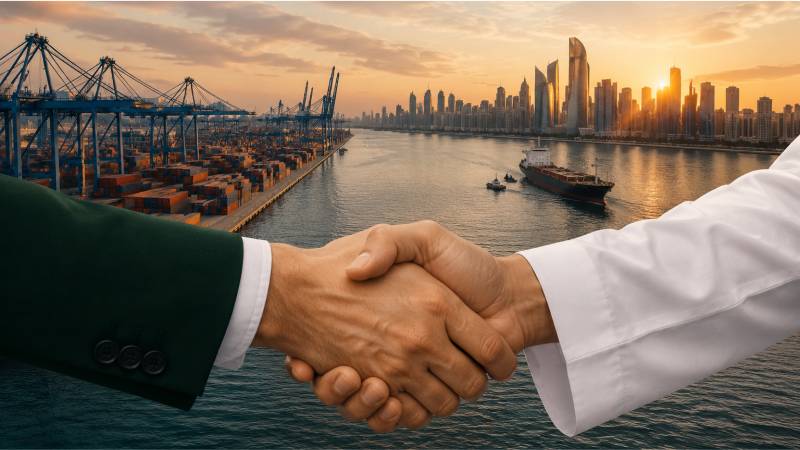
Relationships between nations are rarely measured by moments of warmth or periods of disagreement. They are ultimately judged by whether they continue to serve the long-term interests of their people. Pakistan and the United Arab Emirates have experienced occasional periods of visible strain in recent years, prompting speculation that one of Pakistan’s most enduring strategic partnerships has weakened. Such conclusions are premature. The relationship is far deeper than temporary policy differences, financial negotiations or political transitions. It is built upon five decades of shared history, economic interdependence, cultural affinity and mutual trust. Rather than allowing isolated disagreements to define the future, both countries should recognise that they have far more to gain from renewed strategic cooperation than from unnecessary distance.
Few countries have contributed to Pakistan’s economic resilience as consistently as the United Arab Emirates. Since the founding of the federation in 1971, the UAE has repeatedly stood beside Pakistan during periods of financial difficulty, natural disasters and geopolitical uncertainty. From balance-of-payments assistance and deposits with the State Bank of Pakistan to humanitarian support following devastating earthquakes and floods, Abu Dhabi has demonstrated that its commitment has extended well beyond diplomacy. During successive economic crises, the UAE deposited billions of dollars with Pakistan’s central bank to strengthen foreign exchange reserves and reassure international markets. These deposits have often played an important role in stabilising confidence at moments when Pakistan’s external financing position was under considerable pressure.
The episode in which the UAE sought the repayment or rollover of its deposits during Pakistan’s recent financial crisis attracted considerable public attention. Many interpreted it as a departure from traditional friendship. Yet sovereign financial assistance is never intended to replace fiscal discipline. Every government has obligations to its own citizens and financial institutions. The UAE ultimately maintained substantial financial support while Pakistan honoured its commitments through restructuring and international assistance. Such episodes should not become the defining narrative of a relationship that has successfully weathered far greater challenges over the past half-century.
Today, the economic relationship between the two countries remains among Pakistan’s most important. Bilateral trade exceeds US$10 billion annually, making the UAE one of Pakistan’s largest trading partners in the Middle East. The Emirates is consistently among Pakistan’s leading export destinations while simultaneously serving as a major source of imports, investment and logistics connectivity. Dubai has evolved into one of the world’s largest re-export hubs, allowing Pakistani products to access markets across Africa, Europe and the wider Gulf region. UAE investment spans banking, aviation, telecommunications, logistics, ports, renewable energy, infrastructure and real estate. DP World operates one of Pakistan’s principal container terminals, Emirates Airline has connected Pakistan to the world for decades, while Etihad Airways and Air Arabia continue to strengthen regional connectivity.
Yet the true foundation of this relationship is neither government nor commerce. It is people. Nearly 1.7 to 1.8 million Pakistanis live and work in the United Arab Emirates, making it one of the largest overseas Pakistani communities anywhere in the world. They are engineers, doctors, bankers, teachers, entrepreneurs, labourers, technicians, architects, accountants, hospitality professionals and skilled craftsmen. Together they contribute billions of dollars annually to Pakistan through remittances. During recent fiscal years, remittances from the UAE alone have consistently exceeded US$6 billion, accounting for a significant share of Pakistan’s total overseas inflows. Those remittances finance education, healthcare, housing and small businesses for millions of Pakistani families, while strengthening Pakistan’s external account and supporting macroeconomic stability. Their contribution to the UAE has been equally remarkable.
Successful foreign policy is not measured by ideological loyalty but by tangible benefits delivered to citizens.
Long before Dubai became synonymous with luxury skylines, global finance and architectural ambition, Pakistani workers were helping lay its physical foundations. Thousands of engineers, steel fixers, surveyors, welders, crane operators, electricians and construction workers from Pakistan participated in building the infrastructure that transformed the Emirates into one of the world’s most modern economies. Their contribution can be seen in highways, airports, ports, bridges, metro systems and countless iconic developments.
Even the Burj Khalifa—the tallest building ever constructed—stands as a quiet testament to South Asian craftsmanship. Among the many skilled workers involved in the project were Pakistani engineers and technicians. One of the Pakistani workers involved in placing the building’s final steel spire became a symbol of that contribution, reminding both nations that extraordinary achievements are often built by ordinary people whose names rarely appear in history books.
This is why the Pakistani diaspora should never be viewed merely as expatriate labour. They are an indispensable bridge connecting two nations. Their success has contributed to the prosperity of the UAE while simultaneously strengthening Pakistan’s economy. Estimates frequently suggest that Pakistani entrepreneurs, investors and families have accumulated tens of billions of dollars in assets across the Emirates, making them stakeholders in the country’s continued growth and stability. Their prosperity is inseparable from the prosperity of the UAE itself. For precisely this reason, recent concerns surrounding visa restrictions, deportations and regulatory enforcement deserve careful reflection rather than emotional reaction.
Every sovereign nation possesses the unquestionable right to regulate immigration, enforce its laws and determine who may reside within its borders. The United Arab Emirates has invested decades in building one of the safest, most efficient and economically dynamic societies in the world. Such achievements depend upon strict enforcement of law, respect for institutions and responsible public conduct. Visitors, workers and residents alike are expected to comply with those standards irrespective of nationality.
Pakistanis living abroad must understand that obtaining a visa carries responsibilities alongside privileges. Freedom of expression does not exempt individuals from the laws of the country in which they reside. Social media has transformed communication into an instantaneous global phenomenon, but it has also amplified misinformation, provocation and irresponsible behaviour. Across the world, governments are responding by strengthening regulation of digital platforms. Several democracies have introduced or proposed tougher measures to address online harms, including greater protections for children and increased accountability for digital platforms. The broader international trend is unmistakable: social media is no longer viewed merely as a platform for personal expression but as a space capable of influencing public order, national security and social cohesion.
For overseas Pakistanis, the lesson is straightforward. Respect for the laws of the host country is not simply a legal obligation; it is a moral responsibility. A single irresponsible act by a few individuals can damage opportunities for hundreds of thousands of law-abiding workers and professionals. National reputation is cumulative. It is built slowly but can be undermined quickly. Pakistan itself has much to learn from the remarkable transformation of the UAE.
Half a century ago, the Emirates possessed limited infrastructure and a relatively small population. Today it is among the world’s leading centres for aviation, logistics, tourism, finance, artificial intelligence, renewable energy and global commerce. This transformation was neither accidental nor solely the result of oil wealth. It emerged from disciplined governance, institutional continuity, long-term planning, regulatory certainty and relentless investment in infrastructure and human capital. Tourism illustrates this lesson vividly.
For decades, millions of visitors from across the Gulf travelled to Dubai because it offered experiences unavailable elsewhere in the region. Saudi Arabia recognised this economic reality and responded not through resentment but through strategic investment. Under Vision 2030, the Kingdom invested hundreds of billions of dollars in tourism, entertainment, culture and hospitality. Increasingly, Saudi citizens who once travelled abroad for leisure are finding world-class destinations within their own country.
Pakistan should adopt a similar mindset. Rather than viewing the UAE as a competitor, it should view it as a model. Pakistan possesses mountains, coastlines, deserts, archaeological heritage, religious tourism, cultural diversity and one of the youngest populations in the world. What it lacks is not potential but governance capable of converting potential into prosperity.
The future of Pakistan’s foreign policy must also reflect changing geopolitical realities. The Cold War mentality of choosing permanent camps belongs to another era. Today’s international system is increasingly defined by strategic autonomy, economic partnerships and national interest. Countries no longer align exclusively according to ideology. They cooperate where interests converge and compete where they diverge.
Pakistan has largely demonstrated this maturity in its approach towards the Gulf. It has maintained constructive relations with Saudi Arabia, the United Arab Emirates, Qatar, Türkiye, Iran and other regional partners despite their differing strategic priorities. That balanced diplomacy should continue. Pakistan does not need to choose between Riyadh and Abu Dhabi any more than it needs to choose between Beijing and Washington. Successful foreign policy is not measured by ideological loyalty but by tangible benefits delivered to citizens. Those benefits should become the primary benchmark for evaluating governance itself.
The strength of any government is ultimately reflected in two measurable outcomes. First, whether the Pakistani rupee becomes stronger because confidence, investment and productivity improve. Second, whether Pakistani citizens enjoy greater international mobility because the world increasingly trusts Pakistan’s institutions, documentation and governance. A stable currency and expanding visa-free access are not symbolic achievements; they are indicators of international credibility. They reveal whether a country’s institutions command confidence beyond its borders.
Pakistan’s objective should therefore be simple: build a country that its own citizens never feel compelled to leave permanently, while ensuring that those who travel abroad are welcomed because they are recognised as productive, law-abiding and respected ambassadors of their nation. The relationship between Pakistan and the United Arab Emirates should never be viewed through the narrow lens of temporary disagreements or transactional diplomacy. It is a partnership rooted in shared faith, shared history, shared prosperity and, above all, shared people. Millions of Pakistani families owe their livelihoods to opportunities created in the Emirates, while the UAE’s extraordinary rise bears the imprint of countless Pakistani hands and minds.
Friendships between nations are not sustained by nostalgia alone. They endure through mutual respect, responsible citizenship, institutional cooperation and recognition that prosperity is never a zero-sum game. In an increasingly fragmented world, Pakistan and the United Arab Emirates have every reason to deepen rather than diminish their partnership. The future belongs not to countries that seek confrontation, but to those that understand that peace, openness, collaboration and shared prosperity remain the strongest foundations upon which enduring national success is built.