

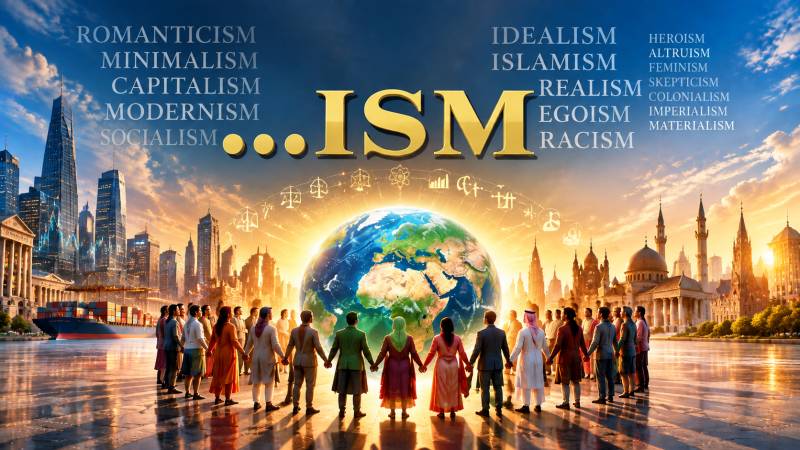
“Humanitarianism consists in never sacrificing a human being to a purpose”—Albert Schweitzer
Human history appears to have an incurable fascination with labels. Capitalism, socialism, communism, liberalism, nationalism, monarchism, fundamentalism and countless other “isms” have been presented at different times as prescriptions for creating the ideal society. Their adherents frequently speak with the confidence of physicians possessing the only cure, while their opponents are dismissed as either ignorant or dangerous. Yet history stubbornly refuses to cooperate with ideological certainty.
No political or economic system is perfect. Equally, very few systems are entirely devoid of merit. The real question, therefore, may not be which “ism” is theoretically superior, but what happens when an ideology encounters the complicated, emotional, ambitious, vulnerable and occasionally irrational creature called the human being. That is where beautiful theories frequently begin to unravel.
Consider monarchy. Conventional political wisdom regards hereditary rule as an anachronism incompatible with modern democratic aspirations. Yet contemporary monarchies present very different outcomes. Oman is officially a hereditary monarchy, while Brunei remains an absolute monarchy. Neither conforms to the Western parliamentary-democratic model. Yet Oman ranks among countries classified as having very high human development and stood 58th in the 2026 World Happiness Report; Brunei also falls within the very-high-human-development category. This does not prove monarchy superior to democracy. Nor does material wellbeing answer legitimate questions concerning political participation, accountability or civil liberties. It proves something subtler: the name of a system alone cannot predict the lived experience of its people.
A benevolent monarchy providing security, social services and administrative continuity may produce better human outcomes than a nominal democracy plagued by corruption, lawlessness and institutional collapse. Conversely, unchecked monarchy can become arbitrary and oppressive. The decisive factor is not the crown itself but how power is exercised, restrained and directed towards human welfare. Socialism offers another lesson. Its moral attraction is understandable. The idea that grotesque disparities of wealth should not condemn millions to deprivation while a minority accumulates abundance springs from an essentially humane concern. Indeed, socialism emerged partly as a response to the brutal working conditions and inequality accompanying early industrial capitalism. Yet the Soviet experience demonstrates what can happen when equality becomes subordinated to centralised authority.
Humanity's mistake has been searching for the perfect “ism” when none exists. The ultimate question is not whether a system defeats another, but whether it serves human beings or sacrifices them to preserve itself.
The erstwhile USSR achieved rapid industrialisation and substantial advances in education, science and military power, but its system also produced political repression, economic inefficiency and chronic shortages. The Library of Congress notes that prolonged centralisation contributed to economic decline, inefficiency and apathy during the 1970s and 1980s. Its eventual collapse in 1991 resulted from multiple economic, political and national pressures, not from one simplistic cause. The lesson is not that the desire for equality was foolish. It is that equality enforced without adequate freedom, accountability and respect for human individuality can become another form of domination.
China presents a very different experiment. After 1978 it gradually departed from rigid central planning while retaining Communist Party leadership. Its official model came to be called “socialism with Chinese characteristics,” incorporating what China itself describes as a socialist market economy in which markets play a major role while the state retains significant control and public ownership remains important.
Whatever one’s view of China's political structure, its economic transformation illustrates an important principle: systems survive by adapting. Ideological purity was sacrificed to practical necessity. Markets, private enterprise, foreign investment and state planning were combined rather than treated as mutually exclusive theological doctrines.
Capitalism provides perhaps the clearest example of ideological adaptation. Its modern ascendancy gathered force with the Industrial Revolution and the nineteenth century. Its extraordinary capacity to generate innovation, investment and wealth cannot reasonably be denied. Neither can its darker tendencies: concentration of wealth, exploitation of labour, financial excess, environmental destruction and the danger of converting everything—including human beings—into commodities.
Yet what has survived is rarely pure laissez-faire capitalism. Successful capitalist societies repeatedly modified it through labour laws, social insurance, public education, progressive taxation, competition regulation and welfare programmes. Capitalism survived partly because it was compelled to absorb some of the very social concerns raised by its critics. Perhaps that is the greatest irony of all “isms”: those that endure generally do so by borrowing from their rivals.
The more serious problem arises when ideology becomes sacred. Once an economic or political doctrine is regarded as morally infallible, humans become expendable in its service. Communism can sacrifice liberty in the name of equality. Capitalism can sacrifice dignity in the name of profit. Nationalism can sacrifice outsiders in the name of collective identity. Religion, when converted into political absolutism, can sacrifice compassion in the name of doctrinal purity. Even democracy can deteriorate into majoritarian arrogance if institutions, minorities and legal restraints are treated as obstacles rather than safeguards. This brings us to two indispensable ingredients that transcend ideology: rule of law and humanism.
Rule of law means that rulers and ruled alike are constrained by institutions rather than personal whim. Yet even law is insufficient if its substance becomes inhuman. History contains plenty of perfectly enforceable laws that were profoundly unjust. Humanism supplies the missing conscience. A humanistic society asks a question ideology often forgets: what is happening to the actual human being?
Can people obtain education? Can they earn a dignified livelihood? Can citizens question authority without terror? Can the weak obtain justice against the powerful? Can enterprise flourish without becoming predatory? Can wealth be created without treating poverty as moral failure? Can a society preserve order without extinguishing individuality? The United Nations Development Programme captures something similar in its conception of human development: the ultimate measure of progress should be people and their capabilities, not economic growth alone.
Perhaps humanity's mistake has been searching for the perfect “ism” when none exists. Societies are not laboratories populated by obedient variables. They are collections of human beings carrying peculiar cultural traits, aspirations, fears, greed, generosity, prejudices, creativity and conscience. Any system that forgets this eventually begins serving itself rather than the people for whom it was supposedly created.
We therefore need not ask whether capitalism defeats socialism, democracy defeats monarchy or one ideological vocabulary defeats another. A more intelligent question is simpler: Does the system serve human beings or are human beings being sacrificed to preserve the system? Once the second occurs, even the noblest ideology can acquire a satanic face. And when human dignity, compassion and the rule of law remain at its centre, even an imperfect system may become capable of producing a remarkably decent society.