

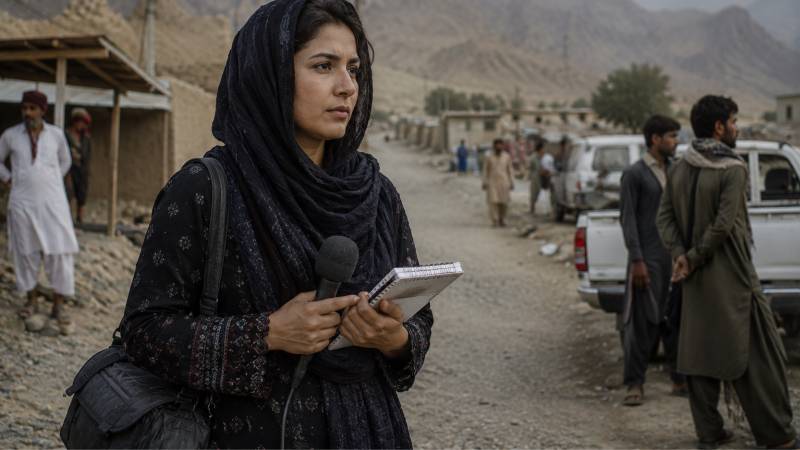
With nothing more than a smartphone, a notebook, and an unwavering sense of purpose, a young woman walks the dusty streets of Pasni, a remote coastal town in Pakistan's Balochistan province. She carries no press card, wears no television network's logo, and enjoys none of the institutional protection that accompanies traditional journalism. Yet she continues to report from one of the country's most conservative and underserved regions.
She is Hani Ramzan—a freelance journalist whose story is defined not by the newsroom she represents, but by the communities whose voices she refuses to let go unheard. From the rugged coastline of Pasni to the isolated villages surrounding the Shadi Kaur Dam, Hani has spent years documenting stories that rarely make national headlines: chronic water shortages, human rights concerns, and the everyday struggles of women living on the margins. One assignment required her to travel alone for nearly 30 kilometres to the Shadi Kaur Dam—a journey that symbolises the risks she is willing to take in pursuit of stories others overlook.
Her determination, however, has come at a cost. While reporting in the field, Hani has repeatedly faced intimidation from influential local figures, who warned her against covering what they described as "sensitive issues." The threats were meant to silence her, but they only reinforced her resolve.
"When I started working as a citizen journalist from the Pak Vandar coastline," Hani recalls, "I was terrified of how people would react. But my work gradually earned recognition and the support of my community. I chose freelance journalism because it gave me the freedom to highlight local issues without editorial pressure or institutional constraints."
That freedom, however, comes without protection. One question follows her almost everywhere she reports: "Which media organisation do you work for?" Without an official press card or the backing of a recognised news outlet, her identity as a journalist is often questioned. The absence of institutional affiliation leaves her doubly exposed—without legal assistance, security support, or the protection normally available to staff reporters.
Her mother remembers the family's early fears. "In the beginning, we worried constantly—not only about what society would say but also about the dangers she faced in the field. But when we saw her videos helping solve problems faced by poor families in our community, our fear turned into pride. Today, we are her greatest source of strength."
Hani credits mobile journalism (MoJo) with transforming the way she reports. Training provided by Beaches for All, a digital media initiative that equips young people and women in Balochistan's coastal communities with digital storytelling, environmental reporting, and social journalism skills, gave her the confidence to work independently in the field. Many of her reports and video stories were later picked up by Pakistan's mainstream digital media, including Independent Urdu and several regional news platforms, bringing the overlooked realities of Pasni and Gwadar to audiences across the country.
The absence of institutional affiliation leaves her doubly exposed—without legal assistance, security support, or the protection normally available to staff reporters.
A Growing Presence, But Little Protection
Hani's journey reflects a quiet yet significant shift taking place across Balochistan. A new generation of freelance women journalists is gradually emerging, driven by expanding access to smartphones, digital media platforms, and training opportunities offered by organisations such as Beaches for All. Young women from towns like Pasni, Gwadar, and Turbat are increasingly reporting for social media platforms and independent news websites, telling stories that have long remained absent from Pakistan's mainstream media landscape. Yet their numbers remain strikingly small. According to senior Balochistan journalist Abrar Ahmed, progress has been slow.
"Compared to the past, more women—particularly freelancers—are entering journalism. But across the entire province, there are still only seven or eight women actively working as freelance journalists. Even in Quetta, media remains a profession that many people consider inappropriate for women." Compared with Punjab and Sindh—particularly metropolitan centres like Lahore and Karachi—Balochistan continues to lag significantly behind in women's participation in journalism. While female journalists elsewhere increasingly occupy leadership positions in press clubs and media organisations, women reporters in Balochistan remain exceptionally rare.
Several factors continue to restrict their participation:
Conservative social norms: Families often discourage or prohibit women from pursuing field reporting.
Geographical barriers: Balochistan's vast distances and rugged terrain make travel to remote areas particularly difficult and unsafe for women travelling alone.
Security concerns: Militancy, armed groups, and an unpredictable law-and-order situation expose freelance journalists to heightened risks.
Legal Recognition Without Practical Protection
Against this backdrop of insecurity, conversations with media law experts reveal a striking contradiction between legal protections and ground realities. According to legal experts specialising in media rights, Pakistan's Protection of Journalists and Media Professionals Act explicitly recognises freelance journalists within its legal definition of a journalist.
"The law is clear," one legal expert explains. "Freelancers are legally recognised as journalists. The problem arises in practice. Unless they carry an official press card or a letter from a registered media organisation, local administrations and police often refuse to acknowledge them as journalists. That is, in itself, a violation of the law." Digital rights advocates argue that press clubs, journalist unions, and media organisations must play a far more proactive role in raising awareness about the constitutional rights and legal protections available to freelance women journalists. Without institutional recognition, they warn, legal safeguards remain little more than words on paper.
Jannat Hameed: A Voice Rising from Gwadar's Coast
Like Hani Ramzan, Jannat Hameed represents another emerging voice from Pakistan's southwestern coastline. Working independently, she produces video stories, photo essays, and interviews focusing on civic issues, women's rights, and development projects in Gwadar. But the path she has chosen is anything but easy. "There is no institution to support us," she says. "Nor is there any local media structure that freelance journalists can rely on."
For Jannat, some stories are simply too dangerous to pursue. "There are issues that cannot be written about—and cannot even be filmed." Her words reflect the invisible pressure many freelance women journalists quietly endure. Without a safe or effective mechanism for lodging complaints, many choose silence over confrontation. Social pressure is another constant challenge.
Freelance journalists will also be accommodated through government initiatives, however, there is currently no dedicated programme for issuing official cards or providing security mechanisms specifically for freelancers.
Influential members of the community frequently remind her that certain subjects are "sensitive" and should not be reported. Without a press card or the logo of a recognised television channel or newspaper, she is routinely asked in the field: "Which organisation do you represent?" The question carries more than curiosity—it carries suspicion. And for freelance women journalists like Jannat, every assignment becomes more dangerous simply because they stand alone. Their identity is often met with suspicion rather than recognition. For freelance women journalists, that lack of institutional legitimacy makes every assignment considerably more dangerous. Without the backing of a recognised newsroom, each step into the field carries heightened personal and professional risks.
Stories That Sparked Debate—and Surveillance
Jannat Hameed's journey into journalism began as a citizen journalist on the shores of Pak Vandar, where she turned to video reporting and photojournalism to document local issues that had long gone unnoticed. As her stories found their way onto digital news platforms, social media, and independent blogs, public reaction was mixed. For many residents of Gwadar, her reporting marked the first time local concerns—particularly women's hardships and the chronic lack of civic services—were being portrayed through the eyes of a woman from the community itself. Her stories resonated with audiences and were widely appreciated for giving visibility to neglected issues.
But recognition came with consequences. As her audience grew, so did digital surveillance by influential circles determined to discourage her reporting. Invisible forms of intimidation began replacing open criticism, creating an atmosphere where monitoring, pressure, and uncertainty became part of her professional life. Despite these challenges, Jannat's work encouraged many local women to speak publicly about their own experiences and helped initiate wider public conversations around development projects and governance in Gwadar.
Kubra Jameel: Caught Between Digital Insecurity and Institutional Neglect
If Hani Ramzan's story illustrates the dangers of field reporting and Jannat Hameed's highlights the pressures of community scrutiny, Kubra Jameel represents another dimension of vulnerability confronting freelance women journalists in Balochistan—the absence of digital security and institutional support. Through videos and written reports shared on social media and independent online outlets, Kubra has consistently highlighted issues affecting Baloch women. Yet, unlike staff journalists, she works without the protection, technical assistance, or digital security training typically provided by established media organisations.
Her journey into journalism began modestly. Initially, she published short videos and written posts on social media, focusing on women's concerns in her community. As her reporting gained credibility, various digital platforms began publishing her work, eventually leading her into freelance journalism. Yet with increased visibility came increased vulnerability.
"We frequently face online harassment," she says. "Sometimes our accounts are monitored; other times we fear our personal data could be leaked. But because we are not affiliated with any media organisation, we have neither the training nor the support system needed to deal with these threats." For freelance women journalists, one of the most significant gaps lies in digital security training, which is generally available only to permanent employees of major media houses. Kubra recalls receiving threatening messages on multiple occasions. However, because she worked independently, she had nowhere to report the abuse and no trusted institution to seek protection from.
Seeking Protection, Finding Closed Doors
When asked whether she had approached any government institution—such as the Federal Investigation Agency's Cyber Crime Wing—to report these threats, Kubra's response reflected the dilemma shared by many independent journalists. "For freelancers, approaching government institutions feels like a nightmare," she explains. "Without the backing of a major media organisation, authorities rarely take your complaints seriously. Worse still, filing a complaint can expose your identity and increase the risks you already face. That is why many of us choose to remain silent."
Even the digital platforms that publish her work offer little assistance. "When we report threats to the platforms we work with, the response is almost always the same: 'We only publish content. Providing security or legal assistance is not our responsibility.'" For Kubra and countless others like her, this institutional vacuum has only deepened their sense of insecurity.
Press Clubs and Journalist Associations: Guardians or Gatekeepers?
Pakistan is home to several organisations representing freelance and digital journalists, including the Digital Media Alliance of Pakistan (DigiMAP) and the Pakistan Freelance Journalists Association (PFJA). Yet traditional press clubs and journalists' unions continue to hesitate when it comes to granting formal membership to freelancers. For women working independently, this exclusion carries serious consequences. Without membership, they are denied institutional protection, professional training, insurance, and access to legal support mechanisms.
Among the existing organisations:
DigiMAP, established in 2020, represents more than fifty digital news platforms. Its mission is to strengthen independent digital media through collaboration, training, and policy advocacy. While women journalists are welcome to participate, membership is primarily extended to media platforms rather than individual freelancers.
The Pakistan Freelance Journalists Association (PFJA), founded in 1979, has long advocated for the rights of independent journalists. Historically, it has campaigned against censorship and developed charters supporting provincial correspondents. Although women freelancers are included within its membership framework, practical support remains limited.
Meanwhile, the Pakistan Freelancers Association (PAFLA) has partnered with press clubs to equip journalists with freelance skills for the global digital marketplace. Workshops organised at the Karachi Press Club have sought to help media professionals diversify their careers beyond conventional newsrooms.
Membership and the Debate Over Professional Recognition
Officials from press clubs and representatives of the Pakistan Federal Union of Journalists (PFUJ) defend their cautious approach by pointing to existing membership rules. According to them, press club constitutions require applicants to demonstrate formal employment with a registered media organisation through appointment letters, salary slips, or similar documentation.
"If we open our doors to everyone claiming to be a freelance journalist," one representative argued, "we risk an influx of non-professionals, which could undermine journalistic standards." Even so, they acknowledge that the circumstances confronting freelance women journalists in Balochistan are unique and may warrant greater flexibility in existing policies. Although Pakistan's Protection of Journalists and Media Professionals Act has broadened the legal definition of journalists to include freelancers, many of the law's promised protections remain absent in practice.
The Road Ahead
According to Balochistan government spokesperson Shahid Rind, authorities intend to create greater opportunities for freelance journalists in the future. "Freelance journalists will also be accommodated through government initiatives," he says. "However, there is currently no dedicated programme for issuing official cards or providing security mechanisms specifically for freelancers."
Former Speaker of the Balochistan Assembly Raheela Durrani believes progress is being made but argues that the pace of reform must accelerate so that women journalists can work without fear. Freelance women journalists in Balochistan—and in many of Pakistan's underserved regions—represent some of the country's most vulnerable yet indispensable storytellers. They document the lives of communities that rarely find space in mainstream media, often at enormous personal risk. Protecting them requires more than symbolic recognition. It demands structural reform. Traditional press clubs, journalist unions, government institutions, and digital media organisations must rethink policies that continue to exclude independent reporters from protection mechanisms.
A dedicated safety framework is urgently needed—one that includes digital security training, state-backed legal assistance, insurance coverage, emergency response systems, and regional support networks tailored specifically for freelance journalists. Without such reforms, countless stories exposing injustice, inequality, and social neglect risk being silenced before they are ever told.