

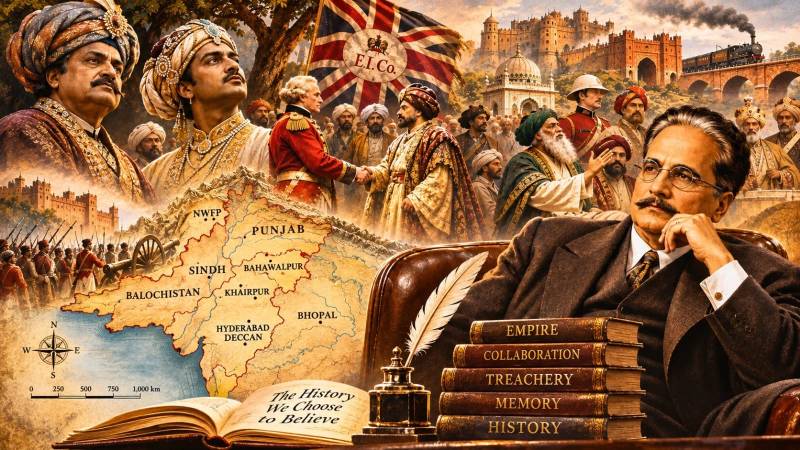
History has a peculiar talent for manufacturing heroes and villains. Few names in South Asia have endured greater damnation than Mir Jafar, the commander whose conspiracy with the East India Company helped overthrow Bengal’s Nawab, Siraj-ud-Daulah, at Plassey in 1757. Mir Jafar became the archetype of treachery; Siraj, the patriotic martyr. But does the historical record support such an uncomplicated morality tale?
The question is not whether Mir Jafar betrayed his ruler. He did. It is whether betrayal of a sovereign in eighteenth-century Bengal necessarily constituted betrayal of a nation and why our judgement of indigenous collaboration with British power remains so selective. The Nawab Behind the Myth: Siraj-ud-Daulah was no unblemished hero. In The Anarchy, William Dalrymple cites Ghulam Husain Khan, a relative and contemporary of the Nawab, who described him as intemperate, abusive towards experienced commanders and given to arbitrary conduct. Contemporary accounts also allege cruelty and sexual predation. Such accusations require caution: court chronicles reflected factional interests, and British narratives often justified imperial intervention. Allegation is not proof.
Yet Siraj’s political isolation is difficult to dispute. Senior officials, powerful bankers, including the Jagat Seth family, and other vested interests joined the conspiracy against him. This was not simply an honourable prince undone by one perfidious general; it was a crisis within Bengal’s governing establishment. Nor should Siraj’s failings exonerate the Company, whose military intervention converted a succession struggle into an opening for imperial conquest.
Treachery Against Whom? Mir Jafar secretly allied with Robert Clive and helped secure Siraj’s defeat on 23 June 1757. He sought the nawabship, not the conscious subjugation of an imagined modern nation. In 1757, Hindustan was a vast mosaic of Mughal successor states, regional kingdoms, Rajwaras, Riyasats and smaller principalities, whose rulers exercised varying degrees of sovereignty under the increasingly nominal authority of the Mughal emperor. Political allegiance was principally dynastic, regional or personal; the modern Indian nation-state did not exist.
Courtiers changed allegiances; rulers were deposed; regicide and fratricide were recurring features of dynastic struggles, while succession frequently involved intrigue, conspiracy and violence. This context does not absolve Mir Jafar. Plassey hastened Company ascendancy, and its acquisition of Bengal’s revenue rights in 1765 brought far-reaching consequences. But motive and consequence are not interchangeable. This was also a world in which political communities had identities and loyalties of their own; the absence of modern nationalism did not mean the absence of patriotism. Yet the modern vocabulary of national treason cannot simply be projected backwards. Siraj-ud-Daulah's resistance to British encroachment did not absolve him of his misrule; equally, his opponents' grievances must be understood within the dynastic politics of their time. The East India Company's territorial ambitions were already unfolding against the backdrop of declining Mughal authority and competing regional powers. Mir Jafar neither comprehended British imperial expansion nor set its machinery in motion; his conspiracy merely accelerated the Company's transformation from a commercial enterprise into a formidable territorial power.
History is neither a courtroom convened to vindicate inherited prejudices nor an armoury from which politicians may selectively draw accusations. Until we distinguish inquiry from mythology, we shall keep weaponising the past instead of understanding it.
The Collaborators We Overlook: If dealing with a foreign power is the definitive measure of treachery, consistency demands confronting the alliances that sustained British conquest and rule in the subcontinent. Mir Jafar’s conspiracy in 1757 and the collaboration of indigenous elites in 1857 were separated by a century of profound political transformation. In 1757 the Company was an emerging territorial power; by 1857 it dominated vast territories. These were different circumstances, not interchangeable offences. In the intervening century, the Company had moved from commercially privileged participant in Indian politics to an imperial state extracting revenue and commanding armies. Equating all accommodations across that transformation obscures rather than illuminates their historical meaning.
Punjab is revealing. Following annexation in 1849, British administrators cultivated landlords, tribal chiefs, Pirs and Sajjada Nashins. During the 1857 uprising, sections of these elite supplied recruits, provisions and intelligence, helping preserve British authority and recapture Delhi. Colonial patronage subsequently extended to influential hereditary custodians of Sufi shrines, particularly in western and southern Punjab, whose religious authority commanded extensive networks of disciples. Land grants, titles, administrative privileges and recognition as landed gentry helped bind sections of this religious aristocracy to imperial rule. As historian David Gilmartin demonstrates, the British deliberately incorporated Sajjada Nashins into the rural power structure, consolidating an alliance between religious authority, landed privilege and colonial administration. Yet Punjab also witnessed resistance, including the Gogera uprising. As historian Turab-ul-Hassan Sargana shows, elite collaboration cannot be mistaken for the allegiance of an entire population.
Sindh tells a related story. During the conquest of 1843, Mir Ali Murad Khan Talpur I of Khairpur, entangled in a dynastic rivalry with his brother Mir Rustam, supported British policy while other Talpur rulers resisted. Khairpur survived under British paramountcy. Colonial authorities subsequently cultivated zamindars and influential Pirs through patronage and recognition of landed privileges, as Sarah F. D. Ansari documents. Yet the battles of Miani and Dubbo in 1843 demonstrate armed resistance. The bargains of selected powerbrokers were not the verdict of Sindh’s people.
In Balochistan, the 1876 arrangements negotiated by Robert Sandeman extended British supervision over Kalat and strengthened indirect rule through tribal Sardars. Subsidies and political recognition secured cooperation, but unequal treaties cannot be confused with popular consent. The settlement also reflected contests between the Khan and tribal chiefs, which British officials used to establish influence. Local political divisions were thus incorporated into the machinery of imperial frontier governance.
The North-West Frontier, later constituted as the NWFP in 1901, presents another revealing example. During the 1857 uprising, Pashtun chiefs and recruits from Peshawar and adjoining areas helped reinforce British authority. Subsequently, colonial administrators cultivated tribal Maliks through subsidies, privileges and political recognition, securing frontier levies and protection of strategic routes. Afridi and Shinwari chiefs, among others, entered arrangements involving substantial annual allowances. Yet the frontier also witnessed determined resistance, including the uprising of 1897. As elsewhere, collaboration by influential intermediaries cannot be equated with the allegiance of an entire people.
Bahawalpur offers an especially striking example. Its rulers supplied troops during the Multan campaign of 1848–49 and received substantial rewards. During the 1857 rebellion, Bahawalpur placed 3,000 men in Sirsa and supplied another detachment of 1,000 at the Punjab administration’s request, as an account in The Friday Times records. Yet its ruling house never acquired Mir Jafar’s enduring notoriety. Elsewhere, rulers and elites in Hyderabad Deccan, Bhopal and princely Punjab aided British authority at critical moments. Motives varied: dynastic survival, protection against rivals, territorial security and privilege. Such decisions were neither identical nor always freely made.
The history of British India cannot be understood simply as a confrontation between foreign conquerors and indigenous patriots. It was also a history of competing interests, shifting allegiances, calculated accommodations and indigenous participation in the machinery of empire. The Inheritance of Empire: British patronage entrenched hereditary hierarchies through jagirs, pensions, titles and administrative influence. Some families retained prominence after independence. Descendants cannot inherit ancestral guilt, but institutions of inherited privilege deserve scrutiny.
Why is one Bengali commander endlessly invoked as the synonym for betrayal, while other alliances become pragmatism, statecraft or forgotten footnotes? In Pakistan, calling someone a “Mir Jafar” too often terminates debate exactly where historical investigation should begin: with evidence, available choices and political interests. Iqbal and the Politics of Historical Memory, Allama Iqbal helped immortalise that verdict:
Jafar az Bengal, Sadiq az Deccan;
Nang-e-deen, nang-e-millat, nang-e-watan.
The couplet condemns Jafar and Sadiq as disgraces to faith, community and homeland. Yet Iqbal’s own intellectual journey illustrates the danger of absolute historical judgements. In 1901, the young Iqbal composed Ashk-e-Khun, an elegy mourning Queen Victoria; an original publication is catalogued by the Iqbal Academy. He later wrote Hamara Tajdar for George V’s coronation celebrations, expressing loyalty to the monarch. During the First World War, he also composed verses associated with imperial wartime occasions. In 1923, he accepted a British knighthood. These early royal tributes did not enter Bang-e-Dara (1924), although their omission does not establish an attempt at concealment.
Iqbal’s political thought subsequently developed into a powerful critique of imperial domination. His changing convictions deserve historical context, not accusations of hypocrisy. But the question follows: if Iqbal’s relationship with imperial Britain is examined in the circumstances of his age, why deny comparable contextual scrutiny to Mir Jafar’s alliance with the East India Company? Their situations were not equivalent; that is precisely why context matters. A poem written under consolidated colonial rule and a military conspiracy during the Company’s ascent are different acts. Neither can be judged responsibly through an isolated epithet.
Iqbal was a great poet and philosopher, not an infallible historian. Poetry may immortalise a verdict. History must still examine the evidence. Mir Jafar need not be rehabilitated as a hero, nor Siraj stripped of every claim to sympathy. History is neither a courtroom convened to vindicate inherited prejudices nor an armoury from which politicians may selectively draw accusations. Until we distinguish inquiry from mythology, we shall keep weaponising the past instead of understanding it.