

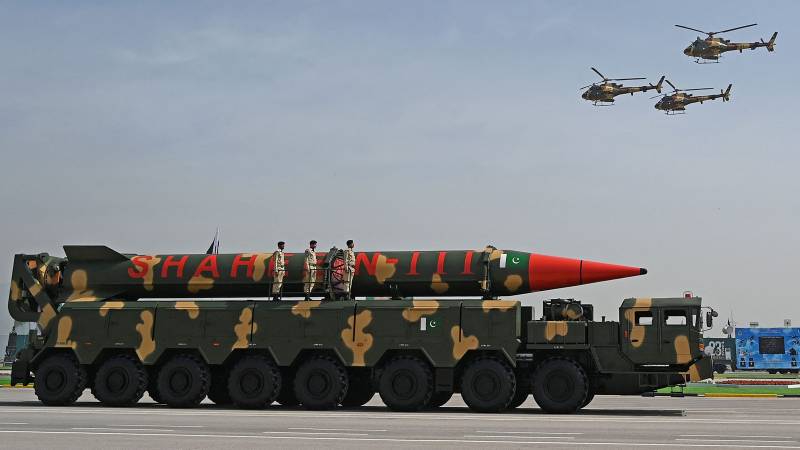
The case for developing nuclear weapons is predicated on two assumptions. First, that they will deter war and yield a peace dividend. Second, they will be accompanied by a reduction in spending on conventional weapons and yield an economic dividend. Both assumptions have proven to be false over time.
The US hit two Japanese cities with atomic bombs in August 1945. While Japan surrendered just a week later, the atomic blasts triggered off a chain reaction. Just four years later, in August 1949, its main post-World War II rival, the USSR, detonated its first atomic bomb. In 1952, the US exploded its first hydrogen bomb. The USSR followed suit in 1955 with its first hydrogen bomb.
To maintain their “great power status, the UK and France detonated their first atomic bombs in 1952 and 1960 respectively. In 1964, China exploded its first atomic bomb, and India followed suit, just a decade later in 1974. In between, Israel is believed to have developed nuclear weapon capability in 1966-67. Finally, Pakistan demonstrated its capability in 1998.
These nuclear weapons have not prevented conventional wars from breaking out between Israel and its neighbours. Furthermore, as discussed previously, Pakistan’s acquisition of the self-styled “Islamic Bomb” has put it in the crosshairs of the ever-paranoid, right-wing Zionists who have been running Israel since 1996.
Recent national security policies claiming no trade-off exists between economic and military spending ignore the stark reality of opportunity costs
Pakistan responded to India’s five nuclear tests in May 1998 with six of its own, ostensibly to restore the strategic balance via a nuclear deterrence and went on to argue that the tests served the interest of peace and stability in South Asia.
Yet, less than a year after the tests, emboldened by the possession of nuclear weapons, Pakistan attacked Indian forces at Kargil. For reasons that are unclear to this day, General Pervez Musharraf, the army chief who launched the attack, was confident that India would not carry out a first strike with nuclear weapons. General Musharraf stated that he had considered attacking India with nuclear weapons during the operation, but the fear of Indian retaliation prevented him from doing so.
After an initial success, the advance ran out of steam, as did the previous advance in 1965, which escalated into a full-scale war with India which Pakistan came to losing. India hit back hard to Pakistan’s incursion in Kargil in 1999, forcing Pakistan to withdraw its forces. Even China did not speak out on Pakistan’s behalf.
That year also witnessed the shooting down of a Pakistani naval reconnaissance aircraft by India, the intensification of India’s counter insurgency operations in Kashmir, and the subsequent hijacking of an Indian airliner to Afghanistan by a militant Kashmiri group alleged to have ties with Pakistan.
In December 2001, terrorists mounted an attack on the Indian parliament in New Delhi. This came on the heels of the 9/11 attacks. India blamed Pakistan for the attack. The war of words between the two countries escalated rapidly into a large-scale mobilisation of conventional forces. At its peak, a million troops were deployed across the international border. Stanford University held two conferences in 2002-03 to find solutions to the dangerous impasse. US intelligence put the probability of a nuclear exchange at 50% and stated that it could kill 150 million people.
Years later, the Taj hotel in Mumbai was attacked by terrorists, once again leading to a dangerous war of words between the two nuclear powers and threats of retaliation.
Fearful of each other’s motives, the sibling adversaries continue to invest in advancing their nuclear arsenal. Pakistan has proudly added battlefield ballistic missiles to its inventory. And the prospect of a nuclear strike has now entered the rather impolite vocabulary of the threats that are routinely exchanged between the opposing generals.
As India acquired more sophisticated fighters, tanks, guns, submarines and surface combatants, so did Pakistan. The arms race has diverted funds from human and economic development. The bigger risk is the possibility of stumbling into a nuclear war. It’s very difficult to read the enemy’s intentions.
It is very instructive to read what Air Marshal Asghar Khan wrote in his book, We’ve Learnt Nothing from History. With unusual clairvoyance, he noted: “If we persist in our folly we, the people of the Indo-Pak subcontinent, will before long destroy ourselves either by self-inflicted misery and hunger and, if not by these, then by the use of nuclear weapons, accidentally or intentionally, in which we appear to take so much pride.”
Then he turned to the nuclearisation of the subcontinent in 1998. He made a striking statement: “I believe that, with an unsatisfactory international situation with India, Pakistan would be more secure without nuclear weapons.”
He laid out a very logical argument: If Pakistan got rid of its nuclear weapons and invited international experts to validate that it had indeed become a nuclear weapons-free zone, India would be unable to use its nuclear weapons against Pakistan. “Because of its heavy investment in maintaining a large nuclear capability, India’s capacity to maintain a large conventional force at the same time would be limited. That itself would give greater security to Pakistan which should review its concept of defence.”
He suggested that Pakistan should focus on fighting a defensive war using conventional weapons: “Pakistan should maintain an effective air force with reasonable armoured strength and should cut down drastically the defence expenditure on its regular land force.”
He said that Pakistan should have a large reserve of trained manpower which would be called up periodically for refresher training. The reserve forces would be spread out over the entire country along with ammunition depots. The forces should be capable of rapid deployment in 24 hours.
If Pakistan did so, not only would its defence be strengthened but it would be able to cut its defence budget drastically. This would allow “wasteful and totally unnecessary expenditures” to be cut down. By doing so, the air force commander, a veteran politician who had devoted his post air force life struggling for democracy, a man who had published widely, and a man whose patriotism was beyond reproach, commented: “Our defence would be greatly strengthened at far lesser cost.”
During Imran Khan’s tenure, a national security policy was issued which stated that the trade-off between economic spending and military spending in Pakistan was archaic. That was wishful thinking. There is a real opportunity cost associated with military spending. Every dollar spent on defence is a dollar that can no longer be spent on economic development. As every economist knows, “There is no such thing as a free lunch.”
Furthermore, national security cannot be ensured by military spending alone. It also depends on economic, social, cultural and human development. These four elements constitute what the English strategist, Professor Michael Howard called the “soft dimensions” of strategy. Ahmad mentions them in my book, which was cited by the Abbottabad Commission of inquiry into the Osama bin Laden episode.