

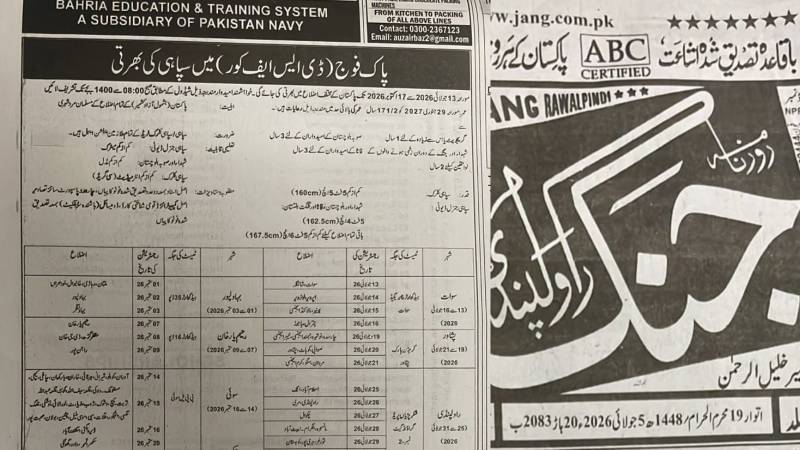
An advertisement for the recruitment of soldiers in Pak Army appeared in the Daily Jang on July 5, 2026 restricting the eligibility to only male Muslim candidates. A human rights organization called the attention of the head of One-Man Commission on Minorities' Rights in Pakistan, Dr. Shoaib Suddle, who took up the matter with the concerned authorities. He was assured that the advertisement will be withdrawn. The promise to rectify the mistake is expected to be honoured, however, the question remains why the drafters and someone who gave approval were inclined to think this was an only Muslim institution.
Earlier, a newspaper advertisement in July 2020, restricted the post of sweepers in Pakistan Navy, for only Christians. The mindset reflected in these two instances runs contrary to the history of these institutions which is testimonial to non-Muslim presence in the soldiery, officials and gallantry. Hence imagining Pakistan’s Military institutions as religiously biased or restricted for religious minorities is contrary to the facts or mere ignorance. Given the Pakistan’s Military’s influence and respect such advertisements are surprising but also a mistake needing an immediate correction. The government policy of reservation of job quota pursued since 2009 is meant to include religious minorities in the mainstream governance, therefore such discriminatory advertisement surfacing howsoever rare is conflict with the government policy.
Citizens have approached courts with complaints of discriminatory practices in government and private institutions entailing courts holding against the religious discrimination in the hiring or implementation of job quota, for instance, Supreme Court of Pakistan – Mubarik Ali Babar v. Punjab Public Service Commission (PLJ 2023 SC 372; 2023 PLC (C.S.) 1049). The Court directed governments to ensure that the minority employment quota was implemented for all grades, publishing discriminatory advertisements was stopped and recruitments were more transparent. Hence, the judgment adopted a comprehensive approach for protecting quotas while a systemic occupational segregation of religious minorities was outlawed.
Contrary to the religious preference shown in the instances at hand, annals of history prove that religious minorities participated in the creation and progress of Pakistan. After the partition in 1947, Pakistan railways, customs, the post and the telegraph, police, foreign affairs, schools, colleges, courts of law, hospitals, health and sanitation services, all began to take shape with the help of Pakistani Christians, Hindus and other religious minorities serving at the forefront.
The drafters, publishers and those who are responsible to keep a watch over the content of the advertisements should be aware of Constitutional protections from religious discrimination.
In 2024, a Christian Sepoy Haroon William made the ultimate sacrifice during a counter-terrorism operation in the Kurram region and a Hindu Sepoy Sachin Kumar sacrificed on May 28, 2026, after fighting a suicide attack in Quetta. Haroon and Sachin are among hundreds of Christian, Sikh and Hindu soldiers and officers who laid down their lives; and thousands rendered outstanding performances and exceptional levels of service. During the major wars Pakistan has fought, officers from religious minorities have excelled in professional competence and patriotism. After having pledged allegiance to Pakistan, not only did the religious minorities contribute towards its creation but have continued to contribute towards its defence, welfare and development.
The drafters, publishers and those who are responsible to keep a watch over the content of the advertisements should be aware of Constitutional protections from religious discrimination under Article 25 (the equality of citizens) and Article 27 (1) (safeguards against discrimination in services); the latter reads , “No citizen otherwise qualified for appointment in the service of Pakistan shall be discriminated against in respect of any such appointment on the ground only of race, religion, caste, sex, residence or place of birth.”
Therefore, the publishing of such advertisements, in disregard to the constitution of Pakistan, impinges on the rights of minorities and also carry severe and lasting consequences, for the institutions and social fabric of Pakistan. Both federal and provincial governments need to proactively monitor how religious minorities are perceived in Pakistan, by consistently acknowledging their contributions to the country and check on discriminatory practices. National human rights institutions, such as the National Commission for Human Rights, should take notice of prejudice among citizens.
The National Commission for Minorities Rights Act is passed so the establishment of NCMR should be a priority to monitor the practical realisation of and to safeguard the rights provided to minorities under the Constitution and law. The Supreme Court judgment by Justice Tassaduq Hussain Jillani on June 19, 2014 should be implemented in letter and spirit.
Moreover, the role of outstanding non-Muslim Pakistanis needs to be highlighted in the national curriculum as a vehicle to promote tolerance. Lessons about heroes such as Group Captain Cecil Chaudhary, Sister Mary Emily Gonsalves, Sr Ruth Lewis, Justice Dorab Patel, Justice A. R. Cornelius and Justice Baghwandas should be widely part of the syllabus.
As a last resort, the media should take ownership and refuse to print discriminatory ads that humiliate and hurt disadvantaged groups. The print and electronic media should instead highlight the contribution of all communities towards the development and progress of Pakistan, so that their audiences can recognise and enjoy the cultural, ethnic and religious diversity that exists in Pakistan. All Pakistanis should know about the contributions of religious minorities. This is how a social and cultural understanding of ourselves can be developed.