

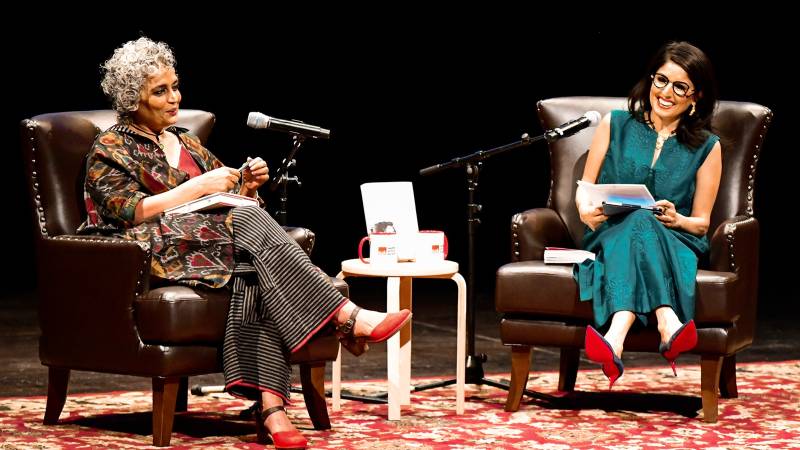
September in Seattle has a sultry, moist scent. A reminder of the rains to come, (although given how often it rains, reminder not really necessary).
This particular autumn day had some warm splashes of sunlight, heightening the mood of expectation at Meany Hall, University of Washington.
Two women of South Asian descent, a heady, charismatic combination of individuals: the iconic Arundhati Roy, writer and activist, in conversation with Shahina PiyarAli.
This September, the author of The God of Small Things and The Ministry of Utmost Happiness, Arundhati Roy, came to Seattle, and spoke of her memoir Mother Mary Comes to Me.
The raw and riveting real-life saga reflects the complex relationship between Arundhati Roy and her mother, Mary, a dynamic force who intensely influenced the writer’s life.
Many years ago, I had found myself mesmerized by Arundhati Roy’s first book, The God of Small Things.
“Slanting silver ropes…” and other lyrical lines of stunning imagery stayed with me long after the book was over. Twenty-eight years later I was not disappointed, both the memoir and the lady were still captivating.
Here I was far from my native Pakistan where I had first heard her speak, more than twenty years ago.
I was now in Seattle and while admiring Roy’s captivating prose, I was struck by her courage. There appeared to be no confusion regarding her call for justice in a world suffocating with the inability to call out brute bias.
As an eager audience filled the room, speaking of Gaza, Roy said “it is a wound through which the whole world bleeds.”
An attentive silence falls upon the hall at the event organized by Seattle Arts and Lectures and Elliot Bay books.
Shahina PiyarAli is a former attorney, Pakistani expat and leader in the Seattle Arts community. She serves on the board of Graywolf Press and UW Press and has in the past served as director of the board at Hugo House. Shahina has been writing reviews for Shelf Awareness for 9 years now.
As I spoke to Shahina PiyarAli, we discussed her dialogue with Arundhati Roy, Shahina’s love of literature and vision of life.
My conversation with Shahina started with me asking her about her interest in literature and how those interests took root.
***
Shahina PiyarAli: My love of literature started early, I was the only one of my sisters always wanting to go to the library. By the time I was old enough to go by myself, I would go and get a pile of books every Friday.
I became a lawyer because it was a more practical profession but literature was always my true love, so I’ve made a huge circle back to it. I was always a voracious reader and I now find myself immersed in it.
Zeinab Masud: You’ve done justice to your passion! I know that you’re on the board of directors of Graywolf Press and also have been on the board at Hugo House. These are great accomplishments, a South Asian woman leaving her mark in Seattle and beyond. Tell us a little bit more about how all this came to be.
SP: There's always been a push for more diversity in the world of arts nonprofits. Being a Pakistani expat raised in England and living in the U.S., I was happy to bring my perspective to the table. Chairing the Hugo House board was truly an honour and also somewhat challenging. At that time in Seattle and across the country there was a major push towards racial justice in Seattle. At Hugo House the younger staff members viewed diversity more aggressively than members of my generation, but it was important to me that a more gracious and inclusive vision of equity and equality prevail at the institution. While Hugo House is based locally, Graywolf Press is a national organization. They bring some phenomenal diverse voices. The other organization which I currently work with is the University of Washington Press, I’m on the advancement board. It’s great to see what is being published and what is resonating with audiences.
ZM: I know that you’re also a writer for Shelf Awareness, tell us what that’s been like.
SP: Yes I’ve been with them for nine years now. They are an organization which bridges the gap between what publishers put out there and what magazines and newspapers publish about books, there a big gap in between.
ZM: How did you first get to connect to Arundhati Roy?
SP: I got to interview Arundhati Roy this April via zoom because I was writing a feature commissioned by her publisher as part of the promotional materials for her new book. The feature included a review and a Q&A with the author.
Shelf Awareness is an independent literary organization, there is no agenda other than recommending the best books for our readers and booksellers.
ZM: And here in Seattle, we were fortunate to hear both you and Arundhati Roy in conversation, two strong, feminine voices, doing South Asian identity proud. Tell me what was it like to first connect with her in April.
SP: She’s very interested in Seattle so we connected on that. We had a wonderful conversation about the city. The day we first spoke, she was in Delhi and I was in Seattle. But despite being in different places, we had a meeting of minds.
She has done what her conscience called her to do, stand up for so many, people who would be displaced by dams, the follies of nuclear armament, she has followed her own conscience.
But I do want to say that there’s nothing “victim like” about her. I felt that this person is strength personified. So many of us compromise on what we would like to say to keep the peace. She would never do that.
That was our first connection.
After that zoom call. I got a message from her agent Antony Arnove, asking whether I would like to interview her when she came to Seattle. I said I would love to do that and I’ve been immersed in her book from April onwards.
That was the first part of the journey.
The second part involved being on stage with her. Arundhati and I had the opportunity to chat beforehand and go over some of my questions. She was incredibly gracious, and we talked easily about many topics which made the conversation on stage all the more comfortable.

ZM: When you met her, was she what you expected her to be?
SP: She’s a very warm person and so self-assured and that composure makes you feel comfortable. Despite her brilliant mind, she’s interested in the other stuff, we laughed about our red shoes, she was interested in clothes and jewellery and took a real interest in my family.
"I think what is painful is when young people limit themselves, because of social media. They think that is their world and they are not able to see the broader world out there"
She showed a lot of intellectual curiosity about life, about people around her.
It’s not often that someone emanates that kind of grace and warmth, that goes beyond the fact that they have a brilliant mind. What I loved about her was that she has a willingness to laugh, her sense of humour.
ZM: In a world gripped with fear, hers is a brave voice.
SP: Yes, she is a deeply empathetic person and has used her platform to amplify causes within India and beyond, including the genocide in Gaza.
ZM: You are a lawyer with such a love of literature. How have you straddled these two interests?
SP: I think there’s been a lot of alignment. In law, you’re trained how to write, how to summarize. One of my favourite things both in England and in the US was the reading involved: learning different cases and the precedents which were set. It aligned well for me in terms of pivoting towards literature.
I was not satisfied however, I felt a lot of anxiety. It’s a cut throat profession. It’s just not me. The practice itself shows you why lawyers have the reputation they have.
ZM: Do you think you will ever write a book?
SP: That’s a great question.
I had an idea about picking a historical figure and writing about that figure.
Perhaps someone involved in partition. An unknown figure. A woman hopefully. Some historical research.
ZM: Next question, straight from my heart to yours. I know you…you’re an amazing mother and wife and you straddle various literary roles. Other than literature, what are your loves in life?
SP: I love going for long walks and a more recent focus is exercise. It’s a freeing, liberating feeling, to find your bones and muscles becoming stronger. And at this stage of my life, friendships, spending time with people who you feel aligned with mentally and spiritually.
ZM: In today’s dichotomous world, what is painful for you and what is beautiful?
SP: I think what is painful is when young people limit themselves, because of social media. They think that is their world and they are not able to see the broader world out there.
In terms of what’s beautiful, I’ve been appreciating art a lot more. Art has a way of lifting you out of yourself and forgetting the moment. I think that’s very valuable.
Seattle is a UNESCO designated city of literature. In that way, it is a very literary city.
ZM: If you could be reborn as anyone…
SP: I think I’d like to be the prime minister of a small country, a critical country where I have some negotiating power to do the right thing.
If you have power, you can wield that power for greater good.
ZM: There were so many beautiful lines which stood out in ‘Mother Mary comes to me’.
One of my favourites was “she was my shelter and my storm.” (p 7)
The kind of lines that make you want to just read three pages a day so you can savour the book for as long as possible. Is there a quote that particularly stands out for you?
SP: Her reflections are achingly tender and point to an understanding, even as a young child, that for Mrs Roy to “shine her light on her students and give them all she had, [Roy and her brother] had to absorb her darkness.” (p 47) That darkness was a gift, the “route to freedom,” (p 47) releasing Roy from the shackles of her inherited past.
This quote speaks to me.
ZM: So we’ve spoken of darkness and lightness. What does brightness mean for you?
SP: Lightness or brightness-reading someone’s words that resonate so deeply within you that they leave you speechless.
A meeting of minds and a feeling of being understood.
The sun peeking through the clouds. Not a cloudless day of unrelenting sunshine, simply a glimmer of sun to show that it’s there despite the grey.
Conversations with my children and the feeling of amazement when they broaden my mind.
ZM: Do you have a message for South Asian women striving for fulfilment in their lives.
SP: I would say look for balance in your life, know that for it all to fall into place something has to give. Learn to let go of past failings and expectations of others. Cultivate kindness. Which also means accepting people and not thinking you can change them. It’s contentment we’re after, not the pressure to be happy all the time.
ZM: Shahina, a final question.
Mother Mary Comes to me…what comes to you?
SP: Oh, I love that…
My sister, teaching me from beyond that mistakes should not be life sentences, they should be lessons we can move on from, and that mental health is precarious. For women, especially, societal messaging can leave us feeling less than. It’s critically important not to care so much that it can destroy you.
Message to parents: Don’t fight in front of the kids.