

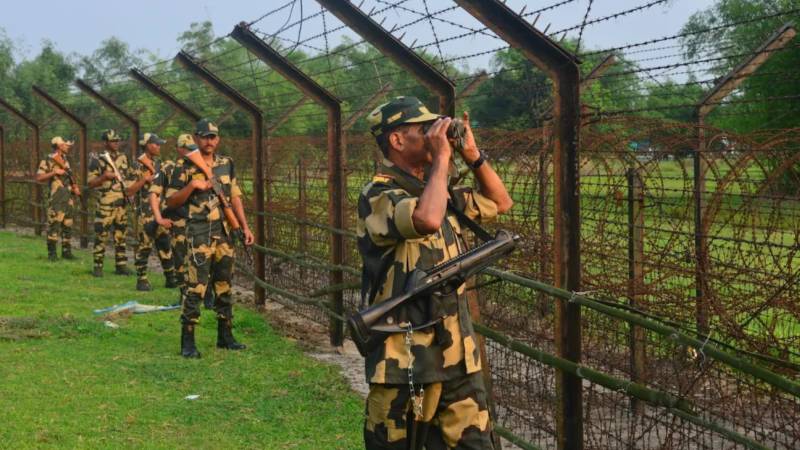
India’s Siliguri corridor has recently witnessed a surge in the deployment of the Border Security Force, Indo-Tibetan Border Police, and the Indian Army’s 33rd Corps. This is in addition to the multilayered air defence architecture comprising the S-400 Air Defence System and the Rafales. These developments speak to India’s growing insecurity arising from its political and diplomatic follies and shifts in Bangladeshi politics. Consequently, the desperate Indian actions in the region can trigger instability.
The Siliguri Corridor is a British cartographic vestige functioning as a connector between mainland India and its northeastern states. Deemed India’s most vulnerable military artery and its Chicken’s Neck, it is a chokepoint as any disruption or instability in the corridor can sever India’s northeastern part from its mainland, incurring economic and strategic costs. India’s current geostrategic anxiety vis-à-vis the region is a result of its misguided hegemonic ambitions and a threat perception emanating from its own wrongdoings.
India’s securitisation of the corridor and the misconstrued threat perception can be understood by drawing a historical parallel with the militarisation of the Strait of Gibraltar during the Second World War which was interpreted as an extreme reaction to the perceived Axis threat. Similarly, India’s hawkish stance is merely a disproportionate response to its flawed imagination of China invading the region, in collaboration with regional actors.
In addition, India is struggling to accept Bangladesh’s pursuit of an independent foreign policy, which during the two decades of Prime Minister Hasina Wajid, was being dictated by India. However, the recent pivot of Bangladesh’s interim government towards China and Pakistan in both rhetoric and practice to court investment and defence collaboration has thrown India off-kilter.
Due to this self-assumed status of the regional hegemon, and its inherent weaknesses in its southeastern region, India is finding it hard to digest Bangladesh’s pursuit of an independent foreign policy
Bangladesh’s interim leader, Dr Muhammad Yunus recently asserted Bangladesh’s position as the sole guardian of the Bay of Bengal, opening doors for the production of Chinese goods and their export to the rest of the world. This was followed by his proclamation that India’s northeast is landlocked. According to various news outlets, Bangladesh also invited Chinese investment in the country, particularly in developing a strategically important airbase in the Lalmonirhat district.
Additionally, post-Hasina, the diplomatic thaw between Pakistan and Bangladesh is also bothering India. This has been marked by bilateral foreign secretary-level talks discussing new avenues of cooperation, including defence and the visit of Bangladesh’s high-level defence delegation to the Pakistan Air Force (PAF) Headquarters in Islamabad. During the meeting, Bangladesh’s Lieutenant General Kamrul Hassan expressed great interest in acquiring Pakistan’s indigenously developed military hardware, especially the JF-17 Thunder fighter jets.
The acquisition of the JF-17 for Bangladesh will be a prudent decision as it can substantially enhance Bangladesh’s ability to defend its airspace. The JF-17’s higher capabilities were demonstrated during Operation Bunyan-un-Marsoos which led to India’s humiliation at the hands of the PAF heralding the tipping of the regional air power balance. JF-17 left its indelible mark after successfully destroying India’s S-400 air defence system in two places. Bangladesh’s economic and diplomatic steps have caused an aggressive Indian reaction. This can be interpreted as New Delhi denying Dhaka its sovereign right to seek an independent foreign policy.
The northeastern states of India have been afflicted with numerous issues: economic underdevelopment, secessionist movements, and ethnic conflicts, to name a few. These political blunders have further added to India’s insecurities. Protracted grievances against India within the seven sister states of India have morphed into cauldrons of resentment. Manipur is a prime example of the aforementioned. Accordingly, a mix of historical, political, and ethnic factors has led to the emergence of armed groups in Manipur aiming to seek autonomy and independence from India. Resultantly, the state has become a hotbed of insurgency and ethnic violence since its integration into India in 1949.
In particular, the locals resented that their distinct identity would become eclipsed by the monolithic Hindutva. Similar reasons have fuelled Nagaland’s fight for independence from India. The remaining northeastern states – Meghalaya, Mizoram, Nagaland, and Sikkim – have also been experiencing intractable ethnic tensions stemming from grievances against New Delhi’s policies.
Dhaka’s budding bonhomie with Beijing and Islamabad has become a source of apprehension for New Delhi. This is because it reflects India’s regional declining influence and power shifts. Since its independence, India has seen itself as the “big brother” in the region denying the right of sovereign equality to its neighbouring states as evident in the Agarwal Doctrine.
Due to this self-assumed status of the regional hegemon, and its inherent weaknesses in its southeastern region, India is finding it hard to digest Bangladesh’s pursuit of an independent foreign policy. The posturing adopted by India to strengthen its eastern front is only showing India’s desperation and destabilising the region.