

The Bharatiya Janata Party (BJP), the ruling party of India, secured its third consecutive general election in 2024 with its further articulation of a Hindutva-led ideological vision. The ideological foundations of the BJP are intricately connected to the Rashtriya Swayamsevak Sangh (RSS), a Hindu nationalist volunteer paramilitary group established in 1925. The RSS was banned three times in free India — in 1948 after the assassination of Mahatma Gandhi, in 1975 during the Emergency, and once more in 1992 in the wake of the Babri Masjid demolition — on the grounds of promoting communal violence and extremist activities. The RSS's influence on BJP rule has been evident since Narendra Modi's first term as prime minister. In 2014, nearly half of Modi’s 19 members of cabinet had direct connections with the RSS, and numerous others had indirect ones through its student wing, the Akhil Bharatiya Vidyarthi Parishad (ABVP). Although few of them were full-time pracharaks (campaigners), their political leaning reflected an entrenched convergence with the Sangh Parivar.
This ideological convergence stems from the philosophy of Hindutva, as articulated by Vinayak Damodar Savarkar in the early 20th century. Hindutva, the RSS version thereof, puts the Hindu identity right at the top of Indian nationhood and has been reaffirmed time and time again in BJP election manifestos since 1996. The fact of Hindutva rising to prominence within mainstream Indian politics is of very serious concern, when it comes to the future of India’s constitutional commitment to pluralism and secularism. The ideology imposes a binary division between Hindus and non-Hindus, restating Indian nationalism as Hindu majoritarianism, and thereby discrediting the pluralistic and inclusive underpinnings of Indian democracy..
Hindutva, in the imagination of Vinayak Damodar Savarkar, conceives of India not just as a nation-state but as a holy Hindu homeland (Punyabhoomi). According to this ideology, only those whose faiths have their roots in the Indian subcontinent that is, Hindus, Sikhs, Buddhists and Jains are the legitimate heirs of Indian identity. Conversely, Muslims and Christians are regarded as alien to the country and are frequently called “guests” or aliens by Hindutva supporters such as Savarkar himself. This exclusivist imagination fosters the notion of India as a Hindu Rashtra (Hindu nation) where religious minorities are either encouraged to assimilate by adopting Hindu cultural values or marginalized.
There has been a controversial extension of this vision on territories which, as per the worldview of the Rashtriya Swayamsevak Sangh (RSS), belong to the geography of the wished-for Akhand Bharat (Undivided India). These include modern-day Nepal, Pakistan, Bangladesh, Myanmar, Sri Lanka, and even parts of Indonesia. Such territorial claims, even if some are symbolic, make ideological challenges to regional peace and stability by contesting the sovereignty and political frontiers of nearby states. The state-aided organizations and groups affiliated with Hindutva are also further buttressed by the institutionalization of Hindutva through state-supported groups. Organizations like the Vishwa Hindu Parishad (VHP), its women’s wing Durga Vahini, and the Hindu Swabhiman Sangh have been accused of indoctrinating young people with anti-Muslim ideology. The Bhonsala Military School, established by RSS ideologues, has also been criticized for allegedly imparting a militarized version of religious nationalism to its cadets. This radicalization of ideas has led to what has been described by scholars and commentators as “saffron terrorism” — a name for violence sponsored by Hindu nationalist organizations in the name of religion. Classic cases are the destruction of the Babri Masjid in 1992, which led to national communal riots; the Shah Bano case of 1985, which was a rallying point for Hindu-Muslim tensions; and recent cases, which keep demonstrating the volatility fostered by Hindutva politics.
In spite of its importance, saffron terrorism has been frequently underreported or glossed over in mainstream media and academic discourse, giving the ideology further opportunity to embed itself in the political and social landscape of the nation. For this reason, the absence of critical debate around this type of religious extremism has contributed to its normalization and helped advance the concentration of power under a Hindutva-aligned state machinery.
The media is responsible for influencing public opinion on different matters. Being one of the most powerful pillars of any structure organized by the state, the media is responsible for obtaining public support. State-controlled media is mostly used by governments for their own interests, presenting other people in negative light or as enemies. In the instance of saffron terrorism in India, for example, violent attacks on Muslims have often been justified by the state-affiliated media in the name of fighting Islamic terrorism. These acts, however, are often based on political agendas rather than real security issues. State-media has been instrumental in magnifying and legitimized saffron terrorism by portraying it as a counter-terrorism policy, thus hiding ideological violence behind the veil of national security.
According to bullet theory, media messages are “injected” or “shot” directly into the passive audience’s mind, producing immediate and uniform effects. The vision of Hindu nationalism promoted by the media results in many incidents such as the one on 3 November 2024, when tensions escalated in the city of Bhagalpur, Bihar. A Hindutva mob climbed a mosque and an (Imam bara) and hoisted a saffron flag while waving an Israeli flag. This incident occurred during the Kali Visarjan Yatra near Tamtam Chowk under the Lalmatia Police Station. Another example is that of clashes between Hindus and Muslims in Maharashtra state’s Nagpur city, that broke out during a protest led by Hindu nationalist groups demanding the demolition of the tomb of Aurangzeb, a Muslim Mughal ruler who has been dead for more than 300 years.
Hindutva-aligned territorial claims, even if some are symbolic, make ideological challenges to regional peace and stability by contesting the sovereignty and political frontiers of nearby states
Of Operation Sindoor
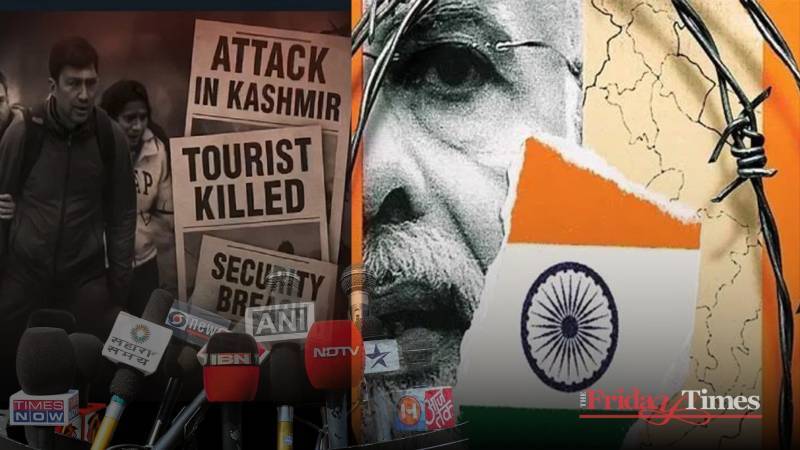
In May this year, Operation Sindoor, initiated by India as a retaliatory action, was constructed in reaction to the 22 April 2025, Pahalgam attack, in which 26 people were massacred in Jammu and Kashmir. State-controlled media contributed immensely to the shaping of the narrative by spreading unverified and misleading information soon after the attack. Within a span of 30 minutes of the attack, news channels started assigning responsibility to Pakistan, connecting the tragedy to cross-border terrorism without providing any tangible evidence. Such premature attribution galvanized public opinion and provided legitimacy to the subsequent military reaction, documenting how media can be manipulated to create strategic narratives in favour of state actions.
“Gul, also known as Sajjad Ahmed Sheikh, is reportedly hiding in Rawalpindi, Pakistan, under the protection of the LeT. He has been linked to several terror activities in Jammu and Kashmir, including targeted killings in Central and South Kashmir from 2020 to 2024, grenade attacks in Central Kashmir in 2023, and ambushes on J&K police personnel in Bijbehra, Jahangir, and the Z-Morh Tunnel in Ganderbal.”
Indian journalists spread false information using news channels and social media following this, without any concrete evidence linking all those incidents, creating a state of hysteria in the Indian public.
Indian media, especially through state-aligned news outlets and social media, have been at the forefront of spreading false and emotive narratives. Following the Pahalgam attack in Jammu and Kashmir, media outlets were quick to frame the event in communal terms. According to official statements, the attackers reportedly interrogated tourists about their religion before executing 25 individuals at point-blank range. A local Muslim guide, Syed Adil Hussain, who attempted to shield the victims, was also killed. However, Indian mainstream media predominantly emphasized that only Hindus were targeted, repeatedly highlighting the victims' religious identity while omitting Muslim casualties.
This biased reporting can be understood by reference to George Gerbner's Cultivation Theory, which argues that repeated exposure to specific media narratives influences public understanding of reality. The incessant focus on Hindu victimhood in this incident and the neglect of Muslim suffering manipulated public opinion, fuelling a wave of nationalist enthusiasm and anti-Muslim feelings throughout India. The aftermath witnessed a sickening upsurge in communal violence, such as social media viral videos of Hindu crowds burning down stalls owned by Muslim vendors, and unabated attacks on mosques, houses and businesses run by the Muslims in different Indian states particularly Karnataka improperly attributing the Pahalgam incident to the Muslim community.
Likewise, Pakistan's Operation Banyan-ul-Marsoos was portrayed as a retaliatory attack after India launched attacks on three airbases across Pakistani airspace, along with a religious site assault. As a response, Pakistan attacked a BrahMos storage site, Udhampur, while an airfield at Pathankot, Brigade Headquarters, “K G Top”, and a supply depot in Uri has also been ruined. Indian media, however, covered these incidents as assaults on civilian targets, which casualty reports in international media coverage fail to substantiate. This disparity indicates a wider pattern where narratives are adjusted to fit state interests, shaping public perception and concealing objective truth. The hypocrisy of foreign media also greatly contributes to shaping global attitudes. The conflict in Israel-Palestine best illustrates this, where Western media tends to report narratives for political friends by downplaying infractions by one party while reporting loudly on the activities of the other. Such reporting makes it increasingly hard to identify biased journalism and genuine reporting in the media today.
Hindu extremism is, to some extent, a spin-off of state-controlled Indian media, which instigates popular opinion through emotive, unbalanced reporting. By reflecting the ideological origins of Vinayak Damodar Savarkar's Hindutva ideology, Indian media has helped create an "us vs. them" communal divide. This has contributed to an escalation of mass violence against Muslims, while conveniently bypassing Hindu extremism under the overarching spotlight on Islamic terrorism. The mainstream media silence on this increasing menace is a threat to regional peace and social harmony. It is necessary that international media and international forums discuss the increase in Hindu extremism and the Hindutva philosophy critically before the situation takes an even greater turn for the worse.