

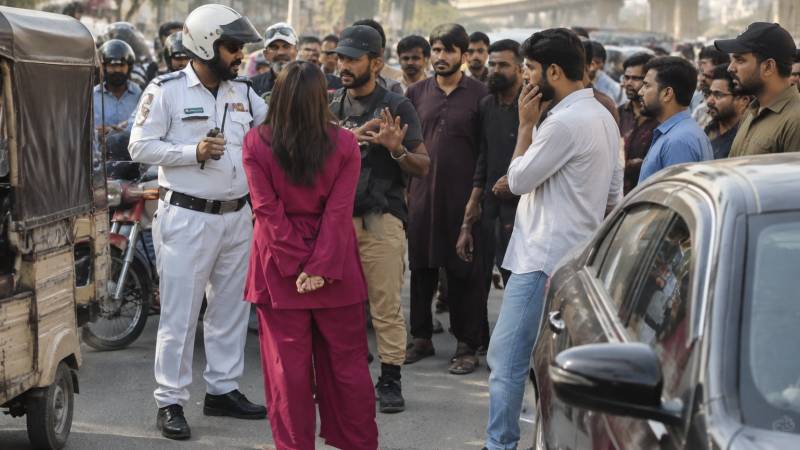
A minor road accident in Karachi should ordinarily be an unremarkable occurrence. In a city where traffic congestion, impatient motorists, overcrowded roads and disregard for traffic regulations have become part of everyday life, the collision of a car and a rickshaw would hardly qualify as extraordinary news. Yet an incident near Johar Mor in Gulistan-e-Johar on October 28, 2026, developed into something far more revealing. A confrontation involving a woman motorist, a rickshaw driver and a gathering crowd brought traffic to a standstill, produced disturbing scenes and soon became the subject of intense social media attention. Within hours, a local traffic dispute had been transformed into a public spectacle, with thousands of strangers passing judgment on the conduct, character and possible condition of a woman they had never met. The episode deserves attention not because one individual allegedly lost control of her temper, but because it exposed several uncomfortable realities about urban behaviour, collective psychology and the fragile boundary between public concern and public humiliation.
According to reports published by Geo News, Express News and other media organisations on October 29, the confrontation followed a collision between a rickshaw and a car near Johar Mor. Police accounts indicated that the woman's vehicle sustained damage and that she subsequently became involved in an angry roadside confrontation. Reports alleged that the rickshaw and other vehicles were damaged during the disturbance. The woman was seen sitting in the rickshaw driver's seat, demanding the keys to her car and attempting to stop passing traffic. As more people gathered, the disturbance spread beyond those directly involved in the collision. At one point, the woman climbed onto the bonnet of a car that a motorist was attempting to move, and the driver pushed her off, causing her to fall onto the road. Police reportedly intervened, and subsequent accounts stated that members of her family apologised and offered compensation for the damage. These are the principal circumstances described in the news coverage, although some details remain disputed.
The incident acquired another dimension when allegations circulated that the woman had been under the influence of alcohol or another intoxicating substance. Some social media posts confidently described her as intoxicated, and certain reports attributed that suspicion to eyewitnesses. Yet suspicion is not medical evidence. No independently verifiable toxicology examination or conclusive police finding establishing intoxication has emerged in the reporting examined. Unusual behaviour, impaired judgment, shouting or apparent loss of emotional control may have several possible explanations. None can be reliably diagnosed from a short video. The distinction matters because once a damaging allegation enters social media, it often becomes permanently attached to an individual, even if subsequent evidence fails to substantiate it. Public curiosity cannot substitute for the basic standards of evidence expected in any civilised society.
The woman later offered an account that complicated the initial narrative. In a video statement reported by the media, she alleged that people had surrounded and harassed her, threatened violence and made insulting remarks about women drivers. According to her version, she had stepped out following the collision to establish whether anyone had been injured. She claimed that members of the gathering questioned her actions, subjected her to intimidation and referred to her as another “Natasha,” invoking memories of an earlier, widely publicised Karachi road tragedy. She also alleged that her mobile phone and bag went missing during the disturbance. These claims require independent verification, just as allegations concerning her conduct require verification. Nevertheless, they raise an important question that the initial viral narrative largely overlooked: what happens when a person involved in a traffic dispute suddenly becomes surrounded by an angry and increasingly hostile crowd?
The reference to the earlier Karachi road tragedy is particularly revealing. Public memory can serve a valuable purpose when it encourages accountability and demands safer roads. Yet memory becomes dangerous when it is used to prejudge an unrelated event. The public understandably remains sensitive to incidents involving powerful motorists, vulnerable road users and unequal treatment before the law. However, every new case must be evaluated on its own evidence. A person cannot be assigned responsibility for another person's actions because of similarities in gender, vehicle ownership or perceived social standing. Such comparisons may generate strong emotional reactions, but they rarely improve the quality of public understanding.
There is also a troubling gender dimension. Women who drive in large cities often encounter expectations and prejudices not applied in the same manner to male motorists. A man involved in an argument may be described as aggressive or short-tempered, while a woman may immediately become the subject of broader assumptions about women's driving abilities, emotional stability or suitability for independent mobility. This does not mean that women should be exempt from criticism or legal accountability. It means that criticism should concern demonstrable conduct rather than gender. If the motorist at Johar Mor behaved dangerously, the criticism should address that behaviour. It should not become an argument against women drivers as a category. Nor should sympathy for the woman prevent a fair examination of the rickshaw driver's position or the losses suffered by other road users.
The internet's informal court operates without an established procedure, without a presumption of innocence and without any meaningful opportunity for appeal. Its judgments may be immediate, but their consequences can be enduring.
The role of the crowd deserves equal scrutiny. Crowds can perform constructive functions. Witnesses may assist injured people, prevent further accidents, provide information to police or help restore order. Yet gatherings around emotionally charged incidents can also become unpredictable. Individuals who might behave cautiously in isolation may become more confrontational when surrounded by others expressing similar emotions. Social psychologists have long examined how group dynamics can influence responsibility, restraint and collective behaviour. In a rapidly developing roadside confrontation, a spectator's shouted accusation may encourage another person's hostility, while the presence of mobile-phone cameras can transform an incident into a performance for an unseen audience. Instead of attempting to resolve the dispute, people may become more interested in recording its most dramatic moments.
The presence of cameras also creates a peculiar form of modern injustice. A video may capture an action without adequately documenting what preceded it. It may show a person shouting but not the words that provoked the shouting. It may record an apparent act of aggression while excluding earlier threats, intimidation or attempts at de-escalation. Conversely, a person's later explanation may omit conduct clearly visible in the recording. Both forms of evidence require careful examination. A viral clip is not necessarily false, but neither is it a complete account of an event. Its reliability depends upon context, continuity, source and corroboration. Unfortunately, social media rewards speed and emotional intensity far more generously than caution and verification. The consequences can be severe. A person recorded during a few minutes of anger may find that those moments define their public identity for years. Online commentary can quickly move from legitimate criticism to ridicule, personal attacks and speculation about private life. Digital platforms rarely provide the accused individual with the same prominence for an explanation that they provide to the original allegation. The internet's informal court operates without an established procedure, without a presumption of innocence and without any meaningful opportunity for appeal. Its judgments may be immediate, but their consequences can be enduring.
The Johar Mor episode also reveals broader weaknesses in urban governance. Traffic collisions are inevitable in a large and congested metropolis, but their escalation into public disorder is not inevitable. Clear procedures for accident reporting, accessible traffic enforcement, prompt police assistance and mechanisms for documenting damage can reduce confrontation. Where motorists believe disputes will be handled fairly and efficiently, they have less reason to take matters into their own hands. Conversely, weak confidence in enforcement can encourage arguments, intimidation and attempts to secure immediate compensation through pressure rather than established procedures.
The apparent resolution of the dispute through apologies and offers of compensation is important, but it does not eliminate the larger questions. Financial compensation may address damaged vehicles, yet it cannot automatically repair the effects of intimidation, physical injury, humiliation or reputational harm. Nor should an apology be treated as conclusive proof of every allegation circulating online. The appropriate response remains a fair examination of the evidence, proportionate accountability where justified and protection of the rights of all parties. A mature society distinguishes between an allegation and a fact, between accountability and humiliation, and between witnessing wrongdoing and participating in further wrongdoing. It does not excuse dangerous conduct, but neither does it surrender justice to the loudest voices in a gathering or the most widely shared video. The most disturbing aspect of the Johar Mor incident may ultimately be neither the collision nor the confrontation itself, but the ease with which a few minutes of roadside disorder became a public trial. A city cannot become civilized merely by widening its roads, installing more cameras or increasing traffic penalties. It must also cultivate restraint, fairness and respect for human dignity. For the true measure of a society is not how loudly it condemns the mistakes of others, but how responsibly it responds when those mistakes occur.