

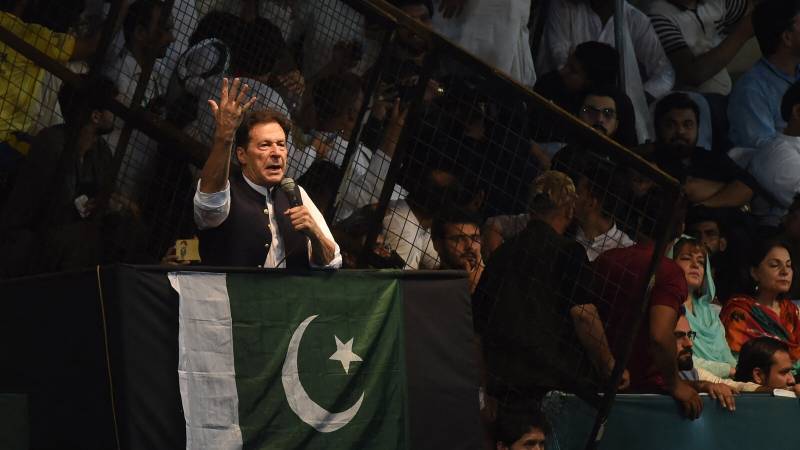
Despite his pretensions and all the hullabaloo about his radical politics of change, I do not consider Imran Khan a revolutionary. He is a man of status quo. But one aspect of his politics distinguishes him from all other Punjab-centric political leaders in Pakistan’s history. His act of using street violence against the military is his bid for power. His popular stronghold is Central Punjab — Punjabi Middle Class to be precise. But unlike all other Punjab-centric leaders in Pakistan’s political history he did not desist from using violence, street power and angry mobs to challenge the hold of the Pakistani military on the power structure of society.
This was despite the fact that his party organisation had no experience of street violence before the May 9 attacks. The modern history of Pakistan has produced two Punjab-centric leaders before Imran Khan who were his equal or somewhat equal in popularity — Zulfiqar Ali Bhutto and Nawaz Sharif. Both were a product of the military’s role of political engineering and both fell on the wrong side of the military establishments of their times at different points in the country’s history. Both Zulfiqar Ali Bhutto and Nawaz Sharif never used street violence as a tool to respond to the military’s machinations to dislodge them from power.
Zia’s military steel frame never allowed Bhutto to mobilise his street power while he was alive. Nawaz Sharif’s political popularity has always been devoid of any following which could be mobilised for street violence. Use of violence as a political tool in our history has always been a trait of political forces whose support base lies outside Punjab. Baloch rebels — both the tribal chiefs of the 1970s and Baloch middle-class rebels at present — challenged the military through violent means. In the 1990s, MQM employed violence to challenge the military’s grip on the country's power structure. The Awami League in East Pakistan was helped by Indian intelligence to challenge the military in 1971.
Imran Khan, however, shares a trait with the other two Punjab-centric popular leaders in the country’s history. His popularity carries the stamp of endorsement from state machinery, just like that of Zulfiqar Ali Bhutto and Nawaz Sharif. Imran Khan’s popularity has been partially a product of the state’s endorsement of his political activity. Pakistani intelligence services’ support for Imran Khan’s political rise is well documented. I do not have to repeat the story here. Bhutto was a cabinet minister in Ayub Khan’s cabinet, and Nawaz Sharif served as Chief Minister of Punjab under Zia’s military government.
Bhutto’s, Sharif’s, and Imran Khan’s popularity was indebted to the endorsement of the state or a segment of the state, whatever form that endorsement might have taken in their respective times
I desisted from labelling Benazir Bhutto as Punjab-centric — she also became Prime Minister because of her electoral victory in Punjab — because she is a rarity among Pakistani politicians. She is the only one in the history of Pakistan who did not receive endorsement from a segment of the state machinery while she was on her way to becoming popular in Pakistani society. Bhutto’s, Sharif’s, and Imran Khan’s popularity was indebted to the endorsement of the state or a segment of the state, whatever form that endorsement might have taken in their respective times.
But this piece is about Imran Khan. I do not have any scientific data with me, but my educated guess is that Imran Khan is as popular as Bhutto was in the 1970s or Nawaz Sharif was in 1993. But I think Imran Khan’s popularity is more akin to Bhutto’s popularity as, just like him, Imran Khan has also transcended ethnic boundaries. Bhutto was popular in Sindh, in Karachi, in Punjab and Khyber Pakhtunkhwa and so was Imran Khan. Nawaz Sharif’s popularity is restricted to Central and Northern Punjab, where he was an uncontested leader from 1993 till 2013, when the ground started to move under his feet in the face of the rise of Imran Khan.
In my opinion, two factors are in a position to prevent Imran Khan from coming to power again in Islamabad. The first factor is his age. He is 72. There are no signs of economic meltdown, political upheaval or radical change in the military — three factors which could lead to Imran Khan’s release from jail — in the near future. A conservative estimate would put a radical shift in the power structure in Islamabad and Rawalpindi at least three to four years away in the future. We can safely assume that Imran Khan would be approaching 80 when he is released from jail — not a very good age for active politics.
The second factor is the consensus in the military that Imran Khan has crossed the red line by using violence as a political tool against the military. This consensus is likely to remain in place if the next Army Chief is appointed through the routine process of postings and transfers within the military hierarchy. Apparently, Imran Khan’s future appears bleak.
Bhutto was physically removed from the scene, and in his place, the social and political vacuum he left behind was filled by religious and militant groups
But let me draw your attention to a consistent pattern of Pakistani politics. The Pakistani military and state machinery have always done a poor job in erasing the traces of popularity of popular leaders in Pakistan’s history, despite the fact that they have, over the course of the country’s history, taken complete control over the coercive machinery of the state. They hanged Bhutto and made persistent attempts to erase the traces of his popularity from Pakistani society. They failed. The Zia regime and the dummy political setup it created by putting the coercive machinery of the state to good use crumbled and was defeated by Bhutto’s party led by his daughter Benazir Bhutto.
The Musharraf regime repeated the exercise in trying to erase the traces of the popularity of Nawaz Sharif between 2002–2008. They failed miserably. Nawaz Sharif’s popularity made him take Punjab again the moment the gun was dropped from the hands of General Musharraf. This time, the situation is a little bit different. There is no military government, and Shahbaz Sharif’s government enjoys legitimacy to the extent that it pieced together a coalition despite losing parliamentary elections. So it has a legal and constitutional legitimacy. But this does not change the reality that Imran Khan is way more popular than all of them put together.
Removing popular leaders from the political scene has cost us heavily in the past. Bhutto was physically removed from the scene, and in his place, the social and political vacuum he left behind was filled by religious and militant groups. The genie of extremism and militancy we have not been able to put back into the bottle since then. Imran Khan’s prolonged absence from the political scene would create a vacuum. The spent cartridges will not be able to perform here. Popularity once lost in the realm of the Punjabi Middle Class could not be restored. All the King’s horses and all the King’s men could not put Humpty Dumpty together again.
How and what will fill the vacuum which Imran Khan will leave behind may not be apparent at the moment. But some very sinister thoughts are making my skin cold.
Imran Khan’s case deserves a dispassionate analysis. Personal grudge or vendetta should not decide his fate. Imran Khan’s case is even beyond the fortunes or misfortunes of any particular political party or a political coalition.
It is about keeping the Pakistani people psychologically normal: how can a society remain normal when every time they choose a leader for themselves, the state machinery presiding over that society attempts to remove him from the political scene?
It is about the legitimacy of the political system: removing popular leaders from the political scene is tantamount to disenfranchising the masses, and how can such a system remain legitimate in public eyes in such a situation?
It is about preventing an already fractured Pakistani society from further divisions. This requires a thought process based on a broad perspective — a perspective with an eye on the needs of society, which is normal, and a political culture devoid of hatred.