

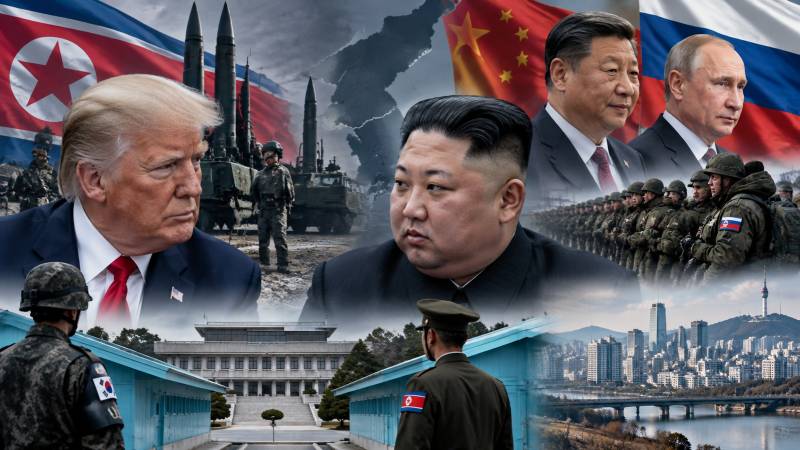
According to Reuters news agency, there has been some speculation about a possible meeting between U.S. President Donald Trump and North Korean leader Kim Jong Un on the sidelines of the Asia-Pacific Economic Cooperation (APEC) summit scheduled to be held in Shenzhen, China, on November 18–19, 2026. The last meeting between President Trump and Chairman Kim took place in Hanoi, Vietnam, on February 27, 2019. During President Trump’s second term, North Korea has occupied a relatively low position on Washington’s policy agenda because of the war in Ukraine, the conflict in Gaza, and tensions involving Iran. Nevertheless, the United States continues to seek a breakthrough in its relations with Pyongyang to promote peace on the Korean Peninsula.
Following Japan’s defeat in the Second World War in 1945, the Korean Peninsula was divided along the 38th parallel, and North and South Korea subsequently established different political systems. After the three-year Korean War (1950–1953), the two Koreas embarked on a competition between their respective systems. South Korea concentrated on economic development, while North Korea placed greater emphasis on military buildup and nuclear development.
In the mid-1990s, North Korea, South Korea, and the United States pursued diplomatic efforts to manage tensions and address the North Korean nuclear issue. The United States and North Korea concluded the Agreed Framework in Geneva in 1994, accompanied by substantial measures to ease sanctions. However, disputes over the implementation of the Agreed Framework eventually led to its breakdown, and North Korea announced its withdrawal from the Nuclear Non-Proliferation Treaty (NPT) in 2003. Since then, Pyongyang has continued to advance its nuclear weapons capabilities while rejecting international demands for denuclearization. By emphasizing its status as a nuclear-armed state and continuing missile provocations, North Korea has ensured that the security threat on the Korean Peninsula remains unresolved.
According to the Stockholm International Peace Research Institute (SIPRI), North Korea is estimated to possess approximately 60 nuclear warheads. Its nuclear ambitions have also extended to the development of intercontinental ballistic missiles (ICBMs) capable of striking the U.S. mainland. Although North Korea possesses nuclear weapons in practice, its position differs from that of India and Pakistan in that it remains subject to international sanctions aimed at achieving its denuclearization.
There are various impediments to peace on the Korean Peninsula. These include North Korea’s military buildup and nuclear weapons development; the persistent deadlock in inter-Korean relations and the question of unification; and the prolonged suspension of dialogue between Washington and Pyongyang following the summit between President Donald Trump and Chairman Kim Jong Un in February 2019. More recently, deepening military cooperation between North Korea and Russia and intensifying strategic competition between the United States and China have emerged as additional obstacles. As these sources of instability persist, the risks of armed confrontation and military miscalculation increase. It is therefore necessary to restore summit-level dialogue between the United States and North Korea in the interest of peace on the Korean Peninsula.
Rather than prioritising military expansion and nuclear weapons development for regime survival, the North Korean leadership should devote greater efforts to economic development and the welfare of its people, whose living standards remain far below those of their South Korean counterparts.
One may ask why the United States remains interested in dialogue with Pyongyang despite the North Korean regime’s continued intransigence and threatening posture. Why do the United States and South Korea continue to explore diplomatic approaches when North Korea already possesses nuclear weapons and is pursuing the development of ICBMs? Why do Russia and China continue to support North Korea, and why has Pyongyang dispatched troops to Russia to participate in the war in Ukraine? These questions arise in the context of the North Korean nuclear issue and the heavily militarized boundary separating the two Koreas.
Unfortunately, sustained efforts at conflict management and confidence-building have not produced sufficient results to overcome the existing standoff on the Korean Peninsula. An expansion of trade, commerce, people-to-people exchanges, and tourism between the two Koreas could contribute to the normalization of relations and the resumption of a peace process. Unlike the collapse of the Berlin Wall and the unification of Germany, however, the prospect of a comparable outcome on the Korean Peninsula remains remote. Nearly eight decades of division and confrontation have made Northeast Asia a major potential flashpoint for international conflict. Against this background, the impediments to peace on the Korean Peninsula need to be examined from three perspectives.
First, the hardline and intransigent posture of the North Korean regime obstructs efforts to ease its confrontation with South Korea and the United States. Washington remains a key actor in the security of the Korean Peninsula, while Russia and China also exercise considerable influence over Pyongyang.
Nevertheless, if North Korea were to resume its long-suspended summit diplomacy with the United States, it could project to the world a narrative of engaging the American leader from the position of an already nuclear-armed state. Such a meeting could also serve to strengthen domestic cohesion and regime propaganda. It might further enable Pyongyang to reduce its dependence on China and Russia and enhance its strategic value in its dealings with major powers. Moreover, an improvement in inter-Korean relations could allow economically prosperous South Korea to become an important partner in improving the socioeconomic conditions of North Korea. Although the two Koreas share a common language and much of their cultural heritage, the legacy of the Korean War and continuing political and military tensions have made reconciliation difficult.
Second, there is a need for a strategic consultative framework to resume dialogue involving the United States, Russia, China, Japan, North Korea, and South Korea. Such dialogue should focus on confidence-building measures and verifiable, phased steps toward halting and ultimately dismantling North Korea’s nuclear weapons program. It should also consider ways to ease restrictions on the movement of people, capital, goods, and services, to the extent permitted by prevailing security conditions.
If the two Koreas, the United States, Russia, Japan, and China adopt a pragmatic and forward-looking approach, meaningful conflict transformation may become possible. This would require all six countries to demonstrate the political will and determination necessary to pursue concrete measures for peace. Russia and China could contribute by persuading North Korea to return to dialogue with the United States and South Korea. In this context, a renewed summit between U.S. President Donald Trump and North Korean leader Kim Jong Un could provide President Trump with an opportunity to reinforce his image as a peacemaker, while enabling both sides to discuss ways to improve their relations and promote stability on the Korean Peninsula.
Finally, rather than prioritizing military expansion and nuclear weapons development for regime survival, the North Korean leadership should devote greater efforts to economic development and the welfare of its people, whose living standards remain far below those of their South Korean counterparts. South Korea is an advanced economy that has achieved remarkable success through economic development. A fundamental shift in Pyongyang’s policy priorities could help remove some of the obstacles to peace and stability on the Korean Peninsula.
It is hoped that, through pragmatic and forward-looking leadership, the two Koreas will gradually replace hostility with cooperation. The North Korean nuclear issue cannot be resolved in a single step. Instead, U.S.–North Korean talks should initiate a phased negotiating process and lay the groundwork for multilateral security cooperation. External stakeholders, including Russia, Japan, and China, also have a responsibility to support this objective. Such progress would ultimately help slow the pace of the regional arms race and ease pressures toward nuclear proliferation in Northeast Asia. Peace on the Korean Peninsula must become a shared vision of all concerned parties. Without meaningful progress, North Korea will remain economically isolated and continue to pose a major threat to regional security.