

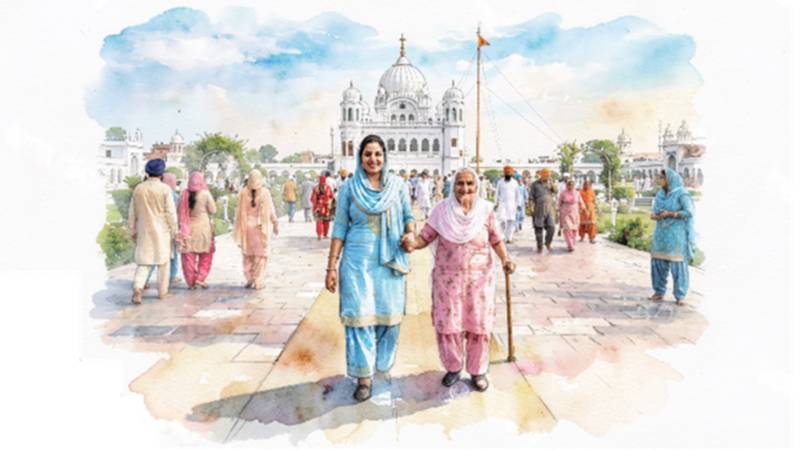
The journey began at the stroke of nine on a Saturday morning, the Islamabad air still holding the crisp, translucent promise of the north before the sun climbed too high. We set out to traverse the deep, sedimentary layers of time—a rendezvous from the modern capital to the spiritual and industrial heart of the Punjab. Winding through the arteries of Wazirabad, Sialkot, and Narowal, it was a pilgrim’s progress, carrying the inherited shared memory and the digital frames of a camera lens to capture what words often fail to hold.
As we emerged onto the Grand Trunk Road, the landscape opened into a living canvas of agrarian gold. Rows of wheat swayed in a rhythmic dance, indented by the life-giving veins of rivers and canals that have sustained this civilisation for millennia. Our first encounter with the heavy hand of history was the Alexandra Bridge.
Construction began in 1871 under the supervision of Francis Joseph Edward Spring, and the bridge opened in 1876. It was inaugurated by Edward VII when he was Prince of Wales and named after Princess Alexandra of Denmark. Spanning the Chenab between Wazirabad and Gujrat, it originally featured 64 spans of 142 feet each, totalling 2,732 feet in length. Over the decades, the river’s erratic course has shifted, leaving several spans standing over dry land like skeletal remains of a vanished tide. Yet, the bridge remains in active service for rail traffic—a massive industrial monument marking the boundary of the Golden Triangle of Sialkot, Gujranwala, and Gujrat.
At Kartarpur, the saint became a householder, and the householder became a saint – he showed that spirituality is not in escaping the world, but in immersing oneself in it with a clean heart
They say the Chenab is the river of lovers, haunted by the ghosts of Sohni and Mahiwal. Sohni, the potter’s daughter, swam these treacherous currents each night using a gharha (baked clay pitcher) to meet her Mahiwal, a trader from Bukhara who became a buffalo herder for her sake. The tragedy of the unbaked pitcher, swapped by a jealous sister-in-law, remains etched in the Punjabi psyche. The folk verse keeps her devotion alive:
کچا گھڑا نہ ویکھ توں سوہنیے، ویکھ یار دی یاری سچا عشق نہ ڈردا موتوں، بھاویں جگ ہو جائے ویری
(Do not look at the unbaked clay pot O Sohni, look at the loyalty of your beloved True love does not fear death, even if the whole world becomes an enemy)
While the river carries the weight of that devotion, the bridge carries the cold, calculated precision of British rivet and girder. Romance collides with industrial resolve. It remains a timeless metaphor for connection.
Wazirabad followed—the dry port of Pakistan where the air smells of molten metal and ancient earth. It is a land of contradictions: rich in agricultural silt yet a global centre for cutlery and surgical tools. Then came Sialkot, a city defined by grit and an almost defiant export culture. Its businessmen are makers of the world’s sporting goods and surgical instruments. Their collective resolve created Sial Air, a private airline launched by the local Chamber of Commerce that took flight in 2021.
At the city’s heart stands the Ghanta Ghar (Clock Tower) in Iqbal Square, completed in 1922. Local philanthropists Sheikh Ghulam Qadir and Seth Rai Bahadur Ralia Ram laid the foundation stone, creating a structure that rises in five receding brick stages. From its base, the roads spill into labyrinths of hammers, leather, and steam.
We paused to seek Sialkot’s culinary breath. We tasted rabri doodh (milk reduced to velvet thickness and served cold in clay) and qulfi from Nawab Din, dense with cream. The bazaar offered Sialkoti karahi, chicken seared with aggressive amounts of black pepper, and murgh cholay (chickpeas and spice) that spoke of winter hearths. The deliciousness is etched in the taste buds. And Noor Jehan's song, “Ve mundia Sialkotia, Teray Mukhray Da Kala Kala Till ve,” hums in the eardrums, making me smile with regional genuineness.
Our destination in the city was quieter, Iqbal Manzil (Iqbal House). The house was purchased in 1861 by Mohammad Rafique, the great-grandfather of Allama Muhammad Iqbal, whose ancestors migrated from Kashmir to Sialkot around 1752. This is the birthplace of the Poet of the East.
The house is a sanctuary of warm light and rain-washed bricks. The architecture of the 1800s is lofty and rhythmic, designed to breathe. Thick walls, high ceilings, and a central sehan (courtyard) pull wind through shadowed verandas. The structure follows the traditional Punjabi haveli plan, a dehliz (entrance vestibule) leads to dalans (halls) and baithaks (sitting rooms). Inside the library, we felt the human pulse of the man who dreamed a nation into existence. In his ghazal, we found the spiritual core of our journey. Here is the whole ghazal:
ترے عشق کی انتہا چاہتا ہوں
مری سادگی دیکھ کیا چاہتا ہوں
ستم ہو کہ ہو وعدۂ بے حجابی
کوئی بات صبر آزما چاہتا ہوں
یہ جنت مبارک رہے زاہدوں کو
کہ میں آپ کا سامنا چاہتا ہوں
ذرا سا تو دل ہوں مگر شوخ اتنا
وہی لن ترانی سنا چاہتا ہوں
بھری بزم میں راز کی بات کہہ دی
بڑا بے ادب ہوں سزا چاہتا ہوں
ذرا سا تو دل ہوں مگر شوخ اتنا
وہی لن ترانی سنا چاہتا ہوں
کوئی دم کا مہماں ہوں اے اہل محفل
چراغ سحر ہوں بجھا چاہتا ہوں
ترے عشق کی انتہا چاہتا ہوں
مری سادگی دیکھ کیا چاہتا ہوں
(I desire the very limit of your love
Look at my simplicity, what is it that I desire
Let it be tyranny or the promise without veil
I desire something that will test my patience
May this paradise be blessed for the ascetics
For I desire only to stand before You
I am but a small heart, yet so mischievous
I desire to hear that same I shall not be seen
I spoke the secret in the full assembly
I am greatly disrespectful, I desire punishment
I am but a small heart, yet so mischievous
I desire to hear that same I shall not be seen
I am a guest for a breath O people of the gathering
I am the lamp of dawn, I desire to be extinguished
I desire the very limit of your love
Look at my simplicity, what is it that I desire)
Outside, however, the lanes were dug up, the air thick with the dust of rait and bajri (sand and gravel). The neglect of our heritage sites stung. When we do not patronise our history, we lose the web of stories that connects us to the soil.
The final leg of the journey took us towards Narowal, to Gurdwara Darbar Sahib Kartarpur (The Court of the Guru). Sialkot was a symphony of layered chaos, in comparison to Kartarpur's revelation of pristine, white geometry. Pakistan opened the Kartarpur Corridor on the 9th of November 2019, creating a visa-free passage for pilgrims. The complex spans 42 acres, making it the largest Gurdwara in the world, yet it retains an intimate, hallowed air.
Kartarpur is a De-escalation Zone. It proves that even when borders are closed to people, trade, politics, ideas, and tourism, they can remain open to humanity. While the two states may disagree on territory, they can still agree on the Sacred.
Before entering the sacred precincts, there is a protocol of purification that settles the mind. We performed ishnaan (ritual bath) and washed our hands and feet at the designated taps, the cold water acting as a physical boundary between the mundane world and the divine. In Sikhism, one must leave the dust of the world at the threshold.
Inside the Darbar Sahib, the atmosphere is dictated by the presence of the Guru Granth Sahib. It is crucial to understand that in this space, the scripture is a Living Guru. Every morning, the Guru is carried in a palki sahib (decorated palanquin) for prakash (ceremonial installation at dawn). It is placed upon the manji sahib (small throne) under a chanani (canopy). A sevadar (volunteer) performs chaur sahib (waving a ceremonial whisk) over the scripture—a gesture of sovereign respect traditionally reserved for royalty.
The scripture opens with the Mool Mantar (Root Verse) that echoed through the marble halls:
ੴ ਸਤਿ ਨਾਮੁ ਕਰਤਾ ਪੁਰਖੁ ਨਿਰਭਉ ਨਿਰਵੈਰੁ
ਅਕਾਲ ਮੂਰਤਿ ਅਜੂਨੀ ਸੈਭੰ ਗੁਰ ਪ੍ਰਸਾਦਿ ॥
(God is One. Truth is His Name. He is the Creator. Without Fear. Without Enmity.
Immortal Form. Beyond Birth. Self-Existent. By the Guru’s Grace)
As we approached the inner sanctum, we observed the deep humility of the pilgrims. The most moving act is matha tekna—bowing the forehead to the ground in total surrender. Many also perform charan sparsh, touching the feet of the threshold or the base of the Palki Sahib, seeking the dust of the feet (charan dhoor) of the enlightened. This is an act of annihilating the ego (haumai).
The spiritual rhythm is maintained by the Asa di Var (Ballad of Hope), recited by ragis (musicians) during the amrit vela (ambrosial hours before sunrise) when the world is still and the soul is most receptive. We watched as the sangat (congregation) sat in rapt silence, waiting for the hukamnama (divine command of the day), chosen by opening the Guru Granth Sahib at a random page to receive guidance. At night, the ceremony of sukhasan is performed, where the Guru is ceremoniously carried to a place of rest, signalling the close of the day’s spiritual court.
We received karah parshad from the deg (sacred iron cauldron), a warm offering of flour, ghee, and sugar that tasted of toasted grain and pure devotion.
Outside the marble complex, the Ravi flows quietly, bordering the very fields where Guru Nanak Dev Ji spent the final 18 years of his life. One must understand the transformation of the Guru here at Kartarpur.
After four epic journeys called Udasis (travels) that took him to the peaks of Tibet, the sands of Makkah and Baghdad, and the shores of Sri Lanka, the Guru chose this specific patch of Punjab to settle around 1522. Here, the world-traveller discarded his pilgrim’s robes for the simple, coarse garb of a Punjabi peasant. He did not retreat into a cave or a monastery; instead, he took to the plough.
By tilling this soil, Guru Nanak fulfilled his own triad of teachings:
- Kirat Karo: Earn an honest living by the sweat of your brow.
- Vand Chhako: Share your earnings and your food with the needy.
- Naam Japo: Meditate on the Divine Name in every breath.
At Kartarpur, the saint became a householder, and the householder became a saint. He showed that spirituality is not in escaping the world, but in immersing oneself in it with a clean heart. He grew wheat and lentils here, the very ingredients that still fuel the langar today. The Ravi witnessed a revolution of the ordinary—where the act of farming became a form of prayer.
We moved towards the langar hall (community kitchen), the beating heart of Sikh hospitality. Here, the protocols are a direct challenge to human arrogance. We sat in pangat (straight rows on the floor) where a billionaire might sit next to a labourer. There is no hierarchy.
The meal served in the langar—simple lentils, vegetables, and rotis—is prepared through seva (selfless service). We saw people from all walks of life peeling garlic, washing massive cauldrons, and sweeping floors.
The egalitarian spirit of Sikhism meets Islam at this very table. Both faiths stand on the bedrock of strict monotheism—Ik Onkar (One God) and Tawhid (Oneness of God). Both reject the caste system and idol worship. The inclusion of the verses of the Muslim Sufi saint Baba Farid in the Guru Granth Sahib is a testament to this centuries-old conversation.
The account of the Guru’s joti-jot (merging of light) on the 22nd of September 1539 is one of the most beautiful legends of the Punjab. As he prepared to depart the physical world, his Hindu and Muslim followers argued over his last rites—one side wanting cremation, the other burial.
The Guru told them to bring flowers; the side whose flowers remained fresh overnight would have their way. When they lifted the chadar (covering sheet) the next morning, his body had vanished, leaving only a heap of fresh, fragrant blooms. The followers divided the flowers. The Muslims built a mazar (tomb) and the Hindus raised a samadh (memorial shrine). Today, the Kartarpur complex houses both, side by side, in a silent, eternal conversation.
As the sun began to set, casting long, golden shadows across the Ravi, a profound stillness settled over our group. This journey had begun as a search for history, but it ended as a confrontation with our own hearts.
We felt the sting of neglect at Iqbal Manzil transform into a balm of hope at Kartarpur. The contrast was stark: one site struggling to breathe through the dust of modernisation, the other pristine architecture to what happens when we treat our history as a living, breathing entity.
Watching a pilgrim perform charan sparsh at the threshold, his face lined with the exhaustion of years trying to self-actualise his faith and roots (بلھا کیہ جاناں میں کون) and the sudden radiance of arrival, made the universe feel small and interconnected. We realised that the 'Progress' in our title was not about the miles on the odometer; it is the distance moved from apathy to empathy.
In the quietude of the Gurdwara, away from the clamour of Sialkot’s factories, we understood that the stories we protect are the only things that truly last. The words of Nanak, the poetry of Iqbal, and the longing of Sohni are all ripples in the same river.
As we drove back towards the flickering lights of Islamabad, the Golden Triangle faded into the rearview mirror. We carried with us the scent of karah parshad and the rhythmic echo of the Asa di Var.
History is the anchor for the generations to come. By facilitating passage and guarding both marble and manuscript, we practice a hospitality that is older than passports and more durable than politics. We returned with photographs, with a renewed comprehension, that in this land of five rivers, every grain of sand is a syllable in a divine poem, and every traveller is, in truth, a pilgrim heading home.
'The universe is one being. Everything and everyone is interconnected through an invisible web of stories. The words that come out of our mouths do not vanish; (Rumi) they are stored' in the infinite space of the Punjab, waiting for the next traveller to stop, listen, immerse, and remember.