

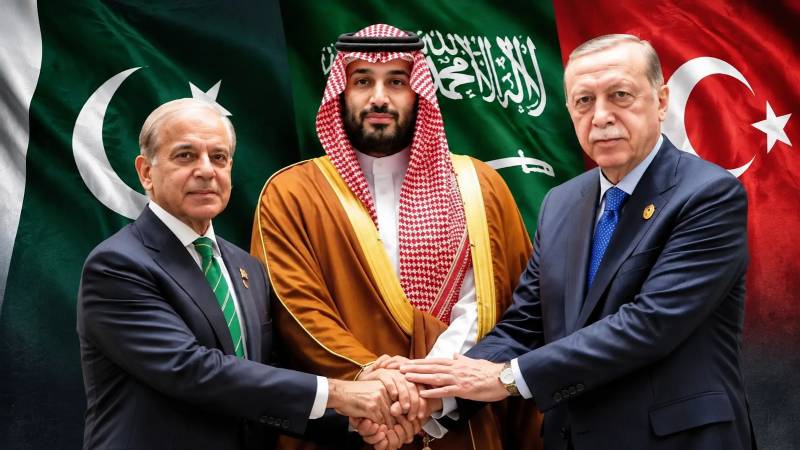
The Islamabad meeting of the Strategic Political and Defence Committee (S-PDC) of the Makkah Alliance on 27 November marks a decisive step towards operationalising the collective defence commitments of Saudi Arabia, Pakistan and Türkiye. With the Iran conflict threatening to reignite and Houthi aggression against Saudi Arabia continuing, the three countries have resolved to intensify collective efforts to safeguard the Kingdom’s security, sovereignty and territorial integrity.
Yemen constitutes the immediate challenge, but the strategic significance of the Makkah Alliance extends well beyond the current conflict. At its centre is Pakistan, whose role in West Asia has expanded considerably over the past year through its defence partnership with Saudi Arabia, diplomatic engagement with Iran and growing strategic convergence with Türkiye. In less than four months since the signing of the Makkah Joint Defence Agreement in August, the Alliance has made considerable legal, institutional and military progress. The Islamabad meeting built upon the decisions taken at the inaugural S-PDC meeting in Istanbul on 31 August and the emergency meeting in Riyadh on 5 October.
President Erdoğan’s completion of Türkiye’s ratification process coincided with the Islamabad meeting, consolidating the domestic legal foundations of the Agreement. The permanent Secretariat in Riyadh, headed by a Pakistan’s Lt Gen (Retd) Nauman Mahmood, is taking operational shape. According to Turkish Foreign Minister Hakan Fidan, decisions in principle concerning the establishment of the General Secretariat as the civilian headquarters and joint military commands as the military headquarters have been taken, with most receiving committee approval in Islamabad. Türkiye will host the next regular S-PDC meeting.
The speed of institutionalisation distinguishes the Makkah Alliance from many previous regional defence arrangements that remained confined to political declarations. Pakistan’s existing military deployment in Saudi Arabia and Türkiye’s defensive assistance to the Kingdom provide a practical foundation for collective military cooperation. For Pakistan, Saudi security has always been a red line, as consistently reiterated by its political and military leadership. The Strategic Mutual Defence Agreement of September 2025 formalised a commitment rooted in decades of military cooperation, religious affinity and mutual trust. The Makkah Agreement extended this commitment to Türkiye, with an armed attack against one member to be considered an attack against all three.
The close relationship among Prime Minister Shehbaz Sharif, Crown Prince Mohammed bin Salman and President Erdoğan has provided political momentum to this process. Equally important has been the sustained engagement among Field Marshal Asim Munir, Saudi Defence Minister Prince Khalid bin Salman and the Turkish military leadership. The evolution of this partnership reflects a fundamental change in the regional security environment. The Arab Gulf countries have suffered the consequences of a war they did not initiate, exposing the vulnerability of their energy infrastructure, economic assets and maritime connectivity. The experience has reinforced the need for regional defence capabilities alongside existing security partnerships with external powers.
The immediate test of the Makkah Alliance lies in Yemen, where the resumption of hostilities in September has seen Houthi territorial gains, mounting pressure on the internationally recognised Yemeni government and persistent attacks against Saudi Arabia. Reported Houthi advances towards Aden and growing insecurity around Bab al-Mandeb have added a maritime dimension to the conflict.
For Pakistan, the journey from Makkah to Islamabad is about more than the defence of a trusted strategic partner. It is about shaping a regional security order in which Pakistan’s military strength and diplomatic influence can serve the common purpose of peace, security and economic prosperity in West Asia.
Meanwhile, mounting American naval and economic pressure on Iran, continued threats to commercial shipping and Gulf countries, and the possibility of renewed US or Israeli strikes against Iran could trigger another round of regional hostilities. The simultaneous threats to navigation through the Strait of Hormuz and Bab al-Mandeb carry serious implications for global energy supplies and international commerce.
Against this backdrop, the Islamabad communiqué’s explicit commitment to intensify collective efforts against Houthi aggression assumes particular significance. Although no additional military deployments were publicly announced, enhanced air and missile defence, intelligence sharing, maritime security and protection of critical infrastructure are possible areas of expanded cooperation.
Collective defence of Saudi territory does not necessarily entail Pakistani or Turkish military intervention inside Yemen. The broader objective is to safeguard Saudi security while preserving Yemen’s sovereignty, unity and territorial integrity through a sustainable political settlement. Significantly, the Islamabad communiqué explicitly condemns Houthi aggression without naming Iran. This distinction preserves the defensive character of the Alliance and the diplomatic space available to Pakistan and Türkiye for engaging Tehran.
Pakistan’s collective defence commitments to Saudi Arabia and its diplomatic efforts to revive the Islamabad peace process between the United States and Iran are complementary rather than contradictory. Pakistan shares a long border with Iran and has a direct stake in its stability. It also has an enduring strategic commitment to Saudi security.
The participation of all three Makkah Alliance members, alongside Egypt, in the four-country diplomatic initiative on the Iran conflict reflects a convergence of their security and diplomatic interests. The Alliance is not directed against Iran or any other country. A stable Iran, at peace with its neighbours and respectful of their sovereignty, would serve the interests of all three members.
Beyond the immediate crisis, the Makkah Alliance brings together the complementary strengths of three major Muslim middle powers. Saudi Arabia possesses considerable economic resources and growing defence capabilities, Türkiye has an advanced defence industry and Pakistan brings extensive military experience, established defence infrastructure and strategic deterrence capabilities.
The Islamabad meeting reaffirmed cooperation in defence industries, joint technological development, military training and capacity-building. Joint production and technological integration could reduce excessive dependence on external defence suppliers while generating economic opportunities for the three countries.
For Pakistan, this represents a structural expansion of its strategic role in West Asia. As I have argued previously, Pakistan’s emergence as a West Asian middle power reflects the rediscovery of its historical and geographical identity at the intersection of South Asia, Central Asia and the Middle East. Its enduring strategic partnership with China, longstanding relations with the Arab Gulf and Türkiye, and geographical proximity to Iran are important elements of this transformation.
The Makkah Alliance gives an institutional dimension to Pakistan’s expanding strategic space. Its significance lies not in replacing existing regional security partnerships but in enabling regional powers to assume greater responsibility for their own security. Yemen will be the first major test of the Alliance’s operational strength and strategic credibility. Its enduring value, however, will lie in collective deterrence, defence industrial integration and greater regional strategic autonomy. For Pakistan, the journey from Makkah to Islamabad is about more than the defence of a trusted strategic partner. It is about shaping a regional security order in which Pakistan’s military strength and diplomatic influence can serve the common purpose of peace, security and economic prosperity in West Asia.