

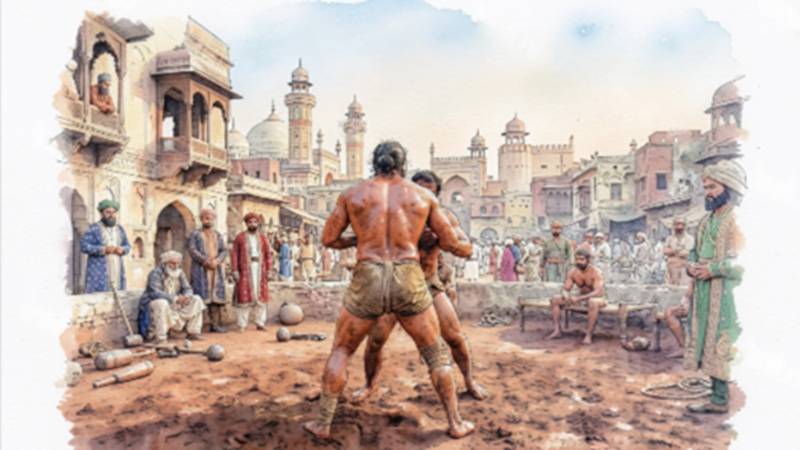
If you walk into the Taxali Gate of the Walled City of Lahore today, navigating the sensory overload of aroma of dishes from the eateries nearby and engine exhaust, and find your way to the ancient Akhara of Shahia Pehlwan, you will step into a time capsule. The air smells of rich earth, the sugarcane juice, and the badam sardai. There, you might see old-school wrestlers, or pehlwans, dusting grey clay from their hands, performing brutal conditioning routines that have remained unchanged for centuries.
Ask the current master of the pit about his lineage, and he won’t give you a modern sports ranking. He will proudly look you in the eye and tell you he is a Nooray-Wala—a follower of Noor.
Most people today assume that the story of Lahori wrestling begins and ends with twentieth-century titans like The Great Gama, Imam Bux, Kikkar Singh or Boota Pehlwan. But if you dig deep into the layers of the city's mud, you will find that our grand wrestling tradition has an ancestor we have collectively forgotten. Long before Gama became a global phenomenon, a 17th-century Lahori boy completely revolutionised subcontinental combat, survived systemic poisoning, travelled across mountains to strip Persia of its greatest prize, and became a legend in the courts of Mughal Emperors. His name was Ustad-e-Zamaan Noor-ud-Din, the Qutab-e-Pehlwani.
The Hybrid Martial Art of Pehlwani
To understand how Noor-ud-din became a superstar of wrestling, one has to understand the wild world he was born into. Before the Mughals arrived, ancient India practised Malla-yuddha—a raw, brutal, and deeply spiritual style of wrestling recorded in ancient scriptures. But when the Mughal Emperor Babur swept in from Central Asia in the 16th century, he brought along the elite Iranian-Mongolian martial style of the Timurid courts.
Over the decades, these two completely different styles slammed into each other and fused together. The result was Pehlwani, a hybrid martial art that combined the bone-crushing grappling of India with the highly sophisticated, fluid conditioning of Persian Varzesh-e-Bastani (the "sport of heroes").
Mughal emperors turned these wrestlers into highly paid, elite athletes. They weren’t just performers; they were court celebrities who drew massive imperial salaries. Yet, if you read the court diaries from that era, the names highlighted are almost always Persian imports like Mirza Khan Gilani or Mir Quli Tabrezi. The local talent of Lahore was ignored by royal biographers—until Noor-ud-din shattered the glass ceiling.
The Birth of the "Light"
Noor-ud-din’s story begins on the 5th of February 1635, under the glittering reign of Shah Jahan. He was born into a prominent Kashmiri family that had migrated to Lahore’s Mohalla Kothidaaraan, right near the iconic Sunehri Masjid. His father, Jamal-ud-din, was no ordinary citizen; he was a Haft Hazari—a commander of seven thousand soldiers in the elite Mughal Army—and a devastatingly powerful wrestler in his own right.
He had invented an astonishing 361 original wrestling moves - complex leverage tricks, joint locks, and sudden momentum shifts that completely broke the rules of the predictable Persian style
On the day of Noor-ud-din’s birth, his father threw a massive, lavish feast. Mid-celebration, a wild-eyed ascetic emerged from the crowd out of nowhere. Ignoring the military elite, the mystic walked straight over to the newborn, ate some sweetmeat, and shouted to the crowd:
"Light (Noor) has arrived, and I have arrived to congratulate you all! This child will soon become the Noor of the world."
Struck by the dervish's words, his father immediately named the boy Noor-ud-Din.
Growing up, the young boy’s life was shaped by an extraordinary cross-border brotherhood. Years earlier, in 1628, a legendary Iranian champion named Cheena Pehlwan had run afoul of a deadly wrestling cabal in Persia who claimed descent from the mythic hero Sohrab. They wanted Cheena dead. Jamal-ud-din used his military authority to intervene, saving Cheena’s life and defusing the crisis. This forged a lifelong bond of honour between Qazwin (where Cheena belonged to) and Iran—a bond that would eventually turn Noor-ud-din into a global champion.
Taming the "Black Devil"
Noor-ud-din’s official introduction to the world didn't happen in a standard wrestling match, but in a moment of sheer, life-or-death chaos. Told by Mr Akhtar Hussian Sheikh in his book, as a teenager, he was sitting in the audience at an imperial sports spectacle organised under Emperor Shah Jahan. The centrepiece of the day was a massive elephant fight.
The atmosphere turned terrifying when one of the massive bull elephants, a notoriously unhinged beast named Kala Dev (The Black Devil), suffered a psychotic break. Driven mad by the noise, Kala Dev brutally gored his elephant opponent, trampled his own driver to death, and began charging directly at the terrified spectator stands.
As guards panicked and drew their weapons, teenager Noor-ud-din did the unthinkable. He leaped over the barrier into the blood-soaked dirt of the arena, holding nothing but a single Mughal sword.
As the multi-ton "Black Devil" thundered toward him, Noor-ud-din stood perfectly still. At the absolute last second, as the beast lowered its head to crush him, the boy swung his sword in a blinding, desperate arc. The blade sliced clean through the elephant's trunk.
Shocked and robbed of its primary sensory organ, the rogue elephant recoiled in agony, collapsed from blood loss, and died shortly after. The stadium went dead silent. Shah Jahan was so astonished that he broke all imperial protocol, descended from his high throne, walked into the dirt, and wrapped the young teenager in a massive hug. Noor-ud-din was a national hero before he had ever even competed in an arena.
The Master and the Pupil
By the time Noor-ud-din turned eighteen, his father knew his son's destiny wasn't in the regular army. He took him to meet his old friend, the great Cheena Pehlwan of Iran. Eager to prove himself, Noor-ud-din immediately demanded a fight with the legendary master. His father was horrified by the rudeness, but Cheena smiled and offered a challenge: "If you can defeat four of my top disciples in a row, I'll give you your match."
Noor-ud-din didn't just defeat them; he dismantled them. He tore through the first two, and physically hurled the third completely out of the ring. Seeing his school crushed, Cheena stepped into the ring himself.
The battle between the old Persian lion and the young Lahori prodigy was short. Noor-ud-din applied a terrifying, multi-directional body pressure that caught Cheena entirely off guard, forcing the Iranian legend to give up. Cheena was so overjoyed by the boy's strength and genius that he adopted Noor-ud-din as his formal foster son and took over his training.
Life under Cheena Pehlwan, however, was highly dangerous. To protect his star pupil from court poisoners, Cheena secretly practised mithridatism—the art of building immunity to poison through small doses. Every single morning, unbeknownst to Noor-ud-din, Cheena laced his heavy athlete's diet of milk, almonds, and ghee with micro-doses of highly refined arsenic.
The insanity of this training was put to the test when a venomous snake bit Noor-ud-din while he slept. The young man fell into a terrifying coma. Cheena rushed to his side, feeding him Tiriyaq-e-Farooq—an ancient, legendary antidote made of dozens of rare ingredients mixed in warm milk.
For days, Noor-ud-din balanced on the edge of death. When he finally woke up completely healthy, Cheena revealed the truth: the snake bite hadn't killed him because his blood had already been made completely hostile to toxins by months of daily arsenic ingestion.
Reclaiming the Derafsh-e-Kavian
With his poison-proof golden boy fully grown, Cheena Pehlwan sent Noor-ud-din on a massive, historic quest: to reclaim the Derafsh-e-Kavian (the Banner of Kaveh).
This legendary banner was originally the leather apron of Kaveh, a mythic Persian blacksmith who used it to lead a revolution that overthrew a tyrant king Zahhak who fed human brains to two snakes growing out of his shoulders. Upon defeating the tyrant king, the banner was passed on to successive rulers. Over centuries, the kings of Iran jewel-encrusted that apron, making it the ultimate symbol of Persian imperial pride until it was lost in the Arab conquests around 650 AD.
A replica of this sacred flag was held by the Sohrabi Daff—the elite, exclusive guild of Persian wrestlers who had once targeted Cheena. By ancient tradition, the flag could only be taken if an outsider came to Iran and systematically defeated their entire hierarchy. The owner of the banner would be declared champion of the field.
In a bid to claim the coveted Derafsh-e-Kaviani, Noor-ud-din crossed the mountain passes and launched a brutal, relentless tour of Iran to fight the wrestlers from Sohrabi-Daff:
- He started in Abadan, wiping out local challengers.
- He marched to the rugged terrain of Kermanshah, dominating their toughest fighters.
- He entered the royal arenas of Isfahan, silencing the imperial crowds.
- He finished his campaign in Tabriz, facing the most elite masters of the Persian empire.
He faced the three undisputed titans of Iran: Afrasiyab Hamdani, Abbas Tabrezi, and the terrifying, undefeated Tahamtan Tabrezi, and defeated all of them.
The Persians had never seen anything like Noor-ud-din. Over his young life, he had invented an astonishing 361 original wrestling moves—complex leverage tricks, joint locks, and sudden momentum shifts that completely broke the rules of the predictable Persian style. He swept the board, defeated every single champion, and claimed the legendary Derafsh-e-Kaviani for his foster father.
Tragically, his greatest victory was met with heartbreaking sorrow. Cheena had arranged for Noor-ud-din to marry his only daughter, Faryal Khanum. But just before the wedding, she was bitten by a venomous snake and died—a cruel twist of fate for a champion whose own blood was completely immune to the very same poison.
The Master of the Age
When Noor-ud-din returned to India, his fame was so massive that it demanded the attention of the state. The Mughal crown had now passed to the strict, hyper-pious Emperor Aurangzeb. Seeking to show off cultural dominance, Aurangzeb organised a massive imperial match, pitting the Lahori champion against an undefeated mountain of a man from the Rohilkhand region.
The Rohilla wrestler relied on pure, crushing brute force. Noor-ud-din, utilising his signature psychological patience, allowed the giant to completely exhaust his energy reserves.
Then, in a flash of movement, Noor-ud-din executed a series of lightning-fast leverage locks, entirely incapacitating the giant and forcing an instant submission. Aurangzeb rose to his feet and formally crowned him with the ultimate title: "Qutab-e-Pehlwani" (The Pivot of Wrestling) and "Ustad-e-Zamaan" (The Master of the Age).
Noor-ud-din never married after losing Faryal, and he left no children of his own. Instead, he adopted his nephews and divided his vast number of disciples into three distinct discipleship branches to ensure no single wrestler could abuse his full martial system: The Nooray-Wale, The Kala-Wale, and The Amarkot-Wale. His legacy continued with the famous wrestlers of the later generations including: Ramzi Pehlwan of Baroda, Khalifa Chiragh Din, Khalifa Mairajuddin, and Khalifa Muhiuddin.
Today, this magnificent history is facing a slow, quiet extinction. The bustling network of subcontinental akharas that once ringed the Walled City—like the Data Darbar and Minto Park pits (akharas)—have been paved over by modern roads and concrete buildings.
But back at the Akhara of Shahia Pehlwan, the old guard refuses to let the light go out. Goga Pehlwan, the son of legendary Shahia Pehlwan, standing in the grey mud of his ancestors, serves as a living shield for this history. "We don't play at modern sports here," he says, dusting the earth from his chest. "We are the Nooray-Wale. Every single move we teach belongs to our grandmaster”. The city might forget its foundations, but this clay always remembers its king.