

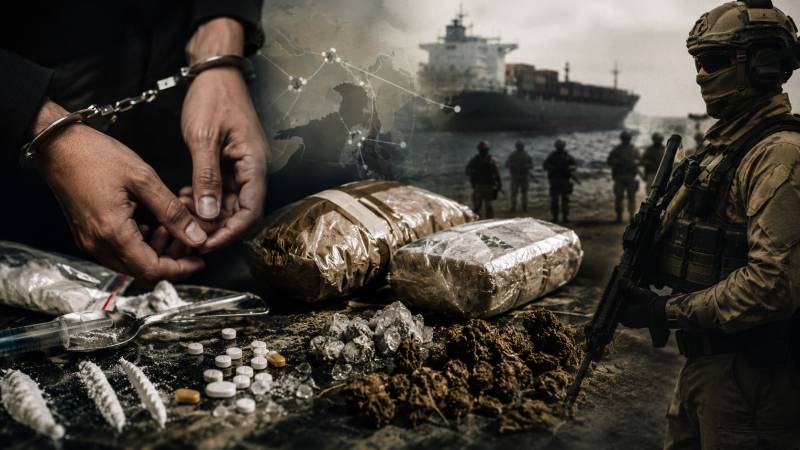
June 26 marks the International Day against Drug Abuse and Illicit Trafficking. According to the United Nations Office on Drugs and Crime (UNODC), nearly 312 million people worldwide use illicit drugs such as cocaine, cannabis, hallucinogens, opiates and sedative-hypnotics. In December 1987, the United Nations General Assembly decided to observe 26 June as the International Day against Drug Abuse and Illicit Trafficking. The United Nations is determined to help create an international society free of drug abuse. Each year, the United Nations Office on Drugs and Crime (UNODC) selects a theme for the day, and this year the theme is, 'Drug problems persist, new challenges emerge, innovative responses are needed.'
Pakistan faces multiple challenges as it combats narcotics trafficking, including a spike in violent extremism from the Tehrik-e-Taliban Pakistan (TTP) and Baloch separatist groups, instability in neighbouring Afghanistan, and an ever-evolving network of drug trafficking routes. The majority of narcotics produced in Afghanistan, namely heroin and opium, transit through Pakistan. While overland transit corridors link Pakistan, Afghanistan, Iran and India, officials assess that large quantities of drugs transit Pakistan's maritime domain with relative ease (International Narcotics Control Strategy Report (INCSR), March 2025).
The latest World Drug Report 2025 paints a disturbing picture. According to the United Nations Office on Drugs and Crime (UNODC), an estimated 316 million people used drugs in 2023, compared with 246 million a decade earlier. Cannabis remained the most widely used drug, followed by opioids, amphetamines, cocaine and ecstasy. Drug use has increased by nearly 28 per cent during the past decade.
Even more alarming is the unprecedented expansion of the cocaine market. Global cocaine production reached a record level in 2023, while seizures, trafficking and consumption simultaneously reached historic highs. At the same time, synthetic drugs have transformed narcotics markets. Methamphetamine, amphetamine-type stimulants and synthetic opioids can now be manufactured almost anywhere, making enforcement far more difficult than in the era when illicit drugs depended primarily on agricultural cultivation.
These statistics compel us to ask a fundamental question: if the war on drugs has been underway for more than half a century, why are drug markets larger today than ever before?
The answer lies in understanding the political economy of narcotics. The modern narcotics economy differs in form but not in substance from the nineteenth-century opium trade. When Britain waged the Opium Wars against China between 1839 and 1860, the objective was not merely to sell a narcotic substance but to preserve a highly profitable commercial arrangement.
Nearly two centuries later, the principal actors and commodities may have changed, but the underlying economics remain remarkably similar. The extraordinary profits generated by addiction continue to create powerful incentives for criminal enterprises and, at times, for political actors willing to overlook the consequences.
Historically, drug trafficking has never been merely a criminal enterprise. It has been deeply intertwined with commerce, geopolitics and state power. Colonial administrations across Asia derived substantial revenues from opium monopolies and excise systems.
Most narcotics produced in Afghanistan are destined for global markets, and Pakistan remains vulnerable because of both land and maritime trafficking corridors
Drug control and drug promotion often coexisted within the same imperial structures. The history of narcotics control therefore reveals a paradox: many of the states that later emerged as champions of prohibition had earlier benefited from the very trade they subsequently condemned.
The modern international narcotics regime emerged during the twentieth century. Yet even as governments publicly condemned illicit drugs, geopolitical considerations frequently produced contradictory policies. During the Cold War, anti-communist struggles, proxy conflicts and intelligence operations often intersected with narcotics-producing regions.
The history of Southeast Asia's Golden Triangle and Afghanistan's Golden Crescent demonstrates that narcotics trafficking frequently flourished in zones of conflict and foreign intervention.
Afghanistan remains a particularly instructive example. For decades, it supplied the overwhelming majority of the world's illicit opium. Successive wars, institutional collapse, poverty and the rise of warlordism transformed narcotics into a parallel economic system. Drug revenues financed insurgents, militias, criminal organisations and corrupt officials alike.
One of the most significant, but least discussed, developments in recent years has been the dramatic decline in poppy cultivation in Afghanistan following the Taliban's 2022 ban. According to UNODC estimates, cultivation, which exceeded 200,000 hectares before the ban, declined dramatically in subsequent years.
While the reduction demonstrated that political will can affect cultivation patterns, it also exposed a deeper structural problem. Thousands of impoverished farming households lost a major source of livelihood. Simultaneously, trafficking networks began adapting by diversifying into methamphetamine and other synthetic substances.
The lesson is that the suppression of cultivation, though necessary, cannot succeed in the long run unless it is accompanied by viable economic alternatives for affected populations. Otherwise, illicit markets merely mutate rather than disappear.
The latest International Narcotics Control Strategy Report 2025 (INCSR), prepared annually by the United States Department of State under Section 489 of the Foreign Assistance Act of 1961, continues to identify Pakistan as a country facing multiple challenges arising from narcotics trafficking, violent extremism, instability in Afghanistan and evolving trafficking routes.
The report notes that most narcotics produced in Afghanistan are destined for global markets and that Pakistan remains vulnerable because of both land and maritime trafficking corridors.
The merchants of death remain innovative and adaptive. Governments must become even more so
Pakistan's experience demonstrates how narcotics, militancy and illicit finance can reinforce one another. During the Afghan war of the 1980s, the country witnessed the simultaneous emergence of heroin addiction, the Kalashnikov culture, informal financial networks and militant organisations operating across porous borders.
What began as a regional security conflict eventually produced profound social, economic and institutional consequences. Several decades later, Pakistan continues to bear the burden of those developments. Millions of young people have been exposed to narcotics, while law enforcement agencies continue to confront trafficking networks that have adapted to changing geopolitical realities. The story documented by this writer in Pakistan: From Hash to Heroin and its sequel, Pakistan: From Drug-trap to Debt-trap, remains unfinished.
The challenge has become more acute with the resurgence of the Tehrik-e-Taliban Pakistan (TTP). Security experts increasingly recognise that contemporary terrorist organisations rarely depend on a single source of funding. Extortion, kidnapping, smuggling, illegal mining, donations and narcotics trafficking frequently operate as interconnected streams of revenue.
The narcotics-terror nexus has assumed renewed significance in Pakistan's security calculus. The TTP and allied networks exploit instability across the region, porous borders and criminal infrastructures developed over decades.
The fight against terrorism cannot succeed merely through kinetic operations. It requires the systematic disruption of financial lifelines, trafficking routes, money-laundering mechanisms and criminal enterprises that sustain extremist violence. In this sense, the struggle against narcotics trafficking is not only a public health imperative but also an essential component of national security.
The financial dimensions of the narcotics trade receive far less attention than they deserve. Drug trafficking generates enormous illicit proceeds that must eventually enter the legitimate economy. This process involves money-laundering networks, offshore financial centres, shell corporations, trade-based laundering mechanisms and increasingly sophisticated digital platforms. The proceeds of narcotics trafficking are invested in real estate, financial assets, luxury goods and legitimate businesses.
The global narcotics trade would not survive without access to the formal financial system. The question is not merely who cultivates poppy in Helmand, produces cocaine in the Andes or manufactures methamphetamine in clandestine laboratories. The more important question is where the hundreds of billions of dollars generated annually by narcotics trafficking ultimately find legal shelter.
Drug money does not remain buried in remote mountains or hidden in border villages. It eventually enters banks, real estate markets, offshore financial centres, stock exchanges and international investment vehicles.
The greatest weakness of the global anti-narcotics regime is its persistent focus on producers and couriers while paying comparatively less attention to the financial architecture that launders criminal proceeds and transforms illicit wealth into legitimate capital.
Pakistan today possesses a far more elaborate legal framework against narcotics trafficking than it did during the 1980s. The Control of Narcotic Substances Act, 1997 criminalises the production, trafficking, possession and financing of narcotics-related activities.
The Anti-Narcotics Force serves as the principal federal enforcement agency, while the Anti-Money Laundering Act, 2010 addresses the financial dimensions of drug trafficking.
Pakistan is also party to the principal United Nations drug-control conventions and international instruments dealing with organised crime and terrorist financing. Yet criminal organisations continue to adapt faster than regulatory systems.
The emergence of synthetic drugs has further complicated the challenge. Methamphetamine, commonly known as "ice", has spread rapidly across South Asia. Unlike heroin, synthetic narcotics do not depend on large-scale cultivation and can be manufactured in clandestine laboratories using precursor chemicals. UNODC has repeatedly warned that synthetic drugs represent one of the fastest-growing segments of the global narcotics market.
Pakistan's strategic location presents another challenge. While public attention often focuses on land routes linking Afghanistan, Pakistan and Iran, maritime trafficking through the Arabian Sea has assumed increasing importance. International assessments repeatedly note that substantial quantities of narcotics move through maritime corridors connecting South Asia, East Africa, the Gulf and international markets.
The latest World Drug Report should compel policymakers to rethink many long-held assumptions. The evidence suggests that while governments have become more efficient at seizing drugs and arresting traffickers, criminal networks have become even more efficient at adapting to new realities.
The challenge before humanity is therefore not merely to suppress narcotics but to confront the political, economic and financial structures that sustain the narcotics economy. As long as the hundreds of billions of dollars generated by drug trafficking continue to find sanctuary within the global financial system, enforcement efforts alone will produce limited results.
The theme selected by the UNODC for 2026 captures this reality. The threats are changing. Synthetic drugs are replacing traditional narcotics. Criminal organisations are exploiting digital technologies. Terrorist groups continue to seek financial support through illicit networks. Drug money moves through increasingly sophisticated financial channels.
The future of drug control lies not in fighting yesterday's wars but in understanding today's realities. It requires reducing demand, strengthening public health systems, dismantling criminal finances, creating economic opportunities in vulnerable regions and enhancing international cooperation.
Above all, it requires acknowledging an uncomfortable truth: the war on drugs has largely been a war against symptoms rather than causes. Until governments address the nexus between narcotics, illicit finance, organised crime and geopolitical conflict, the world drug problem will continue to evolve faster than the policies designed to contain it. The merchants of death remain innovative and adaptive. Governments must become even more so.