

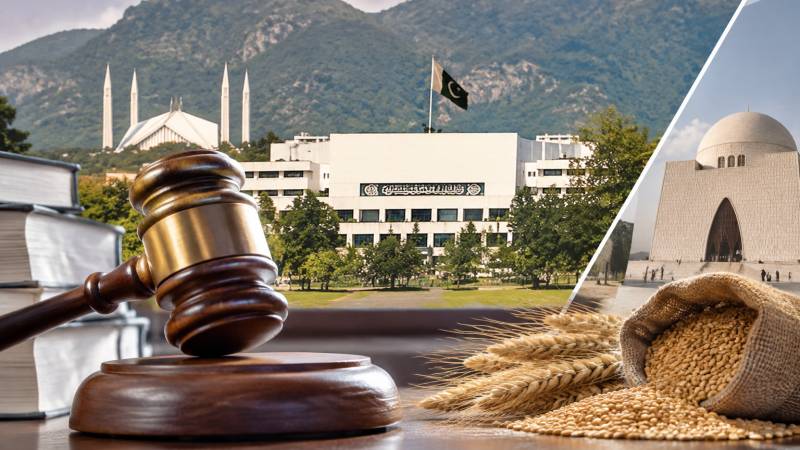
Suddenly, everyone in Islamabad wants to ask the people a question. The Interior Minister has spent weeks carrying his referendum on new provinces from the President in Nawabshah to Chaudhry Shujaat Hussain’s drawing room in Lahore, where the two discussed redrawing the map and devolving power, and on to the Prime Minister’s House, where he was received again on Monday. The same day, the PPP’s Nadeem Afzal Chan replied that consensus on provinces is built in the National Assembly and the Senate or not at all, and that bypassing the assemblies would carry horrible repercussions. The lawyers have raised the objection prior to both, Salman Akram Raja among those asking it: by what standing do the authors of the 26th and 27th Amendments, of disputed mandates and a bruised Constitution, propose to put questions to anyone? And so the capital quarrels over who may ask, and in which forum.
Watching this, I confess to a lawyer’s amusement. A state that has not answered a question in living memory has discovered a sudden enthusiasm for asking one. Compare the week’s other headline. Jensen Huang, removed last fortnight from the most valuable company on earth over an affair with an alleged Chinese asset, was reinstated on Monday, the board unanimous, Washington’s blessing noted in the press release itself. Yet he returns to an investigation that same release promises will run to its conclusion, with his cooperation. Questioned, removed, restored, and still answerable. Nobody rises above the asking, not even on the way back up.
On the merits I said my piece in these pages in August: we do not need new provinces, we need empowered ones. The map is the wrong question. Our problem was never the number of provinces; it is that we stopped devolution one storey too high and watched four provincial capitals hoard power exactly as the centre once hoarded it from them. Article 140A commands every province to build local government with real money and real authority, and sets no penalty for ignoring the command, so it is ignored. Punjab has not elected a mayor since 2015. The money never finishes its journey down; it stops in the cities where the cheques are signed. No referendum is needed to fix any of that. The parties quarrelling this week over how to consult the people have held the instruments of consultation, local elections, in abeyance for a decade. But the quarrel has performed one service. Everyone at the helm now agrees, on the record, that the people are entitled to be asked. Very well. Before the question they have chosen for us, here are two they have been avoiding.
A state that wants to ask citizens about redrawing provincial boundaries must first answer for the billions lost to questionable wheat imports, Karachi’s chronic misgovernance and the continued denial of elected local governments.
First, the wheat. In the caretaker year, this country imported some three and a half million tonnes of it, well beyond even the approved quota, spending over a billion dollars of foreign exchange in a year we were begging friendly capitals for deposits. No one misjudged the harvest; it was among the largest in our history, with millions of tonnes carried forward besides. When the state’s own auditors examined the affair, they found the case for importing unreliable and the demand inflated; releases from official stocks had been choked to manufacture the look of a shortage, while the state’s approved import was held back and private cargoes landed first and took the margin.
The shiploads then crashed the market just as the farmer’s crop came in. The loss to the exchequer runs into figures one hesitates to print. The loss to the grower was his year. And then? An inquiry found some officers responsible and cleared everyone above them; the suspensions came and quietly went; the auditors’ letters remain, as far as anyone knows, unanswered. Nobody has been charged. I am told the gentlemen who made money on that wheat consider the matter died down. Let them not get comfortable. A question is not a news cycle; it does not die of old age, and limitation does not run in favour of fraud. The audit exists, the shipping records exist, the names exist, in files that have already been read. All that is missing is a forum with the nerve to ask, and files have a way of outliving the men who sit on them.
Second, Karachi. The city earns this country more than any other, and one look at its streets tells you how much of that ever comes back. The party that has governed Sindh without interruption since 2008, and which now lectures us on the sanctity of assemblies, presides over a provincial capital where the garbage goes uncollected. Where did two decades of the richest city’s wealth go? Nobody with the power to compel an answer has ever asked; the power-holders of the province and the quarters that keep them afloat are too invested in each other’s comfort. And watch what happens when the question drifts close. The present reset talk had barely begun when back came the warning, within days, that blood would flow in the streets of Sindh. Read that as the defence of a province’s dignity if you like. I have cross-examined enough witnesses to recognise the other thing it might be: the sound a man makes when the question gets too near. Then the questioning subsides, and everyone is back in business, cosy as before. Punjab’s rulers need not smile at any of this; a province run for a decade without an elected mayor, by a party that redraws its local bodies with every regime, has its own ledger waiting.
This is why the referendum enthusiasm rings so hollow. A question put to the people by rulers who will not answer the auditors is not consultation. It is ventriloquism: the state asking itself a question through twenty-four crore borrowed mouths, having first made sure no question can travel the other way. In a functioning country the traffic runs upward. The citizen asks, the official answers, and the ballot is the citizen’s final question, asked every five years and answered honestly: counted as cast, loser conceding, winner sworn in, not one uninvited hand on the scale. Give the people that, give them their mayors and their district purse, let them speak within the law and question without permission, and you will find they have remarkably little appetite for new maps. People demand new jurisdictions only when the existing ones refuse to hear them.
I have been circling this point in these pages for some weeks, first arguing that fear has put us on probation as a nation, then that the real test of a country is whether power can lose. The third side of the triangle is this: a country must be able to ask, upward, at the powerful, before it is asked anything by them. Where the question is permitted, the truth eventually gets a date of hearing. Where it is treated as disloyalty, the only inquiry that ever concludes is the inquiry into whoever asked.
So, by all means, let there be questions. Start with ours. Who inflated the wheat demand, and for whose benefit? Who held back the state’s cargo while private ships docked, and when is the prosecution? Where, ledger by ledger, has Karachi’s money gone these twenty years? Why has no Punjabi elected a mayor in ten? Answer these, under oath, in daylight, and then come talk to us about redrawing the map. A nation that cannot ask cannot learn. And a nation that cannot learn does not stand still, whatever we tell ourselves. It moves backwards, one unasked question at a time.