

Amid the cause célèbre of carving out new provinces in the country, many sensible voices are calling for the formation of a commission before any decision is made. Otherwise, the ongoing debate appears to be a case of putting the cart before the horse. India has undergone the process of state reorganisation in the past. Therefore, it would not be out of place to briefly examine the history of the various commissions established in India at different times to consider the reorganisation of states. It would also be helpful to review the mechanisms for consultation and for securing the consent of the affected populations. This article draws on a scholarly study by Gopi Madaboyina, published in the Arts and Social Sciences Journal in 2021.
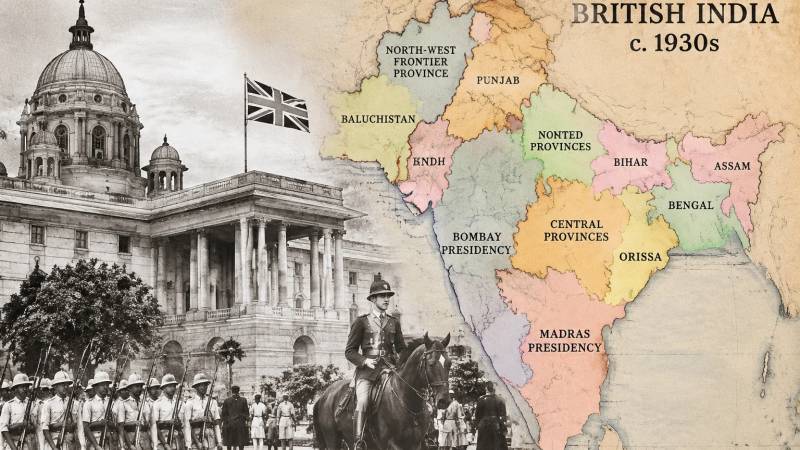
Tracing the history of British India to provide a backdrop to the system of governance at the time, the study states that, “In the British period, the States were known as Provinces, and it was the provinces which first came into existence,” before the formation of the central government. The first central government was formed in 1773. Before its establishment, British India consisted of three provinces known as Presidencies: the Presidency of Fort William in Bengal, the Presidency of Fort St. George in Madras, and the Presidency of Bombay.
Following the cancellation of the bifurcation of the Presidency of Fort William into Bengal and Agra, the North-Western Provinces, under a Lieutenant Governor, were established in 1836. Punjab became a separate province in 1849, Oudh in 1856, the Central Provinces in 1861, Assam in 1874, the North-West Frontier Province in 1901, the United Provinces of Agra and Oudh in 1901, Bihar in 1912, and Sindh and Orissa, both in 1936.
British Baluchistan, Delhi, Ajmer-Merwara (Rajasthan), Karnataka, Madhya Pradesh, and the Andaman and Nicobar Islands were part of the Chief Commissioners' Provinces. At the time of independence, India comprised nine Governor's Provinces and five Chief Commissioners' Provinces, including Delhi. In 1950, when the new Constitution came into force, the constituent units of the Indian Union were classified into Part A, Part B, Part C and Part D states. Part A states comprised the erstwhile Governor's Provinces, while Part B states included the erstwhile Chief Commissioners' Provinces and the princely states. The Andaman and Nicobar Islands were retained as the sole Part D territory. The states across all four categories numbered 29.
There had been a longstanding demand, dating back to 1903, for the redrawing of state boundaries. One of the principal demands was the creation of provinces along linguistic lines. Mahatma Gandhi wanted the provincial units of the Congress Party to be organised on a linguistic basis. The Nehru Report of 1928 proposed the formation of provinces based on “linguistic affinities”. Similarly, the Simon Commission (1927), in its report submitted in 1930, supported the proposal for linguistic provinces, observing that “there is no doubt the use of common speech is a strong and natural basis for provincial individuality.”
The O'Donnell Committee of 1931, while examining the proposed separation of Oriya-speaking areas, also attached fundamental importance to the wishes of the local population. The Congress Party had adopted a resolution in 1927 affirming that “the time has come for the redistribution of provinces on a linguistic basis”. In 1937 and 1938, the Congress reiterated the same commitment. Consequently, in June 1948, the Linguistic Provinces Commission, under the chairmanship of S.K. Dar, was established. The Dar Commission did not approve the redistribution of provinces along linguistic lines. Its report was received with great disappointment.
The Congress Party also rejected the commission's findings and announced the formation of its own committee to consider the question of linguistic provinces. The three-member committee comprised Jawaharlal Nehru, Vallabhbhai Patel and Pattabhi Sitaramayya and became popularly known as the JVP Committee. Formed in 1948, the committee reaffirmed the Dar Commission's position, citing concerns about national unity.
However, it acknowledged that a strong case could be made for the creation of Andhra from the Telugu-speaking region of Madras. It stated that “if the public sentiment was insistent and overwhelming, this and other cases might be given further consideration.” This marked the beginning of a bitter struggle over the reorganisation of states, an issue that would dominate Indian politics from 1953 to 1956. Sri Potti Sriramulu fasted unto death while demanding the creation of a separate state of Andhra. His death was followed by widespread riots. Consequently, Andhra State was created in 1953 on linguistic lines.
Nehru and his Cabinet initially decided to resist further attempts to divide the provinces. States and regions, including Mysore, Bombay and Hyderabad, were also demanding the reorganisation of provincial boundaries along linguistic lines. Nehru remained adamant in his opposition to these demands. However, when he was greeted with black flags during a visit to Belgaum, he “sensed the danger” and, on 29 December 1953, announced the establishment of a commission under the chairmanship of Fazal Ali, a Supreme Court judge, to examine the question of the reorganisation of states on a linguistic basis.
(To be continued)