

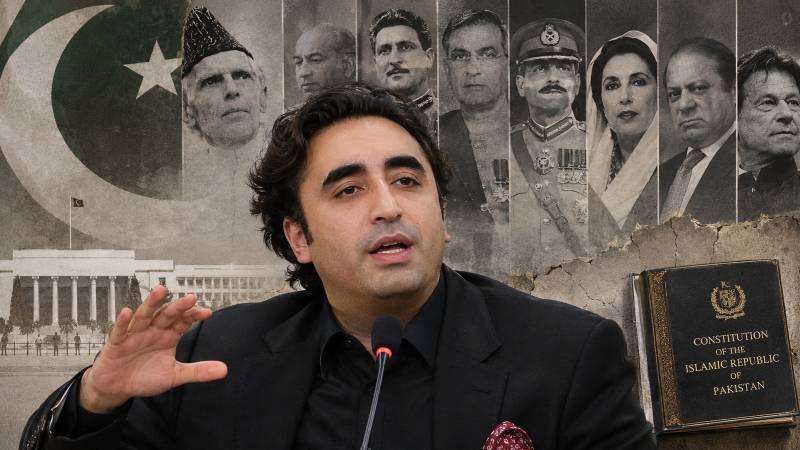
When PPP Chairman Bilawal Bhutto-Zardari told the Karachi Press Club on 17 November 2026 that Pakistan's system "did not collapse but was made to collapse", he summed up 79 years of history in one sentence. No Pakistani prime minister has ever completed a five-year term. Governors-general, generals, presidents armed with Article 58(2)(b) and the courts have repeatedly removed elected governments with familiar tools: emergency powers, the "doctrine of necessity", engineered elections, broken parties and politically motivated accountability drives against opponents.
His speech listed their present-day versions: a referendum floated to create new provinces, a party stripped of its election symbol, and constitutional amendments "passed with brute majority". His remedy, a political reset beginning in Parliament, follows the logic of the 2006 Charter of Democracy. This was a response to Interior Minister Mohsin Naqvi, who wants the failed system reset through new administrative units. Bilawal accepted the diagnosis but rejected the remedy. Nobody disputes the collapse, he said, but nobody asks why; a cure that ignores the cause will fail. He also admitted his own mistakes, saying there comes a time to correct them.
Early on, unelected officials learned they could dismiss elected leaders with judicial approval. Pakistan had seven prime ministers between 1947 and 1958 and never held a national general election. After Liaquat Ali Khan's 1951 assassination, civil servants took over, above all Governor-General Ghulam Muhammad. In April 1953 he dismissed Prime Minister Khawaja Nazimuddin. In October 1954, as the Constituent Assembly moved to curb his powers, he dissolved it. In the Tamizuddin Khan case, the Federal Court under Chief Justice Muhammad Munir upheld the dissolution; this reasoning became the recurring "doctrine of necessity".
In 1955, One Unit merged the western provinces, partly to offset East Bengal's majority. Sindh, Balochistan and the Frontier lost their identities without a popular mandate, which explains why Bilawal reacts so sharply to any attempt to redraw Sindh from above. In October 1958, President Iskander Mirza abrogated the 1956 Constitution months before the first national elections; within three weeks General Ayub Khan ousted him. The Supreme Court validated the coup as a "successful revolution".
Ayub's 1959 Elective Bodies Disqualification Order barred thousands of politicians, the first large-scale use of "accountability" as a political weapon and the ancestor of today's NAB cases. He replaced the electorate with 80,000 indirectly elected "Basic Democrats". A 1960 Yes-or-No referendum confirmed him as president, the first of the referendums that, as Bilawal says, always serve undemocratic ends.
The 1970 election, Pakistan's first on adult franchise, gave Sheikh Mujibur Rahman's Awami League a clear majority. General Yahya Khan refused to convene the Assembly and launched a military operation in March 1971; by December, East Pakistan was Bangladesh. The 1973 Constitution was the high point of parliamentary consensus. On 5 July 1977, General Zia-ul-Haq overthrew Zulfikar Ali Bhutto's elected government; in 1979 Bhutto was hanged after a sham trial. The Supreme Court again invoked necessity. In March 2024, a nine-judge bench unanimously found that Bhutto had been denied a fair trial and due process.
The creation of One Unit, the use of referendums to legitimise military rule, politically motivated accountability drives and the manipulation of electoral processes all point to the same underlying problem: the concentration of power outside representative democratic institutions.
Zia added two tools. His 1984 referendum tied a "yes" for Islamisation to five more years as president, and the 1985 8th Amendment inserted Article 58(2)(b), letting the president dismiss the National Assembly and prime minister. He used it in May 1988 against his own hand-picked premier, Muhammad Khan Junejo; the threat then hung over every successor. Between 1988 and 1999, four elected governments were removed. Benazir Bhutto lasted 20 months before President Ghulam Ishaq Khan dismissed her in August 1990. The next election was rigged: in the 2012 Asghar Khan case, the Supreme Court found a Presidency election cell and ISI funds had created the IJI to keep the PPP out, and held Ghulam Ishaq Khan and Generals Aslam Beg and Asad Durrani responsible for violating the Constitution. The verdict was never fully implemented.
Nawaz Sharif was dismissed in April 1993. The Supreme Court restored him, but by July the army had brokered both his and the president's resignations. Benazir returned, only to be dismissed again in 1996. On 12 October 1999, General Pervez Musharraf overthrew Nawaz; the Supreme Court validated it too. His toolkit was familiar: NAB pursued opponents while clearing defectors, a 2002 referendum extended his rule, the PML-Q was assembled from turncoats, and the 17th Amendment restored presidential dismissal.
After 2008, assemblies began completing their terms; prime ministers still did not. Disruption shifted from open dismissals to courtrooms, and disqualifications. The era began with the 2006 Charter of Democracy, in which Shaheed Benazir Bhutto and Nawaz Sharif committed to a constitutional court and an independent election commission. In April 2010, Parliament passed the 18th Amendment by consensus, repealing 58(2)(b), devolving major subjects and guaranteeing provinces' revenue share. This is why Bilawal treats any rollback as a red line. Governments are no longer dismissed outright but hollowed out, their opponents kept off the field.
In 2012, the Supreme Court convicted Prime Minister Yousaf Raza Gilani of contempt for refusing to write to the Swiss about President Zardari, then disqualified him. In 2013 came the first transfer of power between elected governments after a full term; in 2017 Nawaz was disqualified over the Panama Papers. In 2018, the PTI came to power with military backing, opening the "hybrid" period, and in April 2022 Imran Khan became the first prime minister removed by a no-confidence vote. Bilawal's complaint about decisions made outside Parliament belongs to this remarkably regular vicious cycle and calls for an end to the "tradition of revenge".
History supports this diagnosis, which moves the debate from "the system failed" to "who made it fail", a shift that 79 years of evidence support. It places the remedy within the Constitution and Parliament, rejecting discredited routes: referendums, provinces created by decree, and removals decided outside Parliament. By calling Imran Khan a political prisoner while sitting in the ruling coalition, Bilawal broke with the old habit of cheering a rival's imprisonment. Ending that habit was the central promise of the Charter of Democracy. The learning and lesson of 79 years is plain. Pakistan's solution does not lie in new provinces, referendums or another reset imposed from above. It lies in upholding the Constitution, strengthening the parliament and respecting the people's mandate.